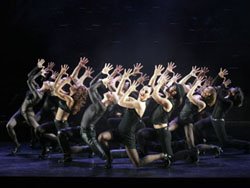
 Midway through Act 1 of Studio 301's production of Cabaret, running at the Wyatt Pavilion through April 16, the Jewish grocer Herr. Schultz (Yahya Rouhani) hands his landlady, Fraulein Schneider (Melanie Levy) a pineapple, which is the impetus for “The Pineapple Song.” During the song, actress Levy kind of bobbles the pineapple accidentally and some fronds fly off of the top of it. I kept waiting for someone to pick up the pineapple fronds, but at the end of the show they were still there. Even when the chorus girls from the Kit Kat club were crawling around on the floor picking up currency during “The Money Song,” they left the pineapple fronds there. Nor did anybody pick them up during intermission.
In Act 2, in another scene between Schultz and Schneider, a broom and an orange are left on the floor. It took 3 scenes before anyone picked them up (they danced on top of the broom and over the orange during the song “If You Could See her”) and toward the end of Act 2, Sally Bowles (Jennifer Nelson) drops what looks like a pitch pipe as she makes her entrance. It didn’t get kicked off stage until the curtain call, though scenery was moved around it.
I mention these serious oversights because I’m having a difficult time knowing what to say about this show. Who can’t like “Cabaret,” right? It’s downright unAmerican.
In fact, I had high hopes for the show when I entered Wyatt Pavilion, which had been turned into the Kit Kat Club, a seedy nightclub in Berlin in the days when the Nazis were coming to power. I was impressed that the atmosphere was perfect, down to the missing and mismatched lightbulbs around the second floor platform where the orchestra sat. Matt Welch and Katie Baad are credited with “original set conception” and deserve high marks for their vision.
The chorus girls, in wonderfully decadent costumes designed by Alexandra Bergere were wandering around on stage prior to the start of the show and it added to the ambience before the lights ever went down.
(Someone should tell whoever printed the programs, however, that while purple is a nice paper color, when you try to read black letters on purple in a dimly lit theater, it just doesn’t work!)
The show’s real problems started with the overture.
I tried to decide how to handle this, and decided not to point fingers because, in truth, with the exception of Rouhani there was not ONE principal who managed to make it through a song without hitting at least a few sour notes, some tried several different keys before settling on one which matched the orchestra, and there was at least one song which was so bad that I don’t think the singer hit one note right throughout. The last two notes of the show caused me to visibly wince.
I am puzzled by why this is because it is obvious that each of the performers has strong vocal talent. I don’t know if having the orchestra seated above them was the reason, or if the fact that the orchestra was out of tune as often as the singers was to blame. But for whatever reason, this is a show with very strong music and vocal problems.
Alas, vocal problems are not the only ones. The decision to cast a woman (Jacquie Pospisil) as the Emcee was a curious one. Pospisil is a good actress and has a good voice, but the role is written for a man and the lines were not changed to indicate that the character was female, yet Pospisil was costumed decidedly feminine, which made the number “Two Ladies,” with Pospisil as the “man” and one of the chorus men as one of the “ladies” distinctly odd.
But the show’s choreography (for actors who aren’t primarily dancers) by Tori Terrell-Carazo was fine.
Jennifer Nelson was Sally Bowles and is obviously a fine actress, but can’t quite carry off the degree of decadence that makes us understand Sally’s Bohemian lifestyle.
Drew Phillips is Cliff Bradshaw. Phillips is another fine actor whom I have seen in other productions, but in this production, we don’t get believability in his sexual orientation. Is he gay? Is he straight? Is he bisexual? Is he sexual at all? There’s not a lot of chemistry between Cliff and Sally.
Another directing oversight has Cliff packing Sally’s clothes into a suitcase, which he then takes with him as he leaves Berlin.
Studio 301 is a student run and funded club, independent from the university’s Theater and Dance Department. Last year’s “Into the Woods” was a promising entree into the world of musicals for the fledgling group. Unfortunately, its second attempt is less so.