Showing posts with label South Pacific. Show all posts

Thursday, July 24, 2014

South Pacific

 It was some enchanted evening at Music Circus’ opening of the beloved Rodgers and Hammerstein classic, “South Pacific.”

This 1950 Tony Award-winning musical, based on James Michener’s Pulitzer Prize-winning novel “Tales of the South Pacific,” is an old war horse, but its popularity has not dimmed. At times, the plot seems very dated. At other times, one marvels at — and is perhaps depressed by — the consistent timeliness of its message.

Rodgers and Hammerstein were not afraid to tackle the problems of the day, albeit in a musical way. They made a courageous statement about racial bigotry, which was not a popular thing to do in the 1940s, and yet the song “You’ve Got to be Taught” remains today — sadly, perhaps — an anthem to answer the bigots of every race, gender and sexual orientation.

“You have to be taught to be afraid of people whose eyes are oddly made and people whose skin is a different shade. You have to be carefully taught. … You have to be taught before it’s too late, before you are 6 or 7 or 8, to hate all the people your relatives hate.” (It’s a simplistic explanation still today for the reason it is so difficult to achieve peace in many parts of the world.)

“South Pacific” is the odd musical that neither opens nor closes with a big musical number, instead opening on the veranda of the home of plantation owner Emile deBecque (John Cudia), where the children, Jerome (Matthew Feniger) and Ngana (Ayanna Navarro) — both adorable, disciplined and talented actors — are singing a French children’s song, the same simple song that ends the show as well.

DeBecque, a French expatriate, is entertaining Arkansas-born Nellie Forbush (Beth Malone), a nurse from the nearby naval base, with eyes toward making her his wife, to fill the loneliness of his life on the island.

Malone establishes herself as a winsome Nellie with her first song, “A Cockeyed Optimist,” with her Kellie Pickler-type accent and sparkly personality. She struggles with her feelings for deBecque, weighed against the reality of his life before she met him. She seems to have no problem accepting that he has killed a man, but can’t handle the reality of his late Polynesian wife.

When Cudia opens his mouth to sing “Some Enchanted Evening,” one has to gasp at the voice. I wish they had put some gray in his hair as he really doesn’t seem old enough to play this character, but there is no denying his talent or charisma, and there is no doubt why Nellie has fallen for him in a matter of only a couple of weeks.

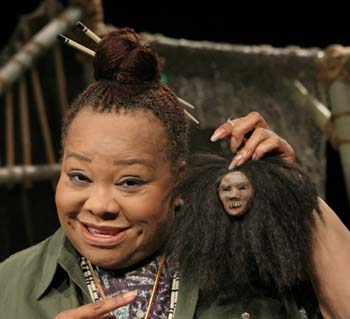
Returning for her second appearance as the Tonkinese woman, Bloody Mary, is Armelia McQueen, who is simply marvelous. She will sell you cheap trinkets, grass skirts, shrunken heads or the body of her young daughter, if she thinks you’ll make beautiful babies together. Her “Bali Ha’i” is outstanding.

Mary has her eye set on Lt. Joe Cable (Eric Kunze, reprising his role), arriving on the island, hoping to enlist deBecque’s help with a covert mission to spy on the Japanese. Cable is young and handsome and, when offered Mary’s daughter Liat (Briahna Yee), he easily succumbs to the temptation, though when faced with the opportunity to marry her, he can’t so easily turn his back on his rigid New England upbringing. The anguish of his situation is painfully clear in his “You Have to be Taught.”

The Liat-Joe plot line feels strikingly inappropriate in this day and age, where there is such emphasis on sexual exploitation of innocent young girls. The lieutenant is taken to meet a very young girl for what becomes an instant physical encounter. As the two embrace for the first time (this being a show from 1949, the manner of the encounter is only hinted at, when the lights go down and then come up on a shirtless Joe lying in the lap of a happy-looking Liat), there is such depth to the emotion that it does not ring true. But the plot line has been playing successfully for more than 50 years, so the audience must not mind.

Providing comic relief is Jeff Skowron as Luther Billis, a Seabee who is a wheeler-dealer, out to make a buck whether it’s making grass skirts or doing laundry for Nellie (who praises his pleats). He has a big, mercenary heart and when he causes a diversion to allow Cable and deBecque’s operation to succeed and is chastised by the Commander, he’s thrilled to discover the unauthorized action cost the military $600,000 because his uncle told him he’d never be worth a dime.

While Skowron is a delight whenever he is on stage, he is at his best in the Thanksgiving show, doing “Honey Bun” with Nellie and the other nurses.

Music Circus stalwart and favorite Ron Wisniski turns in an outstanding performance as Cmdr. William Harbison, trying to keep everything on the base in order. He barks out orders like Mayor Shinn in “The Music Man.”

The ensemble is excellent, particularly the Seabees, a group of men who each have small solos to sing. As someone remarked on leaving the theater, “there is no weak voice in this cast.”

“South Pacific” evokes situations and emotions still prevalent today. In the end, it is through the children that we see hope for a more tolerant tomorrow, a tomorrow for which we are still waiting, more than 50 years later.

Wednesday, March 05, 2014

South Pacific


Before the start of the opening performance of the Davis Musical Theater Company’s excellent new production of Rodgers & Hammerstein’s “South Pacific,” producer Steve Isaacson shared that it was exactly 30 years ago that night when his wife, Jan, woke him to announce that the two of them were going to start a new theater group.

Thirty years later, DMTC is going stronger than ever, with this new production proof of the pudding.  And, sadly, the message of this show rings as true today as it did when it premiered in 1949. Themes of xenophobia, hatred and fear of people who are not like “us” permeate this story of a young Navy nurse on a South Pacific island falling for a handsome middle-aged French ex-patriate,, but unable to make a commitment to him when she discovers that he has children by a Polynesian woman.

While this show has many memorable tunes, like “Some Enchanted Evening,” “Younger than Springtime,” “Bloody Mary,” and “I’m Gonna Wash that Man Right Outta My Hair,” it is the bitter song, “You’ve Got to be Carefully Taught,” sung by Lt. Cable when he realizes that his inbred distaste for people with dark skin will prevent him from marrying the young girl he has come to love which still rings true today.

You’ve got to be taught to be afraid
of people whose eyes are oddly made
and people whose skin is a different shade...
You’ve got to be taught before it’s too late
Before you are six or seven or eight
To hate all the people your relatives hate...

Director John Haine has a first-rate cast for this show.  Laura Woodruff plays Nellie Forbush, the nurse who struggles with the idea of mixed-race children.  She is a strong personality, yet softens when with Emile deBecque (Travis Nagler), the plantation owner she has known only a few days.

Woodruff and Nagler have powerful voices and a lovely chemistry together.  Nagler is not a pretty-boy leading man, but a strong, barrel-chested man who exudes both strength and tenderness.

DeBecque’s children are played by Mckenna Lincoln and Andrew Montano, who are the least likely looking siblings you’d want to see, looking quite different from one another, but so darn cute it doesn’t matter.  Both have mastered their lines in French beautifully.

Bloody Mary, the Tonkinese woman who sells grass skirts and shrunken heads to the military is portrayed beautifully by Dannette Vassar in a role that seems tailor-made for her.  Vassar does not have the vocal power of some Marys, but with clearly modulated tones, the power of her “Bali Hai” comes across just as well as any other.

She is also a woman who is looking for a good future for her daughter, Liat (Ana Chan) and has eyes on Lieutenant Cable, newly arrived on the island, as a mate for the young girl.  She has no qualms about prostituting the girl if it will get her a rich American husband.

Scott Scholes is simply wonderful as Lt. Cable.  He is innocent, idealistic, tortured by his conflicted feelings for Liat...and has a great set of pipes on him too.

The military hierarchy come in the persons of Captain George Brackett (Richard Lui), and Commander William Harbison, played by Ben Bruening, who has been absent from the DMTC stage for 8 years.  It was such a welcome familiar face to see again.

Comic relief is provided by Seabee Luther Billis (Gabe Avila), a wheeler-dealer who knows what he wants and how to get it.  His duet with Nellie at the base’s Thanksgiving Day festival was very funny.

This is a large cast who move well on stage, thanks to the choreography of Katherine Coppola.

The small DMTC budget is never enough for lavish sets but the set and lighting designs of Steve Isaacson managed to create a very believable South Pacific isle.  The silhouette of the volcanic island Bali Hai against a plain sky which changed colors at various times in the day was the perfect effect, and deBecque’s plantation was lovely.  There was even a beach shower with real water for Nellie to wash that man right out of her hair.

This one’s a real winner. 

Monday, March 12, 2012

South Pacific

Some enchanted evening, you may find yourself at the Woodland Opera House watching a wonderful production of Rodgers and Hammerstein’s “South Pacific,” directed by Angela Baltezore, with musical direction by Dan Pool. But be quick, it closes April 1.

“South Pacific” is one of those marvelous, comfortable old chestnuts where you can probably hum along with every song (but please don’t!) and yet it’s best not to examine the plot too carefully, because it’s filled with a lot of not-very-nice stuff (like racism and child prostitution) all surrounded by beautiful and engaging music.

Baltezore’s production is a real gem, with strong characters, wonderful choreography and an orchestra that, after a sometimes wobbily overture, settled in to provide a lush background for the likes of “Younger than Springtime,” “Some Enchanted Evening,” “Bali Ha’i” and a dozen or so other numbers.

The show centers around the expatriate French planter and widower Emile de Becque (Michael Maples) and his love for Ensign Nellie Forbush (Catherine Nickerson). DeBecque is looking for another wife to be not only his soulmate, but the mother to his two children Ngana (Jordan Hayakawa) and Jerome (James Hayakawa) by his Polynesian wife.

Nellie is an unsophisticated girl from Arkansas who has a “gee-whiz, gorsh” Southern hick simplicity about her and who doesn’t know if she can fit into Emile’s world. She is also unaware that he has been married before, or that he has children.

The role of Emile de Becque was played on Broadway initially by the Italian baritone Ezio Pinza and in the movie by the Italian actor Rossano Brazzi, so those familiar with the show are accustomed to hearing an Italian portraying a Frenchman (an accent is an accent is an accent). It is difficult to pinpoint Maples’ accent (Esperanto, perhaps?), but whatever it was, he was consistent throughout. And when you have a suave, debonnaire figure to swoon over, who cares about accent authenticity?

On the other hand, it would be difficult to believe that Nickerson were not a native Southerner, judging by her own accent. She sparkles in this role and is particularly winsome in “Gonna Wash that Man Right Outta My Hair.”

Deborah Hammond steals the show as Bloody Mary, the mysterious Polynesian woman who sells trinkets to the military and who isn’t above selling the body of her young daughter Liat to a handsome young U.S. Navy lieutenant, just arrived at the base, in the hope that he will marry her and take her to America.
(Liat was played the night I saw the show by Briahna Yee, but she alternates in the role with Allison Ruanto.)

Spenser Micetich is that young lieutenant (Joseph Cable). Micetich is a marvel. This young actor is only a senior in high school, yet he has a maturity far beyond his years and has already won an Elly for his portrayal of Jean Valjean in the Young People’s production of “Les Miserables.” But here he is playing against an adult cast, and he holds his own beautifully.

Cable is taken to Bali Ha’i by Bloody Mary and begins an affair with young Liat, yet when Mary assumes the two will marry, he realizes that the prejudices against a mixed marriage are too great and he leaves the young girl.

At the same time, Nellie has encountered de Becque’s children and while she can forgive his confession that he killed a man in France, the idea of his having been married to a Polynesian woman is just too much for her Southern upbringing to handle.

Cable sings the song “You’ve Got to be Carefully Taught,” which is as timely today as it was when the musical premiered in 1949: “You have to be taught, before it’s too late / before you are six, or seven, or eight / to hate all the people your relatives hate / you have to be carefully taught.”

Outstanding is the performance of Alex Cesena as the scheming entrepreneurial Seabee Luther Billis, always looking to make a deal, desperate to find a woman. A highlight was his performance of “Honey Bun,” which he performs with Nellie at the camp’s Thanksgiving talent show.

The ensemble is excellent, particularly the Seabees, a group of men who each have small solos to sing and who each seem to have principal-quality voices. Worthy of special note are Eric Catalan as “Professor” and Jason Hammond as “Stewpot.”

Kudos to set designer John Bowles for his simple design, which worked beautifully for each scene. The projection of Bali Ha’i was a particularly lovely bit.

This is a thoroughly enjoyable production. Don’t miss it!

Thursday, July 27, 2006

South Pacific


“Some Enchanted Evening,” “Bloody Mary,” “There is Nothing Like a Dame,” “Bali Hai,” “Younger than Springtime.” The list reads like a section from Broadway’s All-Time Greatest Hits, and that’s only Act 1.

Rodgers and Hammerstein’s 1950 Tony-Award winning musical (based on James Michener’s Pulitzer Prize winning novel “Tales of the South Pacific”), which opened Tuesday night at Music Circus’ well-air conditioned Wells Fargo Pavilion, is an old war horse, but its popularity has not dimmed. At times the plot of this musical seems very dated. At other times, one marvels at (and is perhaps depressed by) the consistent timeliness of its message.

Amidst a backdrop of military hijinks on a Pacific island, it tells the more serious story of two couples -- Nurse Nellie Forbush in love with the French expatriate Emile de Becque, and the young Marine Lieutenant Joseph Cable in love with Liat, a Tonkinese woman -- and the racial prejudices that affect all four of them.

Leland Ball, returning for the first time since 2005's “King and I,” has directed a first-rate production, with an outstanding cast.

Kerry O’Malley is an absolute delight as Nellie. She has a sparking effervescence that explodes off the stage. Her internal struggles over her attraction to a man who is so different from herself, her joy at discovering her love for him, and her later pain upon learning about de Becque's Polynesian children (Justin Schuyler and Heidi Schuyler) are sincere and believable. She also does a great shower scene (“I”m gonna wash that man right out of my hair”) and her talent show number, “Honey Bun” was delightful.

Samuel Smith is better known for his operatic roles, so he brings the same kind of operatic basso to the character of Emile de Becque that Ezio Pinza did to the original. He gives the role power and dignity. He may be a little lacking in the “suave” department, but this is more than compensated for when he opens his mouth to sing tunes like “Some Enchanted Evening.”

Will Ray is a handsome Lt. Joe Cable with a beautiful voice for “Younger than Springtime,” who effectively displays the bitterness of a conflicted man who realizes that though he loves a woman, his upbringing won’t let him get past the color of her skin (“You’ve Got to be Carefully Taught.”)

Leanne Cabrera is Liat, the young girl, who has almost no lines and no songs, but who makes an impression just for being an endearing young girl swept away by a tall, handsome military man. Since there is a language barrier between the two, her part is mostly pantomime, yet somehow it feels bigger.

The Liat-Joe plot line feels strikingly inappropriate in this day and age, where there is such emphasis on sexual exploitation of innocent young girls. The lieutenant is taken to a remote location by the girl’s mother, where he finds a very young girl for what becomes an instant physical encounter. As the two embrace for the first time (this being a show from 1949, the manner of the encounter is only hinted at, when the lights go down and then come up on a shirtless Joe lying in the lap of a happy-looking Liat), there is such depth to the emotion that it does not ring true. But the plot line has been playing successfully for more than 50 years, so the audience must not mind.

Armelia McQueen is superb “Bloody Mary,” the wise-cracking, betel-nut chewing native woman selling cheap trinkets to the military, speaking broken English and cackling in delight with the seabees, yet she gives a haunting rendition of “Bali Hai,” as she describes the mysterious island just off shore, just out of reach. Mary is a wheeler-dealer who will even prostitute her daughter in the hope of making a good marriage for the young girl.

Simply outstanding is the performance of Robert Creighton as the scheming entrepreneurial seabee Luther Billis, always looking to make a deal, desperate to find a woman. A highlight was his performance of “Honey Bun” at the camps Thanksgiving talent show.

The ensemble is excellent, particularly the seabees, a group of men who each have small solos to sing and who each seem to have principal quality voices.

“South Pacific” is a show which addresses the issue of racial prejudice head on, in a blatantly dated manner, but which evokes situations and emotions still prevalent today. In the end, it is through the children that we see hope for a more tolerant tomorrow. A tomorrow for which we are still waiting, 55 years later.