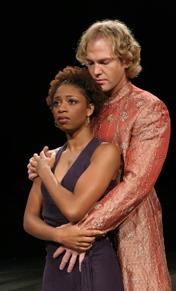
Friday, October 06, 2006

Beijing Opera

The following review appeared in The Davis Enterprise on 10/5/06

For two more nights only there is the rare opportunity to see the first world tour of the Shanghai School of Chinese Opera at the Wyatt Pavilion.

The 13-person performing troupe is visiting the campus through an exchange program between the Department of Theater and Dance and the Shanghai Theater Academy and will perform “The Colorful Essence of Beijing Opera,” which features extracts from five famous operas, “Farewell, My Concubine,” “Golden Monkeys Welcoming the Arrival of Spring,” “Madam Mu Guiying Becomes a General,” and “Yang Yuhuan Gets Drunk.”

In the Western World, we have a good idea of what to expect when we attend an opera. Leave those expectations at home as you enter the theater. Chinese traditional opera is a comprehensive performing art which combines singing, music, dialogue, acrobatics, martial arts, and pantomime. It is one of the three oldest dramatic art forms in the world and dates back to the Tang Dynasty (618-907). It represents the culmination and distillation of two thousand years of Chinese civilization.

Though it evolved from folk songs, dances, talking, and distinctive dialectic music, it is unlikely that most people in the audience will be rushing to buy a copy of music from Chinese opera to relax to some evening, as the sound is quite harsh to a western ear and in places may resemble a catfight.

(For this performance, the group uses recorded music (unfortunate in a couple of pieces where the sound system was rather mushy), primarily because of the expense of traveling with a band. The performers mouth the recorded words, though the recordings are of the actual performers themselves.)

But the music is only a small part of what Beijing Opera has to offer. (The term “Beijing Opera,” by the way, does not necessarily mean that it comes from Beijing. There are several types of Chinese Opera, and Beijing Opera has come to be regarded as the national form.)

The appeal of this performance starts with the large posters which line the walls of the Wyatt Pavilion. Next are the colorful, ornate costumes and the detailed make-up. Exaggerated designs are painted on each person’s face to symbolize the character’s personality, role, and fate. Generally, a red face represents loyalty and bravery; a black face, valor; yellow and white faces, duplicity; and golden and silver faces, mystery.

Finally, the actual movement itself, which can be almost balletic in its grace and beauty, as in “Tian Nv Scattering the Flower,” where Buddha has arranged for Tiam Nv (Sun Li) to scatter flowers for an unnamed ceremony. The costume for this piece includes two very long multi colored pieces of cloth which trail behind the actress and which she spins and snaps and twirls to represent the scattering of the flowers. It was my personal favorite piece of the evening.

At the opposite end of the spectrum would be “The Crossroads,” set in an inn at night. Though performed in full light, supposedly the characters (Ji Yongxin as Ren Tanghui and Li Mingyang as Lin Lihua) are in the dark as they perform a very complicated martial arts dance as they grope their way around the room trying to find the enemy who is supposedly lurking there.

There are 9 numbers in all (no intermission), each introduced in Chinese by Shang Changrong, the Chairman of the Chinese Theater Artist Association, and translated by a woman who struggled so with English that she was almost as difficult to understand as Mr. Changrong.

Some highlights included “Yang Yuhuan Gets Drunk” with Shen Yilang in the title role wearing the most ornate costume of the evening; and “Reed Marsh,” with Kan Xin as Zhang Fei, wearing black makeup round his upper face and still managing to make the best expressions with his eyes. “He is very good at kicking,” the translator told the audience, upon which Fei proved her right with some amazing high kicks.

My companion liked the opening number, “Golden Monkeys Welcoming the Arrival of Spring,” with bright yellow costumes, snapping and waving flags, an impossibly long set of feathers on the headdress of Zhang Shanyuan as Sun Wukong, the Monkey King, and acrobatics that would rival that of any Olympic athlete.

Several of the performers were only 13 years old and their precision, athleticism, and professional demeanor is a great testament to the school’s teaching.

In a full-length opera there would be more scenery, more people on stage, and live music, but for most of us, this may be the closest we’ll get to a full-length performance. It’s well worth the experience and at only and hour and 45 minutes, it’s a short evening, but you definitely won’t feel shortchanged.

On Friday from 1 p.m. to 3 p.m., the community is invited to a free costume and make-up application demonstration at Wyatt Pavilion.

Thursday, October 05, 2006

Fiddler on the Roof

The following review appeared in The Davis Enterprise on 10/4/06

The world is changing for the milkman Tevye (Jeff Nauer). Social mores are changing. Daughters are now falling in love instead of waiting for a match to be made for them. Pogroms and expulsions of Jews are occurring in the surrounding towns and it’s only a matter of time until the Tsar’s iron fist descends on Tevye’s little community of Anatevka. Tevye equates life in these unsettled times with being like a "fiddler on a roof,” trying to scratch out a simple, pleasant tune without breaking his neck.

"Fiddler on the Roof," currently at the Woodland Opera House, is the perennial favorite based on the stories of Sholem Aleichem, with music and lyrics by Jerry Bock and Sheldon Harnick, directed by Jeff Kean (who also designed the scenery). This is a story is about change ... the changing relationships between parents and children, the changing political scene, the change in ... tradition.

Director Kean is fortunate to have a group of principals with experience and excellent singing voices.

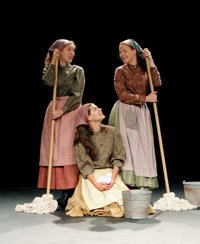
Outstanding among them are Tevye’s three daughters, Bethany Pedersen as Tzeitel (she also plays the spirit of Grandma Tzeitel), Julia Mosby as Hodel, and Monika Joyce Neal as Chava. Each give superb performances. Their trio “Matchmaker, Matchmaker” is a delight, and they have sensitive interactions with their father.

Nauer is an engaging Tevye with a big voice and a sincere characterization which was a real crowd pleaser. He accepts his lot in life, but constantly tries to convince God that it wouldn’t spoil him if he were to have just a bit less strife and a bit more wealth (“If I were a rich man”).

Nancy Agee is Tevye’s wife of 25 years, Golde, who knows the way to make a proper home, a quiet home, a kosher home, and who seems surprised, when asked the question (“Do you love me?”), to discover that yes, she really does love Tevye, a thought which had never occurred to her before.

At 20, Joelle Lorin Wirth is a bit young to be playing Yente, the matchmaker, but with the help of make up and black garb she seems to pull it off, though at times it seemed more of a caricature than a believable character.

Clocky McDowell is making his Woodland Opera House debut in the role of Motel the Tailor, but he is not new to either the show or to the role, having played it previously at Runaway Stage Productions. There is an earnestness and a sincerity in his portrayal of this poor young man asking for Tzeitel’s hand in marriage.

Scott Woodward’s fervor for political causes was palpable in his role as Perchick, the student from Kiev who offers to teach Tevye’s daughters and ends up marrying Hodel.

The character of Feydka is described as “a literate Russian,” and Kyle Hadley adds an element of sweetness which appeals to young Chava, who shares his love of literature and, ultimately, falls in love with the soldier as well, the one sin her father finds unforgivable.

Costumes for this production are by Laurie Everly-Klassen and suitably depict the life of poor peasants in a small shtetl in Russia, so it is surprising that Tzeitel’s wedding dress, with its lace trim and netting and jeweled veil seems so out of place. Is this really what a young bride from a poor family would wear on her wedding day?

Eva Sarry’s choreography was enjoyable and the traditional “bottle dance” at Tzeitel and Motel’s wedding was the expected knockout.

Erik Daniells is musical director for this production. The choral work was particularly lovely, especially for the Sabbath dinner, with the entire cast, holding lighted candles, distributed along the stage, and in the audience, including the balcony. This is always such a moving scene and does not disappoint.

Program bios are generally forgettable, but given the tenor of the times in which we live, the bio for Micail W. Buse (who plays the Rabbi in this production) sums up the production beautifully: “The oppression shown in this show still goes on: in Sudan, Palestine, and on virtually every continent on the Globe. I ...hope that all people will live in harmony, without regard to race, religion or ethnicity.”

“Fiddler on the Roof” continues at the Opera House through October 29 and patrons should be advised that evening performances now start at 7:30, instead of the usual 8 p.m.

Monday, October 02, 2006

This entry brought to you by....

I received a request from someone who read my Wizard of Oz review and wanted to know if I'd be willing to review his videos, Me, Eloise and Eloise Little Miss Christmas. Unfortunately, I don't do movie reviews--I have no choice in the kinds of things I review, as it is an assignment by the newspaper (and my boss is the movie reviewer!). But the video excerpt on the web site looked cute, so I thought I might be able to help the video by posting that video here. So enjoy, and if it looks good to you, check out the web site yourself!

Thursday, September 28, 2006

Movin' Out


With the California Musical Theatre’s Wednesday night premiere of the 2006-2007 Broadway Series, the Sacramento Community Center played host to the 1,000th performance of the “Movin’ Out” national tour, which premiered on January 27, 2004 in Detroit.

“Movin’ Out” is really a dance show with “strong musical content,” rather than a traditional musical. But there is choreography by the legendary choreographer Twyla Tharp to 22 songs of rock and roll legend, Billy Joel, loosely woven into a flimsy plot line to give the show logical progression from A to Z. It’s a short show. Even with a back-up in the parking lot, you’ll be back in Davis by 10:30 p.m.

Joel had been asked many times for permission to translate his songs to the stage, but had always refused until the call from Tharp. Whatever Twyla wants, Twyla gets. The two legends discovered that they shared a sharp eye for presenting stories in new and unique ways. Tharp felt that Joel’s songs were filled with emotional stories and specific characters that could be the basis for a compelling story. The show opened at the Richard Rogers Theater in New York on October 24, 2002 and played 1,037 performances before closing in December of 2005.

The massive yet minimal set by Santo Loquasto puts the “piano man” at the top back of the stage, along with a 10 piece band, while the action takes place below on the stage floor. Donald Holder’s lighting design plays a major role in creating mood and putting on a spectacular lighting show.

Darren Holden, the “piano man” sings the lyrics (if you’re not a Joel fan, it might be nice to get a C.D. or two and read some of the lyrics, because the lyrics are difficult to decipher) and has such nimble fingers that in the opening number of Act 2, “Invention in C Minor,” your eyes are drawn to the piano rather than to the dance that is going on on stage.

What little plot there is deals with a group of six high school friends and follows them from their senior prom until many years later in their lives. It covers loves lost and found, as well as sex. drugs and rock ‘n’ roll. The guys go off to fight in Vietnam and one of them is killed. Those who come home have a difficult time adjusting, but ultimately it all ends happily at a high school reunion, with rekindled hope, love and friendship.

Eddie, the “bad boy,” the loner, the guy with all the problems, is danced by Brendan King, though if the audience thought he looked a bit different after he got off drugs and cleaned up a bit in Act 2, that’s because King was replaced by Lawrence Rabson for the last quarter of the show.
Eddie’s two buddies are James, danced in this performance by Sean Maurice Kelly, and Tony (David Gomez). The men (and all the dancers in the ensemble) are amazingly athletic (watch Eddie doing one-handed push-ups!) and yet do a lovely old-fashioned dance, tongue in cheek, to “Waltz #1 (Nunley’s Invention)” prior to their induction into the military and subsequent tour in Vietnam, where James is killed.

Holly Cruikshank plays Brenda, a femme fatale who is dating Eddie in high school but then finds herself drawn to Tony as the group begins to grow older and start their adult lives. Cruikshank has impossibly long legs and is at her seductive best in “Uptown Girl” and shines in her solo, “Air (Dublinesque)”

Laura Feig is Judy, the “sweet one” (the sweet ones always wear white gloves). She and James are engaged at the start of the show and her heartbreak following his death was beautifully portrayed in the first act finale.

Leave your thinking caps at home for this one, but bring some shoes that will allow you to tap your feet, because you’ll be doing that throughout. This is a visual spectacle, a choreographic triumph and just a darn fun evening for fans of either Billy Joel’s music, or great dancing.

Wednesday, September 20, 2006

West Side Story

Every chorus of male dancers should have Robert Coverdell at the head of the line. Coverdell, who plays Riff in “West Side Story,” the first production of the Davis Musical Theater Company’s 22nd season, was born to dance. He has a tall lanky body that moves with a fluid motion and he makes everybody look good (and some of those guys behind him were definitely not born to dance, but give it the ol’ college try).

“West Side Story,” directed by Steve Isaacson (who is also credited with musical direction) and choreographed by Dian Hoel is a continuous roller coasters of highs and lows. Just when the energy lags and someone can’t quite get the pitch right, along comes a number like “Officer Krupke,” the outstanding number from this production, where everybody – Henry Holloway, Andy Hyum, Ryan Warren, Alex Poe, and Edward Nelson – is right on the money ... and Nelson, as Big Deal, does amazing leaps and somersaults. This number has the sizzle that should be found in all the dance numbers, and sadly is not.

The show is a little difficult to review, with no musical numbers listed in the program (and hence no way to identify minor characters singing solos), and no biographies for the actors, but it appears that there are a lot of new names to the company in the cast..

“West Side Story,”is the classic musical with book by Arthur Laurents, music by Leonard Bernstein and lyrics by Stephen Sondheim, which debuted on Broadway in 1957 and set a musical style which moved musical theater in a whole new direction.

It is, of course, the Romeo and Juliet story, modernized and set on the mean streets of New York. Teri Kanefield is credited as “Scenic Artist,” and I’m not sure if that means she was responsible for the look of the entire show, but the opening bare stage was nicely designed with a brick wall at the back, and projected lights to hint at the fire escapes of tenement buildings. The upper level apartment balcony for Maria’s bedroom was perfect.

I wondered how it was going to go when I saw that there were only four people in the orchestra (Jonathan Rothman on piano, Isaacson on drums, Chris Weisker on oboe and Vicki Davis on bass), but somehow the orchestral arrangement was so well done that you almost didn’t miss the full orchestra for which Leonard Bernstein wrote the score.

The story revolves around the running feud between the Sharks (Puerto Ricans) and the Jets (the native born Americans). Some of the material (particularly the barely censored language, such as “Gee, Officer Krupke--krup you” and “when the spit hits the fan”) seems a bit dated, but the hatred between gangs is, sadly, even more relevant today.

Colby Salmon in the role of Tony obviously has a very good voice and good stage presence, but had breath and pacing problems in his opening number. He appeared to grow in confidence as the evening progressed. He is a strong actor and worked well with Chelsea Baldree, as Maria.

Baldree, too, could use a bit more oomph when singing in her lower register but was a sensitive Maria, the innocent young girl newly arrived from Puerto Rico to marry her brother’s friend Chino (Nick Peters). Over the course of two hours, she learns how to hate, and Baldree makes the transition from innocent girl to angry girl nicely.

Bernardo, the head of the Sharks, is played by Davis Ott who, like Coverdell, presents a wonderful dancing figure and very believably portrays the leader of a Latino gang.

Amanda Morish is outstanding as Anita, Bernardo’s girlfriend who seems to spend most of the first act doing deep backbends as Bernardo continually sweeps her off her feet. She has fun with “America,” comparing the positives about this country with the negatives in Puerto Rico, and she is also able to bring out the rage of a woman who has just lost the love of her life in “A Boy Like That.”

Kayla Sheehan has the minor role of Rosalia, who argues with Anita about the pros and cons of Puerto Rico vs. the United States. She gives a solid performance throughout the production.

This is a big show for a small company and DMTC handles it adequately, though not outstandingly. I suspect that as opening night jitters fade with the principals, we will see more of the polished performances which are hinted at here, and as the entire cast settles into the run, there will be more precision to the dance numbers. All the elements are there and with a bit more energy this could be a good production.

Monday, September 11, 2006

Best of Broadway

Ask any theater goer to list the top ten Broadway shows and you’ll probably get things like "Oklahoma!" "Music Man," or "Sound of Music." It is unlikely that you’ll find "Martin Guerre," or the "Tonight’s the Night," the compilation musical, based on the songs of Rod Stewart (and described by one reviewer as "...starts in Hell and sadly doesn’t get any better.")

So one questions whether "Musical Mystique," the 34th annual "Best of Broadway" musical revue, now at the Luther Burbank Theater in Sacramento through September 24, is actually the best of Broadway, but there is no denying the sincerity of the participants, or the hard work and love that goes into this production. (There are nearly 100 names in the program listed as ushers alone, and 30 listed for the concession stand.)

Best of Broadway was conceived by David L. MacDonald in 1973 as a way to raise money for a local boys’ home, and has grown to become one of the largest non-profit, volunteer community shows in Northern California. The cast consists of over 150 singers, dancers, gymnasts and musicians, ranging in age from 7 to 70, who are chosen from open auditions. Many alumni of Best of Broadway have gone on to actually perform on Broadway.

While there are a few weak spots in the current production -- an inconsistent sound system that was too loud for some and not loud enough for others, and some performers who really shouldn’t have been given solos -- the strengths in this production more than compensated for its shortcomings.

David L. MacDonald is the producer director of this revue, with musical direction by Dan Pool and adult choreography by Diana Ruslin and Terri Taylor-Solorio, with Kat Bahry heading up the choreography for the children’s ensemble, numbering some 50 children. Bahry, along with children’s choral director Enrique Ruiz did a fabulous job with the children, some of whom were obviously born to perform.

Marji DuBois, Jim Crogan and Corey Rickrode are credited with choral direction for the adult ensemble and did an excellent job.

Special mention must also be made of the sign language interpreters. Cristie Pell is the chief interpreter and I have marveled at her work, now, for several years. Her three assistants were not listed in the program. Each took one of two numbers at a time to sign, but Pell did the lion’s share and one could easily see how she made music come alive for the non-hearing members of the audience.

This high energy production is filled with 52 musical numbers from 15 different musicals, and there were definite high points. The choreography for "Step in Time" from "Mary Poppins" was a knockout.

Dewight Mitchell and Elise Reese gave depth to two numbers from "Ragtime," with Mitchell returning later for two numbers from "Brooklyn, the Musical" and Elise Reese with an unbelievable wig for "You Can’t Stop the Beat" from "Hairspray."

Randy Solorio works overtime this year, with his Fonzie-esque presentation for two lengthy sections, the Act 1 salute to "All Shook Up," which features the songs of Elvis Presley, and the Act 2 songs from "Tonight’s the Night." Solorio can shake, rattle and roll with the best of them.

"Tonight’s the Night" also features Robert Lenzi on guitar, bathed in pools of light.

Marji DuBois has an outstanding voice and is featured in seven different numbers, all of which come alive because of her performance.

Josh Gonzales and Tae Kim sing the roles of Martin Guerre and Arnaud du Thil from "Martin Guerre." Both men have marvelous voices, particularly Kim, whose slender build belies the power and the depth of his voice.

Enrique Ruiz, Dewight Mitchell, Ryan Ritter and Aaron MacDonald do an excellent impression of The Four Seasons in the selections from "Jersey Boys."

The children’s chorus, which performs "Supercalifragilistic" in Act 1, returns in Act 2 looking like they ran wild in a Halloween costume shop, with the assistance of costume coordinators Cathy Carpenter and Joan Pohlman. Dressed as doctors, clowns, police officers, ballerinas, and just about any costume you can imagine, they did a very cute rendition of "Always Look on the Bright Side of Life" from Monty Python’s "Spamalot." There is one little girl in green doctor scrubs with a stethoscope around her neck who is having such a good time you can hardly take your eyes off of her.

You can’t think about Best of Broadway without thinking about numbers--numbers of songs, numbers of people, numbers of costumes, numbers of volunteer hours which go into putting on this amazing production. It’s a visual extravaganza and an incredible labor of love for those involved.

And best of all, it goes to support many worthy causes.

Wednesday, August 30, 2006

Boxcar Children

This review appeared in The Davis Enterprise on 8/29/06

“The Boxcar Children,”directed by Jeff Hammond, adapted for the stage by Barbara Field from the book by Gertrude Chandler Warner – and the first in the Woodland Opera House’s “Theater for Families” series for this season.

It’s a depression era story of four children, orphaned when their parents are killed in a boating accident. When the older twins discover that officials plan to split them up, they take matters into their own hands (“we stick together like glue”). They run away and set out to find a way to take care of themselves.

This may be the very best type of play for younger children, raised on the likes of “Sesame Street,” which plays to a child’s short attention span. The story is presented in many, many scenes (in Act 2 I counted 20 scenes; I am sure there were more in Act 1), each with a small bit of scenery (designed by Jeff Kean), whether a clump of grass or a pile of trash or a mailbox to signify a home, but all easily rolled in and out again. A “scene” may consist of only a few lines (some are, of course, longer), but there is no time for a child to become bored with the action on stage because it is constantly changing.

I was pleased to note that all the pre-show fidgiters and bouncers and chair kickers sat engrossed in the action of the play throughout both acts. I didn’t even hear any whispering in the audience.

There is a new look for the Theater for Families series this year. In order to raise the quality of the productions, the company is no longer casting shows only with children 18 and under. The casting is now age appropriate, with adult roles being played by adults.

In this production, however, there is absolutely no question about who holds the show together--it is the children themselves, especially the four title characters.

Rob Blake, as Henry, the oldest boy, is a natural for the stage. I wish that some of the otherwise excellent local actors around Yolo County could project as well as he can. Henry is the responsible one, the one who finds a job and brings in some money to help buy the necessities. Blake makes the role believable and he can be heard in the back of the Opera house, without making his projection seem forced.

Kimberely Casazza, Henry’s twin, Jessie, is the practical one, keeping the family together. She’s the idea person. Casazza has done several productions at the Opera House in the past two years, and her experience shows.

Erin Solomon is absolutely perfect as Violet, the “refined” child. When Henry has money, Violet asks him to buy toothpaste and soap and a tablecloth. She worries about her clothing getting dirty. She is the one who finds “nice” things at the dump to dress up their new “home” and asks if there is enough money to buy seeds because “Mommy always planted flowers.”

Though authorities feel he has special needs, there is nothing “slow” about little Benny (9 year old Drew Thomsen, making his stage drama debut -- he appeared in last year’s “Seussical, the Musical”), who learns to read under Jessie’s tutelage. You would never know from Thomsen’s professional performance that he has so little stage experience.

Charlotte Lenton is great as Myrtle, one of the homeless people the children encounter in their travels. Nicki Reiff is her friend Cookie, and also plays the Baker’s Daughter. Matt Reiff is “Kid,” who travels with Myrtle and Cookie, but who doesn’t speak.

In the adult cast, Don Solomon (Erin’s father) gives a lovely sympathetic performance as Dr. Sam Truman, who hires Henry and then begins to realize that Henry is not quite what he presents himself to be. Carin Beede is Mrs. Truman, giver of lemonade. Her concern for the children is evident.

Vanessa Zaragoza is quite good as Sarah Calder, the social worker who truly has the children’s best interests at heart and who works to bring them to the attention of “Mr. Aldin,” Gary Agid, with positive results.

Rebecca Baland is Mrs. Alberts, who finds the children to be a bother and just wants them out of her life. Alan Smuda is Officer Banning, the policeman charged with finding the runaways.

This is a lovely little family show, suitable for all ages. It continues at the Opera house through September 10. Take your children. Take your grandchildren.

Wednesday, August 23, 2006

Smokey Joe's Cafe


(This video is from "a" production of Forum not from "the" production of Forum that I reviewed.

This review appeared in the Davis Enterprise on 8/23/06


The Music Circus is ending its 2006 season with a high voltage production of “Smokey Joe’s Café,” directed by Barry Ivan and choreographed by Todd L. Underwood. This is a musical salute to the music of Jerry Lieber and Mike Stoller who, if not familiar names to the audience, have written some of the most memorable music of our lives. Songs like “Yakety Yak,” “Charlie Brown,” “Hound Dog,” “Jailhouse Rock,” “Poison Ivy,” “Spanish Harlem,” “Stand by Me,” and the song which brought down the house on opening night, “I’m a Woman.”

“Baby, That is Rock & Roll,” sang the company in the finale, with the middle-aged audience on its feet clapping and cheering its approval.

“Smokey Joe’s Café” is not a plot show. It is simply a revue with nine extremely talented people singing some 42 songs, making some incredible quick costume changes, doing some great dances, and entertaining an appreciative audience.

Inga Ballard, a UCD graduate (a number of years ago), has a big sassy sound and belts out Gospel with the best of ‘em in “Saved,” the first act finale. She does “Fools Fall in Love” in Act 1 and then, for some reason I could not fathom, repeats it in act two. But it’s a knockout number and perhaps worthy of repeating!

Montego Glover was seen earlier in this Music Circus season as the unforgettable title character in “Aida.” When she snaps her feather boa and climbs on, over and under a chair singing “Don Juan,” all thoughts of any Nubian princess will disappear. Her duet with Eric Jordan Young, “Spanish Harlem,” was absolutely stunning.

Deb Lyons, who starred in this show both on Broadway and in London’s West End, lays her heart bare in “I Keep Forgettin’” and tells the story of Pearl the piano player (“Pearl’s a Singer”), who was always looking for that one big break that never came.

The leather-clad Kasey Marino perfected his pelvic thrusts in Elvis fashion for the house-pleasing “Jailhouse Rock.”

Devin Richards, the man with the deep, deep, deep voice brought cheers whenever he went for the low note, but he displayed great comedic talent and was a fine dancer as well.

Harrison White, a great comedic talent, added depth to songs like “Love Potion #9,” “On Broadway,” and “Searchin’” (the first of many songs throughout the evening to bring applause as the audience recognized it).

Darryl Jovan Williams may be small of stature but this is a monumental talent. Whether burying his nose in Inga Ballard’s ample decolletage, “Shoppin’ for Clothes” with some unusual display suits, trying to get himself up out of the gutter as “D.W. Washburn,” or sizzling in “I (Who Have Nothing),” he never failed to be an audience pleaser.

Laura Woyasz must lose at least a pound a performance with her “Teach Me to Shimmy” number alone. Dressed in a white dress made entirely of fringe, she does credit to a Tahitian dancer as she makes that fringe move in ways the designer probably never intended. It’s quite a sight to see.

“Smokey Joe’s Café” is a tour de force for lighting designer, Pamila Grey, whose electric light changes and smokey pools of light created the ambience without the need for elaborate sets.

Steven Howard and Bob Miller deserve kudos for their delicious costumes (and the dressers deserve special recognition for getting the performers on stage with split second timing!)

In anticipation of the popularity of this toe-tapping revue, Music Circus has added an addition four shows to the run, so there should be no problem getting tickets. Get yourself to the Wells Fargo Pavilion while you still have the opportunity.

Wednesday, August 16, 2006

A Funny Thing Happend on the Way to the Forum

This was printed in The Davis Enterprise on 8/16/06

There’s only one word to describe Music Circus’ production of “A Funny Thing Happened on the Way to the Forum,” which opened Tuesday night: Zany.

This 1963 Tony award winner, with music and lyrics by Stephen Sondheim, book by Burt Shevelove and Larry Gelbart, and direction by Marcia Milgrom Dodge is based on the comedies of the ancient Roman playwright Plautus, and the humor is bawdy and fast-paced. (“If I've told you once, I've told you a hundred times; do not fan the girls when they're wet! But you'll never learn, you'll be a eunuch all your life.”)

Set in a time where everybody had slaves, eunuchs were commonplace, courtesans were for hire, and virgins were seen as objects to be conquered, the action centers around three homes, the house of citizen Senex (Walter Hudson), his domineering wife Domina (Jessica Sheridan), and their love-struck son Hero (Ryan Driscoll); the house of Lycus (Ron Wisniski), a buyer and seller of courtesans; and the house of Erronius (Jim Lane), an old man who has been roaming the world for the past twenty years, looking for his son and daughter, stolen in infancy by pirates.

This is a stellar cast, but head and shoulders above the rest is James Brennan as the slave Pseudolus, slave to Hero. Pseudolus is a man who desperately wants his freedom and is always looking for a way to get it. Brennan has a list of theatrical credits as long as your arm, boundless energy, and brilliant comic timing. He also plays well with the audience and handles unexpected situations with aplomb.

Head slave in the house of Senex is the appropriately named Hysterium, a Charles Nelson Reilly-esque portrayal by the very funny John Scherer.

When Pseudolus learns that his master, Hero, has fallen in love with the courtesan, Philia (Ashleigh Davidson, daughter of John Davidson), he sees a way to win his freedom by getting the girl for him. ( “People do not go around freeing slaves every day.” “Be the first. Start a fashion.”)

There’s just one little problem with the plan. Philia, a virgin newly arrived from Crete, has been promised to the warrior Miles Gloriosus (Christopher Carl, last seen as Carl-Magnus in the recent production of “A Little Night Music”), whose name reflects his inflated opinion of himself.

Madness and mayhem ensue, including the plague, leprosy, a magic potion, a soothsayer, body snatching, a bride who is not as dead as everybody thinks she is, “and a happy ending, of course” as the opening number, “Comedy Tonight” promises.

The show could not keep up the rapid pace that it does without “the Proteans,” Venny Carranza, Brant Michaels, and Peyton Royal, who play dozens of roles, from the giggling eunuchs of the house of Senex to the warriors who accompany Miles Gloriosus, and everything in between. They are leaping, tumbling, rolling, running bundles of energy and masterful physical comedy. They were brilliant and hilarious.

Likewise, the courtesans of the house of Lycus each had her own moment to shine, and shine they did as Tintinabula (Melanie Haller), Panacea (Ann Cooley), the cat-like Vibrata (Mindy Haywood), the twins Geminae (Shiloh Goodin and Katie Russell) and the dominatrix Gymnasia (Alison Mixon).

Marcia Milgrom Dodge understands directing for theater in the round and kept her cast moving at all times, never once favoring one part of the audience over another. She worked well with choreographer D.J. Salisbury.

“A Funny Thing Happened on the Way to the Forum” is fun, plain and simple. A funny book, fun songs, great energy, and a splendid cast. It’s the perfect divertissement for a summer evening.

Thursday, August 10, 2006

The Music Man

This appeared in The Davis Enterprise on 8/9/06

Leland Ball started in theater 46 years ago. He joined the Music Circus in 1976 and has been guest director, resident director, associate producer and producing director. He “retired” in 2002, but has directed one or two shows each summer for the past 2 seasons. However, he is finally hanging it up for good and next summer, his bio promises, he will return as a member of the audience only.

Ball chose to go out with the quintessential American musical, Meredith Wilson’s “The Music Man,” which opened last night at the Wells Fargo Pavilion. What better way to top off a professional theatrical career than with 76 trombones (give or take a few), high stepping dancers, a barbershop quartet and a house filled with clappers and toe
-tappers.

John Hillner gives a top notch performance as Harold Hill, the traveling salesman who finds his life changed forever by an impulse stop in a little Iowa town, where he plans to work the “boys band” scam he has been running for years.

Sarah Tattersall is excellent as Marian Paroo, the librarian who is first suspicious of the smooth-talking stranger, and then falls under his spell.

Her mother, Mrs. Paroo, is broadly played by Brooks Almy, with a brogue so thick you could cut it with a knife.

As the mayor with all the verbal eloquence of George Bush, Patrick Quinn delights. He’s bluff and bluster and determined to “get that spellbinder’s credentials” if it’s the last thing he does.

Ruth Gottschall may have done more with the role of Eulalie McKecknie Shinn, the mayor’s wife, than I have ever seen done in many, many productions of this show. She has a face as expressive as Carol Burnett’s and with her impeccable timing, she gets the biggest laugh of the show with her line “I think he means peep.”

Robert Creighton is delightful as Harold’s old scam partner, now gone straight, Marcellus Washburn. When he leads the kids of the town in the “Shipoopi,” he’s great fun to watch, but he shines dancing around the stage while Harold sings about “The Sadder but Wiser Girl.”

Nine year old Matthew Gumley has an impressive set of credentials for one so young, but he seems to have been working steadily since age 4. He is the perfect Winthrop, the shy little boy with a lisp who can’t understand why his Daddy had to die, but who also falls under the spell of Hill. Gumley is one big ball of talent and is obviously enjoying every minute of the attention on stage.

Strong performances are given by Shane Rhoades as Tommy Djilas, the kid from the wrong side of the tracks who “almost had perpetual motion once,” Manoly Farrell as Zaneta, the Mayor’s oldest daughter, who is giggily infatuated with Tommy, and Andrew Boyer as the anvil salesman, Charlie Cowell, who is determined to make sure that Hill gets his commuppance.

Add to this strong cast a chorus of singers and dancers as crisp and precise as a kick line of Rockettes and the end result is a delight.

Due to popular demand, a special Sunday matinee performance has been added on Sunday, August 13 at 2 p.m. Tickets for this production are being offered at $15 off to children, ages 4-11.

Wednesday, August 09, 2006

Good Person of Szechwan

(This appeared in The Davis Enterprise on 8/8/06)

Like Diogenes, the gods are searching for a good man...or, more accurately, a good person. Unlike Diogenes, they actually find one.

The search for a good person is the theme in Bertolt Brecht’s “The Good Person of Szechwan,” directed by Jacob Stoebel, with incidental music composed by Christopher Cook, presented by Acme Theater Company and currently running at the Veterans Memorial Theater.

This 1943 Brecht classic examines the effect of wealth on a good person in an imperfect society and creates a story which is able to illustrate Brecht’s Marxist leanings, while leaving the audience to decide for itself what the real message of the story may be.

Dara Yazdani is humble and earnest as Wang, the water seller, who explains to the audience that he has heard that several important gods are due to arrive and he is awaiting them at the city gate.

The three gods are represented by marvelously innovative 3-person puppets, designed by Nora Allen, and manipulated by Cami Beaumont, Heidi Voelker, Hannah May, Tatiana Ray, Atlanta Parrott, Geoffrey Albrecht, Celsiana Warwick, Vivian Breckenridge and Diana Castillo. They have been traveling, town to town, trying to find people who are still living good lives, but thus far have found only dishonesty, greed and selfishness.

Wang assures them that there are good people in Szechwan and goes off in search of someone who will open their door to the gods, so that they may spend the night. Wang is turned away everywhere except by the young prostitute Shen Te (Elsbeth Poe), who says that she has a small home and has a customer expected, but she cannot turn away anyone in need, so she will find a way to accommodate the gods. Poe nicely illustrates her character’s idealism and goodness.

As they leave, the gods reward Shen Te by giving her a bag of coins, a small fortune for the young woman. In truth it is as much of a test as it is a reward. Will her goodness persevere in the face of newfound wealth?

Initially, Shen Te uses her newfound wealth to do good, but she quickly begins to succumb to the power of money. With the help of the realtor, Mrs. Shin (Madelyn Ligtenberg), she purchases a tobacco shop, but her generosity quickly turns her small shop into a messy, overcrowded poorhouse which attracts crime and police supervision.

To keep from being thought of as a bad person. Shen Te adopts the disguise of her imaginary cousin, Shui Ta, who acts as her overseer while Shen Te is “away.” Shui Ta is able to make all those seemingly heartless business decisions that Shen Te is incapable of doing.

In the end, Shui Ta is suspected of murdering Shen Te and is brought for trial before the gods. Wang pleads to the gods to help in the search for Shen Te.

Again, in dialog which is as relevant to today as it was in the 1940s, the gods express disappointment at Shen Te’s disappearance, as she was the only good person they had encountered in their travels. “All over the world all we have found is poverty, debasement and dilapidation. Even the landscape crumbles away before our eyes...over the mountains we see great clouds of smoke and hear the thunder of guns.”

But they feel that “all will be redeemed if we can just find one who will stand up to this world.”

When Shen Te is discovered to be alive, the gods feel their work is done and they can return to their home because they have found that one good person, though Shen Te is filled with guilt for her duplicity.

It is, we learn, for the audience to discover how a good person can possibly come to a good end in a world that, in essence, is not good, or as narrator Anthony Pinto explains, “we had in mind some golden myth, then found the ending had been tampered with.” The plan, he says, is to leave the ending of the play open for the audience to decide for itself the meaning, as “frustrated audiences mean unemployment.”

“Our play will fail if you can’t recommend it,” he concludes.

Far be it from me to let the play fail. It gets a recommendation from this corner.

Wednesday, August 02, 2006

A Little Night Music

This appeared in the Davis Enterprise on 8/2/06

“The smile for the fools was particularly broad tonight,” says Mme Armfeldt (Barbara Rosenblat) at the conclusion of Stephen Sondheim’s “A Little Night Music,” making its Music Circus debut this week.

I don’t know if those who remained for the entire performance were fools or not, but there were certainly smiles aplenty for those experiencing this near-perfect production. I can only assume that the seats left vacant after the intermission were either because of the chilly temperatures inside the Wells Fargo Pavilion (pay no attention to the outside temperatures; bring a light wrap to avoid being chilled by the air conditioning!) or because this may, perhaps, be the most “operatic” of offerings yet presented by The Music Circus in its 56 year history, which may not suit the tastes of some faithful Music Circus patrons.

Whatever the reason, the real fools were those who did not return following intermission.

Based on Ingmar Bergman’s “Smiles of a Summer Night,” the plot of “A Little Night Music” could rival any modern day soap opera and hold its own. Fifty-ish year old attorney Fredrik Egerman (Paul Schoeffler) has married 18 year old Anne (Carolann M. Sanita), who is still a virgin, 11 months into the marriage. Anne finds herself attracted, not to her husband, but to her stepson, the religiously zealous Henrik (Jim Poulos), a young man with racing hormones and eyes for his stepmother, but hands and other body parts for Petra, the chambermaid (Melissa Dye), and guilt for any sexual feelings at all.

Meanwhile, Fredrik has never gotten over his old love, the famed actress Desirée Armfeldt (Nancy Opel), who has an out of wedlock daughter (Paige Silvester) and a jealous lover named Carl-Magnus (Christopher Carl), who ignores his own bitter wife, Charlotte (Elizabeth Ward Land), who is not only aware of his affair, but is willing to help him sort things out. All of these mismatched lovers convene for a weekend at the luxurious home of Madame Armfeldt, Desirée's crusty old mother, where romance, comedy and wonderful music ensue.

Director Stafford Arima has brought together some terrific principal performers, starting with the Liebeslieder Quintet – Quentin Darrington, Laurie Mitchell, Emily Herring, Michael Scott Harris and Allison Blackwell – who act as a kind of Greek chorus, setting the stage for the action which is to come, or augmenting the action that is taking place. The quintet opens the show, encircling the theater in a very effective, “Night Waltz,” which repeats throughout the show.

As Fredrik Egerman, the middle aged attorney trying to recapture his youth with a child bride, Paul Schoeffler is outstanding. He’s handsome, he has a magnificent voice, and his feeling for his lost love Desirée is palpable.

Carolann M. Sanita is hauntingly beautiful as the young Mrs. Egerman (Anne), who thinks she loves her husband but just isn’t quite ready for the physical aspects of marriage. (“You can’t force a flower,” Fredrik explains to Desirée in “You must meet my wife.”) Anne is struggling to find the maturity to be the wife of a prominent attorney, but prefers giggling with the maid over girl stuff instead.

Nancy Opel is a marvelous Desirée, an aging, but still charismatic actress, who has finally realized that Fredrik is her one true love. She gives a classic performance of the haunting signature song from this show, “Send in the Clowns.”

Christopher Carl is a bombastic Count Carl Magnus, totally insensitive to his wife, Charlotte (Elizabeth Ward Land), as he rants to her about his jealousy upon learning that his mistress has been seeing her former lover.

Jim Poulos is splendid as Henrik, tormented by his desire to give himself to God, yet wracked with temptations of the flesh, to which he guiltily succumbs.

As the family matriarch, a woman who has numbered kings among her lovers, Barbara Rosenblat gives a very regal performance. Madame Armfeldt alerts her granddaughter to watch for the summer night to smile. "It smiles three times," she says, "first, for the young, who know nothing; second, for the fools, who know too little; and third, for the old, who know too much."

Paige Silvester does an outstanding job of playing the child who is often more mature than her mother, who knows more of life than most children her age

Scenic Designer Michael Schweikardt created some beautiful scenes, with hanging tapestries for the drawing rooms and a magnificent forest for the outdoor scenes in Act 2.

“A Little Night Music” is a story about love and growing old without the one ‘true’ love for which everyone is searching. It’s about realizing too late that the one that got away was the one most needed.

This production by Music Circus is simply outstanding, and will leave you, along with the other fools, smiling particularly broadly at its conclusion.

Monday, July 31, 2006

Falsettos

This appeared in The Davis Enterprise on 7/31/2006

When I interviewed Erik Daniells last month about his fledgling company, “Artistic Differences,” he indicated that his goal was to produce small, lesser-known shows, and to cast them with top notch performers from all over the Davis-Sacramento area, in the hopes of creating quality theater that everyone would want to see.

If the first production, “Falsettos,” now playing at the Hoblit Performing Arts Center, is any indication, “Artistic Differences” should have a long and successful life. Each of the 7 actors is outstanding, the stage direction by Michael RJ Campbell is tight and keeps the show moving at crisp pace.

Gino Platina’s choreography is a delight, from the opening “Four Jews in a Room Bitching” to the hilarious “March of the Falsettos.”

“Falsettos” is, in actuality, the second and third acts (“March of the Falsettos” and “Falsettoland”) of the 1992 Tony Award winning musical, “Marvin Trilogy,” by William Finn. It tells the story of Marvin (Craig Howard), a 30-something Jewish man who has admitted to himself (and to his wife and son) that he is gay. He has taken a lover, Whizzer (Jerry Lee), but because Marvin is a good family man, he decides that Whizzer should move into the family home with his wife Trina (Margaret Hollinbeck) and that they all live as one big happy family. (“I want a tight-knit family,” sings Marvin.)

Not surprisingly, this sets up some conflicts for son Jason (Joey Harris), which brings all into therapy with psychiatrist Mendel (Kevin Caravalho), a situation further complicated by Mendel and Trina becoming romantically involved. Soon Trina and Mendel are engaged, and Whizzer leaves Marvin, which leaves Marvin feeling his perfectly constructed little world is falling apart.

Confused? Don’t be. The plot all hangs together. It’s a show about growing up, whether that takes place at 13 or at 30. It’s sweet and funny, touching, and full of heart. Musically, it’s a knockout.

This cast is exceptional. Craig Howard, as Marvin, handles his complex character with aplomb. Marvin is a man who, over the course of two hours, must grow from an irresponsible, eternally boyish man to one who one who embraces the maturity that the situations in his life demand. His relationship with Whizzer is tender and believable, particularly in their final scene, and he has strong, solid voice.

Jerry Lee is a handsome and endearing Whizzer, who brings depth and realism to the role, particularly “You Gotta Die Sometime,” the defiant cry of a man in his prime facing his own mortality.

Kevin Caravalho as the perpetually addled psychiatrist Mendel radiates electricity on stage. With his goofy glasses and expressive face, he’s provides the perfect comic relief from the very first note. Though supposedly the only “sane” one in the cast, he is riddled with his own eccentricities.

Marvin’s wife Trina is played by Margaret Hollinbeck, who also serves as the show’s vocal director, and may deliver the strongest musical performance of the show. She gives a bravura performance in “I’m Breaking Down,” which displays a wide range of talents, from the comedic to the dramatic.

Joey Harris is charming as Jason, trying to come to grips with the fact that “My father’s a homo,”and watching his family fall apart around him, all the while they are trying to plan his bar mitzvah. Harris is quite convincing as a troubled child trying to make sense of a quirky family.

The lesbians next door, don’t appear until act two. Jessica Stein is the kosher caterer Cordelia, always there to offer hors d’oeuvres to anyone in need. Kristen Wagner is her partner, the doctor, who notes that “something very bad is happening,” hinting at the age of AIDS, without actually saying the word (“Bachelors arrive sick and frightened/They leave, weeks later, unenlightened.”) The two characters add some needed additional humor to the darkening mood of Act 2.

The “teeny tiny band,” under the direction of Erik Daniells provide the perfect accompaniment to the action.

Falsettos is the story of immature people of all ages, with perhaps more quirks than most, confronting difficult situations and learning that one must grow up in order to deal with them.

The cast of the newborn“Artistic Differences” handles this situation with professionalism, maturity and a level of talent which predicts a successful life for the company.

Thursday, July 27, 2006

South Pacific


“Some Enchanted Evening,” “Bloody Mary,” “There is Nothing Like a Dame,” “Bali Hai,” “Younger than Springtime.” The list reads like a section from Broadway’s All-Time Greatest Hits, and that’s only Act 1.

Rodgers and Hammerstein’s 1950 Tony-Award winning musical (based on James Michener’s Pulitzer Prize winning novel “Tales of the South Pacific”), which opened Tuesday night at Music Circus’ well-air conditioned Wells Fargo Pavilion, is an old war horse, but its popularity has not dimmed. At times the plot of this musical seems very dated. At other times, one marvels at (and is perhaps depressed by) the consistent timeliness of its message.

Amidst a backdrop of military hijinks on a Pacific island, it tells the more serious story of two couples -- Nurse Nellie Forbush in love with the French expatriate Emile de Becque, and the young Marine Lieutenant Joseph Cable in love with Liat, a Tonkinese woman -- and the racial prejudices that affect all four of them.

Leland Ball, returning for the first time since 2005's “King and I,” has directed a first-rate production, with an outstanding cast.

Kerry O’Malley is an absolute delight as Nellie. She has a sparking effervescence that explodes off the stage. Her internal struggles over her attraction to a man who is so different from herself, her joy at discovering her love for him, and her later pain upon learning about de Becque's Polynesian children (Justin Schuyler and Heidi Schuyler) are sincere and believable. She also does a great shower scene (“I”m gonna wash that man right out of my hair”) and her talent show number, “Honey Bun” was delightful.

Samuel Smith is better known for his operatic roles, so he brings the same kind of operatic basso to the character of Emile de Becque that Ezio Pinza did to the original. He gives the role power and dignity. He may be a little lacking in the “suave” department, but this is more than compensated for when he opens his mouth to sing tunes like “Some Enchanted Evening.”

Will Ray is a handsome Lt. Joe Cable with a beautiful voice for “Younger than Springtime,” who effectively displays the bitterness of a conflicted man who realizes that though he loves a woman, his upbringing won’t let him get past the color of her skin (“You’ve Got to be Carefully Taught.”)

Leanne Cabrera is Liat, the young girl, who has almost no lines and no songs, but who makes an impression just for being an endearing young girl swept away by a tall, handsome military man. Since there is a language barrier between the two, her part is mostly pantomime, yet somehow it feels bigger.

The Liat-Joe plot line feels strikingly inappropriate in this day and age, where there is such emphasis on sexual exploitation of innocent young girls. The lieutenant is taken to a remote location by the girl’s mother, where he finds a very young girl for what becomes an instant physical encounter. As the two embrace for the first time (this being a show from 1949, the manner of the encounter is only hinted at, when the lights go down and then come up on a shirtless Joe lying in the lap of a happy-looking Liat), there is such depth to the emotion that it does not ring true. But the plot line has been playing successfully for more than 50 years, so the audience must not mind.

Armelia McQueen is superb “Bloody Mary,” the wise-cracking, betel-nut chewing native woman selling cheap trinkets to the military, speaking broken English and cackling in delight with the seabees, yet she gives a haunting rendition of “Bali Hai,” as she describes the mysterious island just off shore, just out of reach. Mary is a wheeler-dealer who will even prostitute her daughter in the hope of making a good marriage for the young girl.

Simply outstanding is the performance of Robert Creighton as the scheming entrepreneurial seabee Luther Billis, always looking to make a deal, desperate to find a woman. A highlight was his performance of “Honey Bun” at the camps Thanksgiving talent show.

The ensemble is excellent, particularly the seabees, a group of men who each have small solos to sing and who each seem to have principal quality voices.

“South Pacific” is a show which addresses the issue of racial prejudice head on, in a blatantly dated manner, but which evokes situations and emotions still prevalent today. In the end, it is through the children that we see hope for a more tolerant tomorrow. A tomorrow for which we are still waiting, 55 years later.

Wednesday, July 26, 2006

A Flag Touched the Ground

The folks at Barnyard Theater, now celebrating its third season at historic Schmeiser’s Barn, off Rd. 31, had the decided misfortune to open its new production, “A Flag Touched the Ground, or Thorlock’s Tale” by local playwright Nicholas Herbert, during the hottest week of the year.

The price of admission to the play includes free spritzing with bug spray to ward off bugs attracted to the light inside the building, but there is, unfortunately, nothing that can be done to cool off a hot barn, except offer ice cold bottled water at the concession stand and sturdy programs which nicely double as fans.

Temperatures had dropped slightly by Act 2, but not much.

Playwright (or “Dramaturge”) Herbert, who also plays Thorlock, gives his thought process in writing this play.

“‘A Flag touched the Ground’ takes place in Sebess, a city-state which exists in an alternative reality,” he explains, “which echoes, but does not necessarily parallel, our own. The play is not an allegory about the current war in Iraq, Afghanistan, or 9-11. ... [it] employs a wider concept of war - as both cyclical and escalating - as a way of exploring not only our current world, but the historical relationships between war-torn countries and their people.”

The temptation for the audience is to assume that the situation in the Middle East was the inspiration for the show, but as the action proceeds and we watch the orders given to the soldiers, it quickly becomes obvious that this could be any country and any war.

Chris Shepard, who plays The General, stands on a platform shouting encouragement to his troops and you realize he could be Gen. George Patton, Adolf Hitler, Osama bin Laden, or George Bush. The message is the same, the enemy is the same, the encouragement is the same. “They” are a danger to our community and “we” have to attack them, and too bad about the civilians who must die in the process.

Thorlock is a good man who lives with his daughter and his aging father (Josh Nielsen), a tyrant who feels Thorlock is a coward. Herbert’s performance as Thorlock is good in his interactions with the troops (all 4 of them), but is less convincing in the home scenes. Perhaps, as the author of the piece, he’s too close to it.

Fifteen year old Lila Wicker Hunt, the youngest person in the production, had some projection problems in the opening scenes, but she became more understandable later on. She had the unenviable task of spending much of the evening lying under a blanket.

At some point in the past, Thorlock’s wife Alice (Beth Bishop) “disappeared” after going out to the garden to pick mushrooms (in high heels...but let’s not quibble about costuming). Thorlock’s present life is a hunt for the missing Alice, whom he is sure he is going to find somewhere. The search for Alice drives his battle with the enemy.

I have to be honest. I didn’t much like this play. I felt much of the dialogue seemed stilted, though I freely admit that my discomfort in the heat of the barn may have contributed to my negative opinion about the show in general.

Performances overall were adequate, but did not live up to the promise of “My Avisia Winger,” this company’s first show, 2 years ago. Only Zoe Sophia Garcia, in the role of “The Chorus,” the narrator of the piece, rose above adequate. She gave her character a real sparkle.

In addition to those actors already mentioned, the Soldiers of Sebess were played by: Nathan Strickland, James Burchill, Mark Carpenter, Davis Wurzler and Lucas MacDonald.

The one part of the show that gets an unqualified rave is the scene change. I don’t know if the credit belongs to Set Designer Ian Wallace or someone else, but it’s brilliant. To explain it would be to spoil the surprise, so I won’t, but I think it’s fair to say that the audience has probably never seen anything like it before, at least not in this area.

“A Flag Touched the Ground” continues weekends through August 13.

Wednesday, July 19, 2006

Aida

Nobody had a bigger smile on her face at the curtain call than Montego Glover. The actress, playing the title role in Elton John and Tim Rice’s “Aida,” this week’s Music Circus production, had every reason to smile. She had just turned in a mesmerizing performance as the fiery Nubian princess, captured by Egyptian soldiers, who falls in love with her captor, Army captain Radames (Michael Hunsaker).

“Aida” probably has no songs you’ve heard before, but Glover gives a stunning, emotional performance of the first act finale, “The gods love Nubia” and a song from prison, “Easy as Life.”

As her lover, Hunsaker is a strong, virile, handsome man torn between his love of Aida and his duty to his father, Zoser (Adrian Zmed), whose dream is to see his son on the throne of Egypt and who, to that end, has arranged for his son to marry the daughter of the Pharoah (Mark La Mura)

The third member of this love triangle is Radames’ fiancee, Amneris, the Egyptian equivalent of a “Jewish American princess,” a woman best known for her “beauty, her wisdom, and her accessories,” who also acts as a narrator to the story. Kelli Provart is from the Broadway and touring productions of “Aida” and is simply excellent. She brings a comic touch to the tragic tale, but is also regal as the daughter of the Pharoah, who will assume her father’s throne upon his death and bring peace to the region.

An outstanding trio "A Step Too Far," which opens the second act with the three principal characters describing how they find themselves entangled in conflicted loyalties and emotions.

Though the story will be familiar to opera goers, John and Rice have introduced a new character, Mereb, the wise-cracking Nubian slave who delivers Aida from the slave ship to the palace, and suddenly recognizes her as his princess ("How I know you"). Edward M. Barker gives Mereb a nice balance between wheeler-dealer who really kind of likes his life at the palace, and dedicated Nubian who will protect his princess and his king at all costs.

In the small role of Aida’s father, Amonasro is popular local actor, James Wheatley, who gives a somewhat over the top performance, but who makes a fantastic escape in a boat designed by Michael Schweikardt.

Choreography by Todd L. Underwood is energetic, particularly in the Nubian dance sequences.

This is not a “happily ever after” story, the lovers meeting a tragic end, of course, but as a Disney production the writers can’t let people leave the theater depressed, so they cop out and toss in a “what if...?,” “maybe...” sort of ending to give everyone hope.

With all that is going on in the middle east this week, it seemed odd to be watching this musical, where so many of the lines seem applicable to the Israel-Lebanon conflict.

Thursday, July 13, 2006

Artistic Differences


It is rare that one looks to the field of pharmacology for theatrical inspiration, but if it weren’t for the fact that the girlfriend of Davis Musical Theater Company music director Erik Daniels was attending pharmacology school in Stockton, we might not be looking at the birth of “Artistic Differences,” the latest Sacramento area theater company to get its start in Davis.

Daniels, a 23 year old music student in piano performance at Sac State, has been in theater most of his life. He played his first show with the DMTC’s Young Performer’s Theater at the age of 12. By age 13 Steve Isaacson had hired him as the resident accompanist for DMTC. For the past 10 years he has been musical director for most of the DMTC shows. He has also worked with the Woodland Opera House and the Runaway Stage, and produced shows at the Natomas Charter School.

But that didn’t seem to be enough. On his long drives back and forth to Stockton, he began to think of all the under-produced shows that he would like to produce himself. “I hadn’t really intended to start a theater company. It kind of happened in reverse,” he said.

“I’d be on these long drives and think that I wanted to produce a show. I had a list of 5-10 shows, some of which were a little ambitious (like “A Little Night Music”). A friend suggested ‘Falsettos.’ and I thought ‘It’s the perfect show.’

Daniels had seen the show at UC Davis and fell in love with it. “The score is incredible and it has a strong message about family and people overcoming obstacles, about life and death. I think the show is as relevant now as ever, talking about ‘what is a family?’ It may even be more relevant now than it was originally. And the music is wonderful.”

Once he’d chosen a show, ideas for a new theater company began to flow. He invited people he had worked with in other companies to audition for the 7-member cast. “I want to have a lot of actors from different areas, not just Davis.” Joining the cast for Falsettos, then, were Margaret Hollenbeck from Runaway Stage, Kevin Carvalho, Jessie Stein and Kristen Wagner, from DMTC, Greg Howard who has worked in Sacramento and at the Woodland Opera House, Jerry Lee, from Magic Circle in Roseville, and as Jason, who is the young boy in the show, newcomer, Joey Harris.

Finding a venue was never a problem. DMTC had blocks of time between productions, and Steve Isaacson was glad to give his young protege, whom he describes as “incredibly talented” an opportunity to mount his show at the Hoblit Performing Arts Center.

Speaking like a proud Papa, Isaacson said, “Doc Larsen at Sac State said something wonderful to his alumni: ‘go out and do theater.’ Jan and I have been able do that and now we can help give a venue to help other people grow and express themselves creatively.”

With the show chosen and cast, someone asked Daniels, “what’s the next show your company is doing?” “I thought ‘Oh--I’m not really a company, but ...oh...that’s an interesting idea...’” Just like that a company was born.

The fledgling company didn’t have a name, other than the unimaginative “Erik Daniels Productions.” “We went through some jokes and I suggested “how about ‘Artistic Differences’ because it implies conflict and why would you want to have that message? and I thought--wait! I actually like that name.’ So we stuck with it and here we are.”

To get the word out and publicize the upcoming production, Daniels staged a special preview show at the Hoblit Performing Arts Center, featuring songs from the upcoming production of “Falsettos,” as well as songs from a wide range of musicals from the contemporary: Tony Award winner “Urinetown”; the newly emerging: “The Last Five Years” and “A New Brain”; to the rarely produced: “Chess” and Stephen Sondheim’s Tony Award winning classics, “A Little Night Music” and “Assassins.”

“It’s not that we’re competing with other theater companies for audience,” said Daniels. “We’re more set to complement other companies’ shows.”

The preview show was a great success.

“I accomplished what I wanted, which was to to educate people. There are so many shows out there that no one knows. I want to spread the awareness that there is more to theater than ‘Annie.’ People were coming up to me and saying ‘I’ve never heard of this show. I love it! I want to buy the soundtrack.’”

Despite his young age, Daniels has a solid head on his shoulders, and many years watching what works and doesn’t work in theater. He has set the wheels in motion for choosing an artistic committee to decide on future shows. He also knows he cannot function without a Board of Directors to handle the financial side. “One thing with the board is they have to agree not to be in a show. I definitely want someone who loves theater and wants to see this succeed, but who doesn’t want to be on stage. Someone very business minded who has new ways to make a theater company work. We have to do a lot of work with grant writing, so we have to spend a lot of time on that.”

Historically, Davis has provided a wonderful atmosphere for encouraging artistic enterprises and many a theater company has started small and gone on to flourish in this nurturing environment, (and some have not). Whether “Artistic Differences” will be one of those companies which “make it” or whether it will be short-lived remains to be seen, but if enthusiasm and organization have anything to do with it, I feel that we will see a lot more of “Artistic Differences,” as it settles into the theatrical community of Davis.

Tuesday, July 11, 2006

Fiddler on the Roof

There are a lot of flashy ways to open a musical show. Some use glitz to capture the audience’s attention from the start. One of the most famous stage and film musicals, “Fiddler on the Roof,” Music Circus’ opening production, opens, with a brief introduction by the milkman, Tevye (Ron Orbach) followed by a simple circle dance. “Tradition,” is the simple number in which all Jewish members of the small pre-revolution Russian village of Anatevka join hands and dance around the stage as each group describes its role in the life of the village (Papa earns the money, leads the prayers, and has the final say in family matters; Mama runs the house and tries to make life peaceful for Papa; the son studies and waits for the family to find a bride for him; the daughter learns the ways of running a house and also waits for the family to choose her spouse).

I have seen the circle dance dozens of times and I would be hard pressed to explain why I found this Music Circus staging so special, but it just stuck out for me. It foreshadowed the high energy production to follow.

“Fiddler on the Roof,” based on the 1949 stories of Sholem Aleichem, the 1965 Tony award winner for best musical, with music by Jerry Bock, lyrics by Sheldon Harnick, and libretto by Joseph Stein, is a study in contrasts. There is the fun of Tevye’s personal conversations with God, the innocence of his daughters imagining their future husbands, the antics of the town matchmaker, the tenderness of first love and discovered old love, all contrasted with the bleakness of life in the village, the antagonism between the Jewish community and their Russian overlords. This isn’t a lighthearted comedy, but neither is it a story that is filled with nothing but sadness.

Ron Orbach’s Teveye is a bit more bombastic than I am accustomed to, but he handles the role well.

His wife Golde is played by Valerie Perri, who is quite surprised to discover, after 25 years of marriage that yes, she probably DOES love her husband. (“Do You Love Me?”)

Shannon Warne gives a strong performance as the oldest daughter, Tzeitel, the first in her family to break with tradition by marrying the man she loves (Motel the Tailor – Richard Israel) rather than, Lazar Wolf, the Butcher (Barry Pearl), chosen for her by Yente the matchmaker (an outstanding performance by Helen Geller). Warne and Israel are beautiful together and Motel’s “Miracle of Miracles” is a real ode to joy. Teveye’s love for his daughter is palpable as he gives in to her when she cries that if she marries Lazar Wolf she will be unhappy all of her life.

Tzeitel’s sisters give equally strong performances, Bets Malone as Hodel, who gives her heart to Perchik, the student (Shannon Stoeke) who moves into Tevye’s home to give lessons to his two youngest daughters, Shprintze (Francesca Arostegui) and Bielke ( Harper Junior High student Camille Totah, who will be familiar to Davis audiences); and Julianne Katz as Chava, her father’s favorite, who enrages him by giving her heart to the Russian soldier, Fyedka.

Director Glenn Casale has created a production, with many memorable visual moments. The Sabbath scene is particularly lovely, with Tevye and his family at a table on stage, singing the Sabbath prayers, while the stage rotates, and other members of the town joining in from all around the aisles of the theater.

Michael Schweikardt is credited with scenic design and his on-stage work is good (particularly the roof on which the fiddler (Ivory McKay) plays in the opening scene. Homes in the village are suggested by roofs hung from the rigging above the stage, but they are hung much too high to even be noticed, unless one is looking for them. Greenery, which is supposed to suggest outdoor scenes, is almost invisible and seems hardly worth the trouble to hang.

Choreographer Bob Richard gives us some delightful moments. The dance of the daughters as they sing "Matchmaker, Matchmaker" is fun, and the bottle dance at the wedding of Motel and Tzeitel is always a crowd pleaser. The dream sequence where Tevye convinces Golde that he has seen her grandmother, who disapproves of Tzitel’s marriage to Lazar wolf is great fun.

After a shocking end to Act 1, Act 2 is the darker act, when the reality of the condition of the people of Anatevka comes to light and the happy community is broken up.

This is not a "happily ever after" show, but it demonstrates the resilience of the human spirit and at its core is a salute "to life!"

Thursday, June 29, 2006

Have Camera, Will Vlog

The following is the article I submitted to The Davis Enterprise for a Spotlight piece. It was edited slightly, for clarity, but is basically the way I originally wrote it...

"Missbhavens" (who prefers to be known by her internet name) is a labor and delivery nurse who is trying to clean up the home she owns in New Orleans, which was flooded during Katrina. She makes videos where she talks about the bugs which have taken up residence in her home since the hurricane and her feelings of frustration about her job.

Linda McClure, from Palm Springs is retired. She loves golf and her dog Pumpkin and she likes to take videos featuring both.


Ravi Jain, with help from his wife Sonia, conducts interviews with interesting people in his car, as he drives to and from work in the Boston area and posts the interviews to his web site.


In January of 2005, Steve Garfield and his wife Carol started their own "Steve and Carol Show," a "dramady" that ran weekly for a year. Steve has also become a reporter for the popular "Rocketboom," an internet news program, hosted by Amanda Congdon, which provides a daily report on things that are happening in the "vlogosphere."


Not wanting to be left out, I take videos of my SPCA foster puppies, and have a wealth of old home movies my kids made 20 years ago that are getting new life by being posted on the net.


What do we all have in common?

We are all pioneers in the exploding new field of "vlogging."


"Vlogging" is the compressed form of the phrase "video blogging," yet another Lewis Carrollean portmanteau word that typifies Internet jargon. Similarly, a "blog" -- blended from "Web log" -- is like a daily diary that is posted on the Interneet for anybody with a computer and online access to read; a video blog is a norma blog, with video added.


San Francisco’s Schlomo Rabinowitz, one of the organizers of Vloggercon 06, the second annual international vlogging convention, held in San Francisco last week, pointed out that a year and a half ago, there were approximately 100 vloggers on the net--and nobody had heard the term “vlog” before.

A Google search I ran today came up with 6,300,000 entries for the term "vlog.”


Part of the explosion came about because of the creation of sites like Blip.TV or YouTube, video sharing sites which offer free video publishing services to people who have no other way of putting video onto the Internet, and FreeVlog, the brainchild of Michael Verdi and Ryanne Hodson (authors of the newly released “Secrets of Videoblogging”), which gives simple, detailed step-by-step instructions for total neophytes to learn how to create and post their videos.

Vloggercon 06 was attended by nearly 500 people, who came from all over the world. Paul Knight, from Nottingham in England, who was making his first visit to the United States, came only for the weekend, simply to meet his vlogger friends.

Videoblogging is for everyone, of any age. Rainlin, a 7 year old using her mother’s camera, has started her own video blog. Caleb Shickles, a 94 year old retired minister and self-described "Baptist Buddhist," posts weekly videos to his "Hug Nation."

"I’m a creator and an artist," says New York artist, Jan McLaughlin. " To me video blogging is anything I want it to be."

"It’s making something of beauty and sharing it with the world," added Knight.

The two day event reflected a sense of trying to decide where we are and where we are going as a fledgling community. The sessions spanned the level of technology from the very basic to the very technical and showed that while you can get as technical as you want, you really don’t need more than a simple camera that can take videos, a computer, internet access, and a little bit of simple instruction to join the fun.

"A lot of us say that it’s cheap and it’s easy to get into," said Carl Weaver, a teacher from Worcester, Mass. "It is, but only if you’ve already sunk the money into a computer and a camera.

"It’s accessible in the sense that it’s not hard to do. It allows most people to do this relatively easily, and relatively cheaply. It’s still not cheap, but it’s cheaper than it’s ever been before. And it’s getting cheaper.

"That’s a powerful thing."


Kari Peterson, who recently left her long-held position with Davis Community Television and is now working on digital media projects with other community media organizations, including Davis Community Network, was one of the presenters in a panel on public access television. I caught up with her on Sunday morning before her session. She was so excited she was ready to burst.

The day before, she had attended a session on community vlogging and she saw this as an ideal way for Davis residents to come together in a community internet collaboration.


"Public access TV has long been a vehicle for self-expression and self-representation in a medium that is otherwise controlled by commercial and corporate forces," she explained. "Video blogging offers the same thing, but is not encumbered by many of the factors that make television an unlikely medium for the average person.”

Peterson also noted that people’s media consumption habits are changing significantly, making short video blogs more accessible for viewing than longer television shows that have limited airtime.


She questions how best to use this new medium to make a difference in people’s communities.


"It might be used to bring people of like minds together around certain issues,” she said. “Yesterday I sat in meetings about vlogging for political purposes. That resonated with me because we do a lot of that in community media, using the medium to mobilize and educate people, organize them around social issues."

Here's an example: Peace Corps worker Melody Jenkins, in collaboration with world traveler Jon Rawlinson, for example, started a community vlog which brings the world news of Nata, Botswana (described as “nothing more than a dust hole”), where the population is 5,000 and 37% are infected with the AIDS virus.

Through frequent videos, they are making the world aware of the fight in this one tiny corner of Africa.


Peterson also recognizes that video blogging can be so much more.


For Erin Nealey, a stay at home mom from South Carolina, video blogging started out as being a way to communicate with close friends and family, and to let the grandparents watch the kids grow. Later, as she began to make friends with other vloggers, it became a way to connect with people and share ideas.


Josh Leo a 22 year old from Grand Rapids, Michigan echoes that sentiment. "It’s sharing your life and forming relationships by doing that."


Susan Kitchens is using video blogging to create an oral history project and to help people gather their own family histories.

"Digital storytelling, oral history projects and videoblogging have a lot to offer each other," she explains. "At their best, the best video blogs are about personal storytelling. New advances in capturing oral histories add another dimension to the story."


Richard Hall, from the Missouri Ozarks, looks at it more technically, and in a manner likely to make a casual listener's eyes glaze.

"A traditional thing with video blogs is that they have syndication so that you can use an RSS reader so you can use RSS with enclosures. To me it’s kind of a technical bit to define it technically."

That sort
of response may turn off people who have no idea what "video syndication" is, or what an RSS feed is, but the variety of responses I got to my question about what constitutes a video blog shows how there is something for everyone, and that even those involved in doing it aren’t exactly sure how to define it.

The ideas are limitless.


"It is like the wild west," said Rabinowitz, describing his vision of this pioneering art form. "All of us are just trying to figure out where you make the streets and where you set up a house and that sort of thing. We want to do that now, which is very important, before some professional corporation walks in and buys the block.

"Now is our time. If we did this in a year from now or two years from now we would be walking into this strip mall that we didn’t help create. We might as well create our own town here."


Kari Peterson’s immediate dream is to get together with people of all ages in the Davis Community who are either vlogging or interested in learning more about vlogging. She sees Davis as creating our own subdivision of this wild west town Rabinowitz describes. With its long tradition of oral history, with political activism, and with its openness to new things, she feels that Davis is perhaps the perfect community to design and implement a community video blog, learning as we go along exactly how that can benefit the community at large.


Anyone who would like more information on this project, contact Kari Peterson (kapeters@dcn.org) or myself (basykes@dcn.org).


Tuesday, June 20, 2006

Oklahoma!


The Davis Musical Theater Company has closed out its first full season at the new Hoblit Performing Arts Center with a sparkling, energetic production of the classic “Oklahoma!” produced by Jan and Steve Isaacson, Directed and staged by Michael Manley, with musical direction by Steve Isaacson and Choreography by Dian Hoel.

“Oklahoma!,” the first musical collaboration of Rodgers and Hammerstein, who later brought the world the likes of “Carousel,” “South Pacific,” “The King and I” and “Sound of Music,” changed the face of musical theater history when it debuted in 1943, for telling an emotional story through music, lyrics and dance as had never been before. Based on the play “Green Grow the Lilacs” by Lynn Riggs, “Oklahoma!” brought something akin to folk art to professional theater and won the Pulitzer prize for drama in 1944.

One dare not look too closely at the “plot” of this musical, for there is little there. At a time where we have come to follow heavy themes like “Les Miserables” or “Evita” or “Titanic,”, the story of a boy and a girl, their friends and a lunch box social is not exactly likely to provoke much psychological introspection.

The story is set in the Oklahoma territory, in 1907, the days just before statehood, and touches ever so lightly on the ongoing feud between farmers and cattlemen, though that definitely takes a back seat to the story of Curly, a cattleman, in love with Laurey, who lives on a farm with her Aunt Eller and the hired man, Jud Fry, the dark character who has his eye on Laurey, while Laurey has her eye on Curly.

Brennen Cull heads a strong cast in the role of Curly while Claire Lawrence is Laurey. Cull and Lawrence are just wonderful together. Both are blessed with strong, clear voices. The sparks fly when they argue, making the chemistry when they are emotionally together believable.

Mary Young is the perfect Aunt Eller, and you just haven’t lived until you’ve seen Young as a gun-totin’ senior citizen.

Jaime Tvrdik gives Jud Fry a sympathetic persona that we don’t often see (Steve Isaacson, doing the role decades ago, had that same touch). Fry is desperately in love with Laurey, but doesn’t know how to treat a woman and frightens her more than anything else.

Lauren Miller is an adorable hormone-charged Ado Annie, who falls in love with any guy who sweet talks her. Miller’s Annie is at the same time coy, flirtatious, and sometimes the stereotypical blonde airhead and she carries it off beautifully.

Hoping to save $50 so he can marry Annie is Will Parker (Brad Bong). Will and Annie are intellectually matched, and Bong gives a strong performance, imbued with a simple innocence, which works because he is as cute as he is talented.

Robert Bugg is Ali Hakim, the peddler whose eye is also set for Annie, though not in quite the same way as the lovestruck Will. Eddie Albert played this role in the 1955 movie and Bugg’s performance is every bit as good.

Dian Hoel and Ryan Adame are “Dream Laurey” and “Dream Curly” in the Act 2 ballet.

The DMTC Orchestra is under the direction of Kate Jansen and is one of the better orchestras I’ve heard since DMTC moved into its new theater.

Costumes are by Jeanne Henderson, who has created a beautiful rainbow of colors for both the women and for the men. Henderson works so hard at making her costumes authentic, that it is a bit of a puzzlement to know why she puts Laurey in bib overalls in the opening scene. Though Claire Lawrence is cute as a button in them, the effect is jarring, seems contrary to the period, and contrasts negatively with all the frills and lace of her friends, or the utilitarian work skirt of Aunt Eller.

Jennifer Bonomo did the scenic design, including a beautiful rolling hill scene at the back. It is unfortunate that more care was not taken to make sure that the pieces of the wood lined up, as the gaps where the pieces did not meet properly were distracting.

Dannette Vasser, however, has done a beautiful job of lighting, especially the lovely sunrise which opens the show.

The Davis Musical Theater Company has settled into its new home and things are all coming together. This is the first show that didn’t feel “almost, but not quite ready” on opening night. There wasn’t even a crowd in the lobby waiting for the doors to open, 5 minutes before the publicized start of the performance.

With things finally coming together so nicely, it bodes well for an exciting 2006-2007 season.

Thursday, June 15, 2006

Dr. Dolittle

Besides being a multi talented choreographer, director and actor who has, over his career won some 9 Tony awards, Tommy Tune, now appearing as Dr. Dolittle in the musical of the same name (a show which he is credited with staging) at the Sacramento Community Center, has the longest legs in show biz. Whether he is towering over the chorus, or draping his legs over the arm of his plush chair as he decides to learn how to “talk with the animals,” you are always aware of those long, long legs (accentuated by the costumer’s [Dona Granata] choice of bold stripes for the actor’s pants.)

“Dr. Dolittle” was originally scheduled for earlier in the season, but had production problems to work out, and so was brought in to close out the Broadway Series for this year. It’s a 90 minute bit of fluff, performed without intermission (so be sure to make a pit stop on the way into the theater), based on the Oscar award winning movie of the same name, starring Rex Harrison in the title role, and based on Hugh Lofting’s “The Voyages of Dr. Doolittle,” a six book set, the first of which was written in 1920.

It is obvious that this show is based on a series of short stories, as there is no real “flow” from beginning to end, with individual scenes that could easily stand alone, and only the flimsiest of plots. It is designed to appeal to children, and children will love the colors, the animals, and the action, but may get bored in the more serious moments – Dolittle’s song of farewell to Sophie the Seal, for example, and his brief almost-romantic scenes with Lady Fairfax (Dee Hoty). Adults may feel that it drags in spots, but will find enough charm to keep the interest alive through to the end--and Tune’s overly long curtain speech about how much he loves Sacramento and how he will be happy to autograph his $20 lithographs on sale in the outer lobby.

Some songs may be familiar – the aforementioned “Talk with the animals,” and “Fabulous Places” (which those who don’t recognize the title will recognize as soon as it begins), others are forgettable and slow the pace, but then along comes “Monkey-Monkey Island Dance,” with enough tap dancing to satisfy any devotee and the show is right back on track again.

The story follows John Dolittle, a physician who realizes that he is not very good with people, but wonderful with animals, so decides to become a veterinarian instead. His “stable” of patients is delightful. Jip, the shaggy dog (operated by Allan Mangaser and Jessica Wu), Polynesia the operatic macaw (Sandi DeGeorge), Toggle, the extremely sway-back, nearsighted horse (David F.M. Vaughn and Erin Webley), and my personal favorite Gub-Gub, the overweight pig (Matthew Crowle). Each of these animals is a puppet of sorts, while Chee-Chee, the monkey is played by costumed 12 year old Aaron Burr, whom Tune described as “America’s best tap dancer” when he discovered him on “Good Morning, America.”

As the show progresses, more animals are added to the mix. Sophie (Elisa Van Duyne and Steven Wenslawski) is a lovesick sea lion, who longs to return to her fiancé, Ernie (Joe Jackson).

And of course there is the famous Pushmi/Pullyu, the coming-or-going llama (Scott Leindecker and Jonathan Richard Sandler) who becomes a circus star under the Ringmaster, Blossom (Joel Blum), who gives an energetic and outstanding performance.

Rounding out the menagerie are the fantastical giant snail, Jean-Pierre (Jonathan Richard Sandler), who speaks only “ancient escargot” and the Giant Lunar Moth (Elisa Van Duyne), who flies Dolittle from Monkey Island back to his town of Puddleby-on-the-Marsh.

There are some nice special effects in the show, such as a perilous shipwreck and, more subtle, a lovely waterfall on Monkey Island (scenery designed by Kenneth Foy).

Adults who have seen Tune throughout his long career may have wished for a bit more dancing (he does most of “Talk to the Animals” sitting in a chair, for example), but he has been dancing across the stage for more than forty years now and seems thrilled to be passing the torch on to young Burr. Their tap-dancing duet in the “Monkey-Monkey Island Dance” was delightful.

Musical Direction is by Michael Biagi, who wears several different hats (literally) throughout the performance.

“Dr. Dolittle” isn’t the best show you’re going to see all year, but it is charming, entertaining, and with all that is going on visually and musically, there is something for just about everyone to like.