Friday, December 30, 2005

Lamb, The Gospel According to Biff


This book was introduced to me by someone who told me it was "the funniest book I've ever read."

As I started the book, the whole concept was hysterical. Jesus (called Joshua or Josh) in his adolescence, hanging with his best friend "Levi, who is called Biff" and trying to find meaning in his life.

There are very funny things which happen, but as the book progressed, it became not quite so funny and more...something else. I'm not sure how to express it. For all the possible cries of "blasphemy," Joshua becomes very human, very endearing, and it ends up being a more or less believable account of what might possibly have happened, especially toward the end of Joshua's life.

The actual story line takes Joshua and Biff to visit the three kings who visited the infant in the stable in Bethlehem. It becomes at the same time an adventure story and a spiritual study.

In the end, it was definitely not "the funniest book I ever read," but it was an entertaining read.

Tuesday, December 27, 2005

Kathmandu Kitchen


It was an accident that we ended up at the Kathmandu Kitchen last night. We were headed to the new bistro which they built on the site of the old police station, but it had a 35 minute wait time, so we went wandering around to other places nearby and ended up at Kathmandu.

There was a point at which we realized that we could have waited at the other place, since it took so long before the wait staff noticed us. I remembered this as being the situation most other times I've eaten here. This is not a place to come in a hurry, and you will never feel like you're being rushed to finish so they can clean up your table. We sat and looked around the place and remembered when it had been Shakey's Pizza and then Mountain Mike's pizza. We started remembering all the stores and restaurants in town now that used to be other things. The four of us (Walt and me, Jeri and Phil) have all lived in Davis over 30 years and have seen things come and go.

We each chose different things to eat, three of them various curry dishes and me the Kathmandu special, a "sizzling rack of lamb." While we were waiting, we had some garlic-basal naan bread, which was fabulous. Not too heavy or too greasy. Just right.

Unlike some restaurants Kathmandu apparently does not have the "every dish comes out at the same time" rule, since all the curries were delivered long before my sizzling rack of lamb arrived. I nibbled on Jeri's chicken curry a bit, which was quite tasty.

My lamb sizzled all across the restaurant as they finally brought it to the table. And it sizzled while I continued to munch on the plain naan that came with my order.

Finally it stopped sizzling and with a lot of "blowing" I could make it cool enough to put into my mouth. It was tastey, but a bit mealy, as if it had sat in a marinade a bit too long. But still very good. I think, however, that the next time we go there, I will opt for one of the curries.

Toward the end of the meal, the waiter noticed that he had forgotten to light the candles on our table, and in apology, he lit the candles and then brought us a complimentary dessert, kind of like donut balls drenched in a sweet sauce, which was also a nice little morcel to top off the meal.

All in all, this was a good night of dining. Good that we were after a leisurely meal and not a quick pick-up dinner en route to the theatre or something. We eat out so seldom in Davis, that I always forget how much I enjoy eating at this place.

Saturday, December 24, 2005

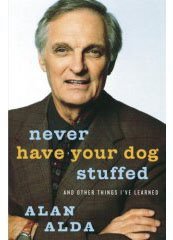
Never Have Your Dog Stuffed


Alan Alda is one of the good guys. He's always likeable when you see him perform (at least I've never seen him play the bad guy, which does not, I realize, mean that he has not done so). He always seems like the next door neighbor you'd like to hang out over the back fence and chat with.

It's delightful to read this book and discover that it reads the same way we've all known Alda from his performances and his guest show appearances.

This is not your typical Hollywood biography, written in chronological order and filled with tidbits about other celebrities. This is a very personal story which reads like memories that pop into his head and are written down as they come. The book grips you from it's opening sentence, "My mother didn't try to stab my father until I was six," and goes on to detail his extraordinary life growing up backstage in a bawdy vaudeville house.

Alda had a life-changing moment when he nearly died on a trip to Chile and it started the wheels turning to produce this delightful read, which he wrote without a ghost writer. Of all the books I read this year, I think I enjoyed this book the most.

Friday, December 23, 2005

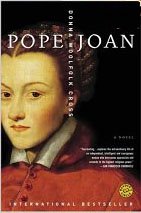
Pope Joan

I had heard about this book by Donna Cross before, but it wasn't until I was in Minneapolis with three friends, browsing through a book store, that they began raving about this story and I was intrigued, so bought the book.

It is a gripping story, and presents an intriguing question -- was there ever a woman in the Catholic church who was able to fool everyone and rise to the position of Pope?

The story is believable and held my interest, but even more fascinating was doing research on the "legend." Author Cross has done extensive research on the story, and on what she says is the attempt by the Catholic church to cover the whole thing up.

In doing my own internet research, I could see the scorn with which the church holds the theory that a woman could ever be pope. Frankly, I found Cross's research more compelling.

My strong recommendation, however, is wait to do your own research after finishing the book. I did it about 2/3 of the way into the book, to find out how it all ended, and it definitely ruined my enjoyment of the ending of the book.

Highly recommended book.

Thursday, December 22, 2005

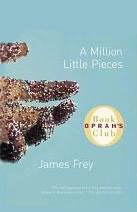
A Million Little Pieces

I only read 13 books (so far) in 2005, so I thought I would attempt to review them--and see if I can remember all the way back to January, when I read the first one ("The Magician's Assistant"). I'm going to start with the last one and work my way backwards.


A Million Little Pieces by James Frey is a book I probably would never have bought or even thought of reading if Oprah hadn't raved and raved and raved about it. How can you not be intrigued by a book that everyone in the audience agreed kept them awake all night reading until they finished.

It didn't do that for me, but it did hold my interest. If you want to get a hard-hitting, ugly, brutal feel for what it's like to be addicted and to recover from drugs and alcohol, this is the book for you.

If you love someone who is trying to recover from drugs and alcohol, this is the book for you, because it will give you a much greater appreciation for what the road back is like and why when you've made it through the first days of coming off the drugs, the work is just beginning.

The positive thing about this book is that James Frey wrote it, so we know that he was successful. If it were written as a biography instead of an autobiography, I think I would have been far more riveted to find out whether or not the man had achieved his objectives.

There are shocking revelations, amazing characters, triumphant and very sad stories in this book. All are made more compelling because they really existed. They really succeeded, or not, as Frey presents them (though all identities are hidden, of course).

I have long said that Alcoholics Anonymous is our family "club," rather than the Kiwanis or Elks club or anything else, since I come from a long line of alcoholics. Fortunately, I don't think there were any hard core drug users that I knew (or know) well, though undoubtedly there are some. So I could relate to the book on a familial level.

In this day when methamphetamine addicts are born every day and that drug is ruining families and lives, I think this is an important book for everyone to read.

1/6/06 post script: even if the book is a work of mostly fiction (as is now alleged), it's still a good book to read to get a sense of what drug addiction and recovery is like.

Tuesday, December 20, 2005

Jacob Marley's Christmas Carol

“And now you know the rest of the story,” as Paul Harvey would say.

Most people are familiar with the story of Ebenezer Scrooge and the transformation which takes place in his life one Christmas Eve, following the visit by his former partner, Jacob Marley, who appears before Scrooge, wearing “the chains he forged in life,” to warn Scrooge that he will be wearing his own chains, if he doesn’t quickly do something to repent.

When you think about it, if Marley was as much of a curmudgeon as Ebenezer Scrooge, it’s a bit out of character for him to be compassionate enough to warn his former partner and to offer him the opportunity for reform and redemption, isn’t it?

Ten year old Hazel Flowers McCabe, the daughter of director Terry McCabe, thought so. After seeing a production of “A Christmas Carol,”starring Tom Mula as Scrooge, she commented to Mula that she thought Jacob “got a raw deal,” helping Scrooge reform his life, but remaining in chains himself.

Mula, also a playwright, agreed with her and found the concept of looking at the incident from Jacob’s perspective so compelling, that, with apologies to Charles Dickens, he took it upon himself to write such a story. The result is “Jacob Marley’s Christmas Carol,” now being presented by Capital Stage at the Delta King theater, through December 24.

Like the Dickens version, Mula’s story was originally a book, published in 1995. The book became a best seller. An award winning PBS radio broadcast was presented and the story eventually made it to the stage, where it has quickly become a holiday favorite in theaters across the country.

This outstanding production at the Delta King, under the direction of Stephanie Gularte, features an unparalleled ensemble, which is second to none. The quartet act as both narrators and performers, each moving seamlessly from narrator to character, often seeming to melt into character mid-narration, dropping American accent for British so skillfully that one hardly notices it has been done.

In the title role is Davis’ own Harry Harris who gives an unforgettable performance. Harris is adept at handling any number of emotions, from that of the ill-tempered businessman to a man suddenly possessed by the exuberance of the Ghost of Christmas Present, to a grief-stricken child, reliving a painful past. When his tears flow freely, dropping onto the stage, you sense they come from very real emotion.

Jamie Jones gives a sparkling performance as the sprightly Bogle, a “malicious little hell sprite” who offers Marley one last chance to save his own soul. Jones manages to be funny, bitchy, and engaging all at once. She begins her relationship with Marley as a torn in his side (or, more accurately, a flea in his ear) and her affection grows for him throughout the play, though she attempts to hide it.

The amazing Lucinda Hitchcock Cone plays any number of roles, beginning with Hell’s recordkeeper, who, on going over Marley’s accounts points out that due to a lifetime of selfishness, he can expect a very unpleasant eternity.


Rounding out the ensemble is Miles Miniaci as Ebenezer Scrooge, whose own story takes a back seat in this production. Miniaci’s angular facial features add to the effectiveness of the portrayal as the actor presents the qualities of the Scrooge we have all come to know -- the blustering curmudgeon, the simpering man discovering the reality of his life, and the joy of a born-again philanthropist. Miniaci handles all emotions with aplomb.

Jonathan Williams’ set design presents no actual set pieces, but several levels on which the actors play. In one scene, Marley and Scrooge climb to the highest point from which they move together to appear to “fly” over London. In another, the recordkeeper seems to grow before our very eyes, with the assistance not only of the set, but also the lighting design of Stephen Jones. Bogle perches on a tall platform to be visible to the audience, while really being a tiny thing hidden in Marley’s ear.

Like the story which sparked this spin-off, Jacob Marley’s Christmas Carol takes us on an emotional ride toward redemption, and for those who know the original inside and out, this first rate production of Tom Mula’s companion piece may be a wonderful change of pace way to usher in the holiday season.

Saturday, December 10, 2005

Christmas Story

It was 25 years ago, in December of 1985, when a group of theater folk in Winters, with $37 to their name, decided to put on a show. This led to the founding of the Winters Community Theater, which, 25 years later, has 131 productions under its belt. More than 900 people have been involved in WCT shows, either on stage or behind the scenes, over the past 25 years. In many cases this may involve several generations of a family..

The Winters Community Theater is never going to make any splash in any big theatrical arena, but you couldn’t find more pride or more sincerity in a group anywhere. From the big smiles and hearty welcomes that patrons receive, to the cheesecake and champagne served on opening night, to the great support that the audiences give to the cast on stage. Opening night audiences seem to be comprised mostly of friends or relatives of the cast. It’s like the Davis Comic Opera Company in its early years, and it’s a real feel good night of theater.

I had never heard of the Winters Community Theater before I became a critic, but in the past five years I have seen many productions, some better than others. I had been warned that the current production, “A Christmas Story” was “a little rough still,” so I was prepared for anything.

To my delight, this production of Jean Shepherd’s delightful Christmas classic is one of the better productions I’ve seen from this company. With 19 characters, played by 12 actors, seven of whom are children, this may be one of the larger shows presented by this company. Director Howard Hupe has made some excellent casting choices.

Mark Dahn, in the role of the adult Ralph was a joy to watch as the play progresses. The adult Ralph acts as the narrator of this story about one special Christmas memory from his childhood, a child of the 1940s. Dahn was fine as the play began, but as his rapport with the audience grew, he relaxed in his part and was delightful to watch.

Brandon Emery was perfect as the 9 year old Ralphie, the boy whose one dream for Christmas was an official, Red Ryder, Carbine-action, 200-Shot, Range Model, Air Rifle. Brandon fantasizes meetings with Red Ryder himself and campaigns to convince his parents to get him the rifle for Christmas, though his mother (Gina Wingard) poo-poo’s the idea with every mother’s perennial excuse, “You’ll put your eye out.”

Wingard flawlessly portrays a wife and mother of the 40s, constantly putting on her apron, cooking dinner for her family, showing she’s really smarter than her husband, while at the same time making her husband feel the head of the household, though it is really she who runs the place.

Trent Beeby is Ralphie’s father. This “Old Man” is straight out of a 50s sitcom, in the best tradition of an Ozzie Nelson, a man who is head of the household, but who still can’t quite get it right most of the time, whether it’s the house furnace, or car problems, or the dogs next door who are out to get him.

Ralphie’s younger brother, Randy (Loren Tolley) is cute as a button, with terrific facial expressions. and a comfortable stage presence. When Mother wraps him up in many layers to go out and play in the snow, he looks like a character out of SouthPark.

Ralphie’s best friends, Flick (Tommy Halbach) and Schwartz (Andrew Gonzales) may have been a bit stilted in their line delivery, but it more came across as the way that a group of 9 year olds might have interacted with each other. Halbach is particularly funny in the tongue-on-the-light pole scene.

Lauren Hupe is Esther Jane, with a huge crush on Ralphie. Lauren and her sister (I assume), Elaina, are third generation Winters Theater actors, doing a good job of carrying on the family tradition.

Helen (Olivia Orosco) is another classmate, having the opportunity to perform on stage with her father, Rodney Orosco, a Big Elf in the Santa scene.

Cori Beeby’s height makes her an imposing bully to the shorter boys, though with her hair tucked under her hat, she easily passes for a boy.

Jim Hewlett plays several roles: Santa Claus, The Cowboy, the Tree Lot Owner, the Delivery Man and the Neighbor. He is best as the cowboy in the conversations with Ralphie.

Additional children in the cast are Elaina Hupe, William Halbach (another third-generation actor) and Trichelle Leslie. Ralphie’s teacher is Joann May.

Howard Hupe has directed this delightful Christmas pastiche. It’s a bright, witty script and the cast delivers it well. It’s worth the trip out to Winters to get your holiday season started with an classic story told lovingly by this dedicated group of thespians.

Friday, December 02, 2005

A Christmas Carol

What better way to usher in the Christmas season than with a production of “A Christmas Carol” or two? If you’re only going to see one version of “A Christmas Carol” this year, it should definitely be the production currently entertaining audiences at the Sacramento Theater Company, directed by Philip Charles Sneed, through December 24.

This musical adaption of the Charles Dickens’ classic was written by Richard Helleson and then-STC resident composer, David de Berry and orchestral “reconstruction” by Gregg Coffin. With a cast of 39, this is a holiday extravaganza certain to add a sprig of holly to the hardest of hearts.

This play is structured so that narration, straight out of the pages of the original, overlaps with the action, and the narration is delivered by actors who also move the set pieces around the stage as they verbally set up the next scene. The music is not intrusive, but adds just the right touch at just the right moment. The accompaniment is pre-recorded.

The utilitarian set designed by UCD graduate John Klonowski (with complementary lighting by designer Victor En Yu Tan) is gloomy, as befits a ghost story. There is just the right touch of fog to make it look spooky without engulfing the actors, which happened last year.

New to the Sacramento Theater Company is Richard Farrell in the role of everybody’s favorite curmudgeon, Ebenezer Scrooge. Farrell is fresh from eight seasons at the Oregon Shakespeare Festival and gives Scrooge just the right touch--just enough grit and growl without being over the top. His transformation at the conclusion of the story is delightful.

As Jacob Marley, Scrooge’s long-dead partner, David Silberman is a marvelously ghastly ghost, rattling his chains and issuing dire warnings to his old friend, as he tells Ebenezer that he will be visited by three ghosts who will try to help him see the mistakes he has made throughout his life.

(Aside: Marley says they will come every night for 3 nights at 1 a.m....however, it appears that they all come in one night, since the action begins on Christmas Eve and ends Christmas morning. However, I quibble.)

Suzanne Irving, another member of the Oregon Shakespeare Festival, appears as the Ghost of Christmas Past, an ethereal looking wisp of a thing to guide Scrooge through the happier moments of his early life, as a child in boarding school (played by either Aubrey Harwell or Dylan Sneed). As Ebenezer watches his young sister Fan (Paige Silvester, repeating the role she played a year ago) singing “Home at Christmastide,” there is a brief softening of his heart as he remembers the young beggar child (Rebecca Scott) whom he shunned the day before. (Scott has a wonderfully strong voice as she opens the show with “Advent Carol.”)

Scrooge visits himself as a young apprentice (Matt Moore) to the ebullient Fezziwig (J.T. Holmstrom, who appears later as the Ghost of Christmas Present), and as the young man whose burgeoning love of money forces a break-up with his beloved Belle (Maggie Roesser, who later also plays Martha Cratchit).

Davis audiences will recognize Ebenezer, the young man, as Andrew Conard, who has delighted Acme Theater audiences for several years.

Holmstrom returns as the jovial Ghost of Christmas Present and accompanies Ebenezer to the home of his nephew (Michael Claudio), a man of modest means but whose heart seems full of love for every, even his miserly uncle.

At the home of his long-suffering clerk, Bob Cratchit (Allen Pontes) and his wife (another role for Suzanne Irving) Ebenezer has another tug at his heartstrings as he watches the crippled Tiny Tim (Christian Salmon). Others in the Cratchit family are Corey Porter as Peter, Alena Rose as Belinda, Aubrey Harwell as Edward, and Roesser as Martha.

The funereal Ghost of Christmas Yet to Come (Thomas J. Engstrom) doesn’t say much, but makes a lasting impression.

Charles Dickens described the holidays as “a good time: a kind, forgiving, charitable, pleasant time: the only time I know of in the long calendar of the year, when men and women seem by one consent to open their shut-up hearts freely, and to think of other people below them as if they really were fellow passengers to the grave, and not another race of creatures bound on other journeys.”

As we move forward through this holiday season may we, like Scrooge, take those words to heart and be a little more kind, a little more forgiving, and a little more loving toward those around us.

Sacramento Theater Company’s “Christmas Carol” should be on everyone’s list of things to do to enhance their holiday spirit.

Thursday, December 01, 2005

Into the Woods

After all the hopes, the dreams and the plans. After years of stop and start progress and frustrating delays, Jan and Steve Isaacson finally welcomed Davis Musical Theater Company’s loyal audience to the first production in the new Hoblit Center for the Performing arts, at 607 Pena Street in Davis on Friday night.

There was the smell of fresh paint throughout the building, and places that still need to be painted or stained or carpeted. The curtains had only been hung the night before and the wrinkles were still falling out of the grand drape. The acoustic designer won’t get to work until everything is in place, but the show must go on, and go on it did.

“Into the Woods,” with music and lyrics by Stephen Sondheim and book by James Lapine, was the opener. Sondheim shows are not necessarily easy under the best of circumstances and I fully expected there would be lots of glitches with this opening night performance and was prepared to be forgiving because of all the work that the company has been putting in trying to get the theater ready.

I was pleasantly surprised. If there were glitches, other than a couple of faulty light cues, I was unaware of them. The set, designed by Woodrow & IvyMoss, with its stark spiky trees for the forest and the traditional wagon sets for Cinderella’s home (later the palace), the home of Jack (of Beanstalk fame), and the bakery where the baker and his wife long for a child were perfect for the Hoblit stage. (And the scene change from houses to forest was great!)

The DMTC orchestra, under the direction of Erik Daniells, now has its own pit and the difference in sound was amazing. I’ve never heard them sound better.

There will be some adjustments that will have to be made as the performers learn how to project out over an orchestra rather than one which is backstage on a platform, as it has been for years. Some of the actors handled this change better than others. Most could use a bit more oomph in their delivery for spoken lines.

However, that said, this is a good production.

“Into The Woods” was Stephen Sondheim’s attempt to prove that not everything he wrote had to be heavy, loaded with gloom and doom and psychological undertones, and that he could also write light hearted material.

Act One weaves together the stories of many familiar tales from our childhood. Cinderella (Rosie Babich) sits at home with her stepmother (Monique McKisson) and two stepsisters (Dannette Vassar and Stacia Truesdale), longing to go to the Prince’s ball.

Next door, Jack (Steven Ross) and his mother (Jannette Kragen) are arguing over selling Jack’s beloved cow, Milky White (playing herself).

Rounding out the families is the Baker (Ryan Adame) and his wife (Kristen Wagner), who are disappointed that they have not yet conceived a child.

Into the mix comes Little Red (Jocelyn Price) on her way to bring goodies to Granny (Melissa Tolley). There are a couple of princes, Cinderella’s Prince (Bob Olson) and Rapunzel’s Prince (Ryan Favorite). And of course Rapunzel is there too (Jessica Hammon) along with the witch who is keeping her captive (Marguerite Morris). Binding it all together is Steve Isaacson, as the Narrator

It is an excellent cast with few weak performers. Those who rise above the rest are Price, whose Little Red is energetic and cute as a button. Babich as Cinderella gives an outstanding performance, as do Adame and Wagner, as the Baker and his wife. Both princes have strong voices and are quite regal on stage (well, perhaps except for that rolling around on the floor in an illicit encounter business).

Marguerite Morris gives her usual first-rate performance. She is at her best when singing, but needs to work more on projection in her spoken lines.

Melissa Tolley is the offstage voice of the wife of the Giant that Jack killed. It is unfortunate that some sort of amplification was not used for the voice. It should have sounded more scary.

Act 2 of “Into the Woods” shows us that there really is no “happily ever after,” and many characters meet horrible ends. However, for purposes of this production, they all died gloriously.

Director Jan Isaacson was beaming in the lobby after the show ended, saying “I just can’t believe we’re finally here.” After all this time, she must feel like she is living her own kind of fairy tale. It is this reviewer’s hope that, unlike most of the characters in “Into the Woods,” the Davis Musical Theater Company has finally found its “happily ever after” and that they, along with their loyal patrons, can enjoy it for years to come.

Monday, September 19, 2005

Cabaret

Between 1929 and 1933, Christopher Isherwood lived in Berlin, which formed the backdrop for stories he wrote on his return to London, published as “The Berlin Stories.”  One such story, that of writer Clifford Bradshaw and cabaret singer Sally Bowles was dramatized by John Van Druten as the play, “I am a Camera” (later made into a movie). 

In 1966, John Kander and Fred Ebb won a Tony with their musical version, which they called “Cabaret.”  The musical, of course, was made into a very popular film vehicle for Liza Minnelli and Joel Gray in 1972. 

In 1993, director Sam Mendes revived the Kander and Ebb musical for his cabaret theater and gave it a darker, harder edge, emphasizing the decadence of the period.  By the time the show moved to Broadway, where it enjoyed another successful run, the production, while still maintaining the darker feel, had lost a bit of the “edge” that it had in the smaller venue.  The tunes were so familiar to the American public that it was difficult to keep them down for two hours.

The Davis Musical Theater Company opened its 2005-2006 season with the Kander and Ebb version of “Cabaret” this weekend.  It was to have been a gala opening at the new Hoblit Theater on Pena Drive, but again there have been delays, and Cabaret opened once again at the Varsity Theater.

Set in Berlin in 1930, just before the Nazis come to power, the action takes place at the Kit Kat Club, a seedy nightclub where one goes to escape the reality of life.  “Leave your troubles outside,” invites the Emcee (Ryan Adame).

While not actually a part of the story itself, the Master of Ceremonies (“Emcee”) is the unifying character that brings all of the action together and Ryan Adame is perfect in the role.  With a garish white clown-ish face and lascivious manner, he commands attention.

Cliff Bradshaw is played by Ryan Favorite, last seen as Lun Tha in “The King and I.”  While we caught a hint of Favorite’s talent in “The King and I,” he really gets to shine in “Cabaret.”  The character of Cliff has gone through many permutations over the history of this story, being heterosexual, homosexual and bisexual, depending on the particular version or the decision of the director.  Director Steve Isaacson’s Cliff is unquestionably heterosexual and the chemistry between himself and Sally Bowles (Jessica Hammon) is real and believable.

Hammon is a bubbly Sally Bowles with a huge smile.  Her British accent isn’t always spot-on, but she inhabits the character and has a terrific voice, especially when belting out the title song.  She needs to learn about stepping into the spotlight, however, as half of her big number was sung with her face in shadows.

DMTC veteran Mary Young delivers the kind of performance we have come to expect from her as Fraulein Schneider, who runs the boarding house where Cliff takes up residence.  Frau Schneider has a larger role to play in the stage version of this story and her romance with her boarder, Herr Schultz (William Hedge) is very tender, especially in their lovely duet, “Married.”

Hedge is making his DMTC debut, and is very good as the old Jewish greengrocer whose heart is given to his landlady.  He gives special bits of fruit as if they were diamonds.

Heather Sheridan, the boarder who has a lot of “gentleman callers” has some projection problems, but otherwise does a good job.

Michael Manly, in his return to DMTC after a 9 year absence, is quite good as Ernst Ludwig, the German smuggler who befriends Clifford.

Wendy Young makes a fetching Gorilla (in “If you could see her through my eyes”) and Robert Coverdell sings a smashing rendition of “Tomorrow Belongs to Me,” the bone-chilling song that epitomizes the rise of the Nazi Party.

Michael Miiler is the choreographer for this show, with lighting design by Isaacson and Dannette Vassar.

Jeannie Henderson did her usual outstanding job of costume design.  The gown for Sally’s closing number was spectacular.

Cabaret is an entertaining evening of theater which, everyone hopes, is REALLY the final DMTC show to be presented on the Varsity Theater stage.


Sunday, September 18, 2005

Best of Broadway

If “Best of Broadway” (which opened in Sacramento at Luther Burbank School) were to hand out “the show must go on” awards, I would nominate Lou Parell in a heartbeat.

It was Act 2. We had already watched a rousing opening number, “Happy,” from “Grand Hotel” and a section called “Broadway’s Latin Suite,” a salute to Latin music in Broadway musicals.

The tone changed and a section featuring songs from “Napoleon” began. Lou Parell had just stepped into a pool of light, dressed as Napoleon, and he began the dramatic, “The Dream Within,” when pinpoint lights started flashing on the walls around the house and an obnoxious honking sound began going on and off.

At first we weren’t sure if it was part of the show or not, this being such a varied show with all sorts of different moods, but then someone said something about a fire alarm and ushers were coming down the aisle telling us we had to evacuate the building. Parell sang through it all, to the end of his song, even though the theater was empty.

While we milled around outside, someone told me that the rumor was that either one of the children in the cast had pulled the fire alarm in the bathroom, or the stage smoke had set it off (though I didn’t notice much stage smoke). Some members of the cast, still dressed in zoot suits from the Latin suite, were standing on the sidewalk yelling “Don’t leave! There will be more!”

Twenty minutes and three fire engines later, we were back inside the theater watching Parell pick up where he left off, in a touching duet with Marji DuBois while Jen Kern and Gerardo Martinez performed a dance duet.

This had been an evening already plagued with microphone problems. Marlee Hernandez, who started out beautifully in “Teenager in Love” from “Return to the Forbidden Planet” lost the sound in her mic shortly into her number, which was a shame, since she had a lovely voice (displayed in the opening number, “My Night” from “Closer to Heaven.”)

Likewise several children who had solos in “I Know” from “Children’s Letters to God,” the rousing first Act finale were unable to be heard because one of the four microphones was dead, which must have disappointed the audience full of family and friends. Other microphones popped and sizzled throughout much of the show.

Despite the problems, however, Best of Broadway, in this year’s extravaganza, “Light Up the Night,” has delivered another enjoyable evening showcasing some of the finest talent Sacramento has to offer.

Best of Broadway was an idea conceived by David L. MacDonald in 1973 as a way to raise money for a local boys’ home. Thirty-three years later it is still under the direction of MacDonald and still raising funds for local charities.

After 33 years, this may not exactly be the “best” of Broadway (with obscure musicals such as “Closer to Heaven,” “Down River,” “The Card,” “Feel It,” “Children’s Letters to God,” and the aforementioned “Napoleon” (which opened in 2000 in London to mostly negative reviews and closed after 16 weeks), among the old favorites like “West Side Story” and “South Pacific,” but it was an extravaganza nonetheless.

Choreographers Terri Taylor-Solario, Diana Ruslin and Kat Bahry have done an outstanding job of blending dancers with non-dancers and having all look spectacular. Bahry, who was able to get some 75 children to perform such complicated synchronized dances, deserves special kudos.

Musical director Dan Pool, choral director Aaron Clemens and children’s choral director Enrique Ruiz deserve credit for the enthusiastic musical performances.

Sign language interpreters Cristie Pell and Kathy Jackson gave their own performance, nearly as entertaining as what was going on on stage.

This was an edgier “Best of Broadway.” Gone are the sequins and glitter and in their place are costumes (coordinated by Cathy Carpenter and Joan Pohlman) which look like they may have come from Britney Spears’ discard bin. Lots of cut-off jeans, bare midriffs, net stockings with holes in them, tattoos, and leather, all of which worked well for the salute to “We Will Rock You,” with the outstanding “We are the Champions,” led by the powerful Dewight Mitchell.

As the cast assembled on the stage and in the aisles to perform the finale, “Give My Regards to Broadway,” from “George M,” I wondered what George M. Cohan would have thought of the look of inner city urban blight, and decided that given the enthusiasm of the performances, he would have loved it.

Best of Broadway continues through October 1, with a 7:30 curtain. Even with a fire drill and 50 musical numbers, you’ll be out by 10:30.

Thursday, August 18, 2005

After the Falderal

What do cigarettes and “nunzilla” (a wind-up nun who walks around with fire shooting out of her mouth) have in common? They are the thread that holds together the relationship of Billy and Jane through the years, from high school into adulthood.

Billy (Sam Tanng) and Jane (Dana Snyder) are the characters in a two person piece called “After the Falderal,” (created by Tanng and Snyder) the third offering by the Fat Cow Theater Festival at The California Stage in Sacramento.

Is “After the Falderal” a play? a dance? a multi-media piece? experimental theater? a drama? a comedy?

Yes to all questions. This delightful one hour, two act piece begins as a play, then becomes a dance, and then includes some other media as a sort of a set dressing.

While it has no actual plot, it does follow the couple from high school through their on-again, off-again relationship, all held together by compulsive smoking and the role “Nunzilla” plays in that bad habit, and in their relationship itself.

There are some delightful moments, particularly Billy’s description of college life in Act 2, with the assistance of some props, which had the audience giggling.

Ironically, as one enters the theater, there is a sign, prominently displayed over the door, which says “No Smoking.” It is ironic, since the first thing the characters do as the lights come up is to light up (herbal) cigarettes and fill the air with smoke. They continue to smoke, both literally and figuratively, throughout the piece, since the theme of smoking is what binds them together. The depiction of chain smoking in Act 2 is particularly funny.

Tanng and Snyder are strong, experienced performers who can tell a story as well with body language as they can with words. Snyder’s scene about breaking up with Billy is very effective, without saying a thing.

A scene in a museum is both funny and touching, as Billy attempts to help Jane to understand a piece of artwork they are viewing.

As with all three works of this theater festival, the stars are also the manual labor, and so Snyder was at the door selling tickets and refreshments in a nice business suit before changing into her flimsy costume for the play. At intermission, both Tanng and Snyder donned the black ensemble of a stage crew (black pants, black shirts, black hats) to sweep up the stage and rearrange the set, before changing back into their character costumes (Tanng has cornered the market on colored bib overalls). One of them probably would have run the lights too, if they could have done it without waking through the audience to get to the light booth.

“After the falderal, nothing is quite the same again,” says Jane, in a reflective moment, a statement that rings true for all of us.

There are three more performances of After the Falderal, the 20th, 21st and 26th, playing in rotation with “American Chippendale” and “James McKinley.”

This has been an ambitious and promising start for this fledgling theater festival, and one hopes to see more from the company next summer.

Sunday, July 31, 2005

Once in a Lifetime

“Once in a Lifetime,” by Moss Hart and George S. Kaufman, the latest offering by Acme Theater Company, at the Veterans Memorial Theater, is a huge show. There are some 84 characters listed on the program. Some actors play more than one role, but there is still a dizzying number of actors.

In his director’s notes, Director Dave Burmester explains that more than one-third of the cast is new to the company and more than half the cast has been in no more than two Acme shows. This would explain the unevenness of the performances, a situation that was to be expected this year, with the company having lost so many experienced actors when they graduated from high school last year.

The leads in this fast-paced comedy are very strong; the supporting players need to work on projection and timing, something that will come as they get more experience under their belts, if Acme history is any indication.

This is also a huge show with respect to sets (designed by Burmester), some of which are very large, unwieldy pieces, difficult to move around the stage, which slows the pace of the show many times. Thought should also have been given to better placement of the blacks backstage, as actors can be seen waiting for their entrances.

That said, however, let’s look at the good. This very funny three-act satire takes place in the early days of the motion picture industry, just as Al Jolson’s “The Jazz Singer” has revolutionized the business by making movies talk and creating an instant need for people who are ready and able to jump into the new technology.

George, May and Jerry (Dara Yazdani, Maddy Ryen, and James Henderson) are out of work vaudevillians, down to their last $158 with no prospects for work in sight. Jerry convinces his partners to go to Hollywood to seek their fame and fortune.

James Henderson’s performance as Jerry fairly sizzles. Jerry is the money man, the idea man, the one who has the enthusiasm he wishes to impart to his partners. Henderson has the energy, the pacing, and the comic timing that the role requires and he’s very good.

Dara Yazdani’s laconic performance as George is perfect. George is a good-natured but rather slow-witted guy who becomes the most influential man in Hollywood through a series of lucky coincidences. Yazdani has a dry wit that gets the most out of the humor in his lines.

Maddy Ryen is the tough-talking practical May, in love with Jerry. Her character has some of the funniest lines, which Ryen delivers in a sardonic, deadpan manner. May finds little to bring excitement to her life.

Betsy Raymond as the gossip columnist Helen Hobart was marvelously over the top and a delight.

Madelyn Ligtenberg as Susan Walker, the ingenue who comes under George’s wing, was suitably marginally talented, the girl who wants to be a star, but doesn’t quite have it. Ligtenberg ably brought those characteristics to the role.

Marianne Lagarias is Susan’s mother, a somewhat clueless woman who never changes her costume and who tags around after Susan, not quite sure why she’s there. Lagarias does a good job.

Andrew Conard gave a strong performance as Herman Glogauer, the head of the studio, his performance reminiscent of a young Howard Hughes.

Anthony Pinto was hilarious as the manic director Rudolph Kammerling, the stereotype of every foreign-born director who has ever been characterized in film comedies. He never failed to elicit laughs from the audience.

Julieanne Conard and Laura Flanigan are Phyllis Fontaine and Florabel Leigh, two silent screen actresses who are going to be out of work unless May’s school of elocution can refine their voices to be fit for audience ears. The two are quite funny.

In the small role of the cigarette girl, Rachel Cherones caught my eye. There was not enough substance to her character to really assess, but she had that “certain something” in her brief time on stage.

Costume designer Randi Famula did a great job in creating the feel of the 20's-30's, especially in the night club scenes.

This is not the strongest Acme production I’ve seen, but it’s an enjoyable one that is full of laughs and worth seeing.

Wednesday, July 27, 2005

Crazy for You

In 1930 Ethel Merman starred in the first production of the George and Ira Gershwin musical, “Girl Crazy,” the story of a spoiled New York rich kid who learns about life , love and everything else on a Nevada dude ranch.  In 1943, Judy Garland and Micky Rooney brought the story to the big screen, with choreography by the infamous Busby Berkeley.

In 1992, with the blessing of the Gershwin heirs, Ken Ludwig took another look at the old chestnut, did some extensive rewriting of the plot line, and produced “Crazy for You,” the story of a spoiled New York rich kid who learns about life, love and everything else in the sleepy town of Deadrock, Nevada.  The show won the 1992 Tony for Best New Musical and is this week’s Music Circus production, under the direction of James Brennan, with Choreography by Deanna L. Dys and musical direction by Dennis Castellano.

This is an old fashioned musical in every sense of the word, with predictable plot line (boy meets girl, girl dumps boy, boy finds a way to win girl back), lots of dancing, snazzy show girls, and those Gershwin songs anybody of a certain age will have known from their cradle: “Bidin’ My Time,” “Embraceable You,” “Someone to Watch Over Me,” “I Got Rhythm,” and “They Can’t Take That Away From Me,” for starters.

In a show like this, it is the cast which makes or breaks it and the Music Circus cast is a stellar one.  David Engel, in the role of Bobby Child is a two-time recipient of the L.A. Stage Alliance Ovation Award for best actor in a musical for his performance in this role.  Engel has the grace of Fred Astaire, combined with the athleticism of Gene Kelly.  His Bobby is a guy who is not going to be stuck under Mama’s thumb working in a bank, but wants to fulfill his dream of being a performer, and along the way it won’t hurt if he can dump his overbearing fiancee and find the love of his life.

Beverly Ward, as Bobby’s Polly Baker, has toured with “Crazy for You” and garnered a Helen Hayes nomination for best actress in a musical while playing Polly at The Kennedy Center in Washington, D.C.  She’s a feisty, independent woman stuck in a one-horse town, but determined to take control of her life.  Ward is also a talented dancer who is able to bring all that Ginger Rogers-esque grace to the stage.

While the story centers on these two, there is a fine cast of supporting players including Stephen Berger as Bella Zangler a famous theatrical producer in love with Tess (Joann Hess); Eleanor Glockner is Bobby’s indomitable mother, Lottie Child; Jessica Wright is Bobby’s overbearing fiancee Elaine; Jim Bisom is the descriptively named Lank Hawkins, owner of Deadrock’s town saloon and in love with Polly; Sacramento News & Review film critic Jim Lane does an excellent job as Polly’s Dad, Everett Baker, hanging on to his deserted theater and remembering the glory days when his late wife graced its stage.

Costumes by Steven Howard and Bob Miller are dazzling, especially for the show girls.

Scenic designer Michael Schweikardt and Lighting designer Pamila Gray have created a wonderful look for this musical.  Especially noteworthy are the Broadway scenes, with theatrical marquees represented both by pieces lowered from the flies, and projected onto the walls.

“Crazy for You” is not a show that is going to force you to think, or present any political agenda, or make the audience uncomfortable with questionable lyrics or overly loud music.  But it will set your toe to tapping and leave you humming a tune or two as you leave the theater, and remind you of a simpler time when all a musical had to do was entertain.

Saturday, May 28, 2005

Much Ado about Nothing

It took director Dave Burmester 23 years to find the right cast to present William Shakespeare’s “Much Ado about Nothing.” It was well worth the wait.

Acme Theater company’s 23rd annual free Shakespeare in the Park opened Friday at the Davis Art Center Outdoor Pavillion. It was a delight from beginning to end. It’s a story of love, hate, betrayal and redemption. It features everything from witty repartee to brief tragedy to hilarious slapstick highjinks.

In keeping with Acme’s tradition of using non-traditional locales, this “Much Ado” was set in nineteenth century Bahia, which gave the opportunity for a few colorful Brazilian dance numbers, choreographed by Laura Yen and Mollie Hope.

“Much Ado about Nothing” is one of Shakespeare’s better known comedies tells the tale of two couples, Hero and Claudio, who fall in love at first sight and who must weather a test of that love; and Beatrice and Benedick, who have been foils for one another since childhood and need help realizing that their biting, sarcastic remarks to each other are really hiding a deeper romantic feeling.

In any young persons’ theater production, you expect to find outstanding performances and merely competent performances. However, with “Much Ado,” Burmester has found a consistently excellent cast, starting with Anthony Pinto, as Leonato, the Governor of Bahia and father to Hero. Pinto handled the transition from serious to comic very well.

Betsy Raymond as Pinto’s sister Antonia, has a small role, but makes the most of it, and is allowed to shine in an act 2 scene.

Genevieve Moreno as Hero and Scott Scholes as Claudio are a very sweet love-sick couple, whose romance is momentarily sidetracked by the nefarious Don John (Josh Toliver), bastard brother of Don Pedro, who despises Claudio and is determined to foil his union with Hero. Don John is only unlikable character in the play (though Toliver’s performance itself was again excellent).

Maddy Ryen sparkles as Beatrice, an intelligent, feisty woman with a quick wit, eager to trade barbs with Benedick, a lord of Ceara, played by Andrew Conard. Ryen and Conard have marvelous comic timing and good chemistry between them. Their scenes together sizzled.

Don Pedro, the Prince of Rio, was played by James Henderson, in another very strong performance.

Dara Yazdani was the highlight of the evening with his over-the-top Kramer-esque interpretation of the constable, Dogberry, wearing a helmet with an impossibly large feather. Yazdani is tall of stature, with a body that at times seemed to be made of silly putty. From the moment he marched on the stage, chanting “Left, right...left, right...left right” (while actually always marching Right, left...right, left...right, left), he was impossible to ignore.

Dogberry’s entourage, Verges (Fiona Lakeland), Virges (Laura Flanigan) and members of the watch: Ali Moreno, Julieanne Conard and Ernie Hernandez moved with the precision of Rockettes and were very funny.

Lesser roles included Tatiana Ray as Margaret and Randi Famula as Ursula, two of Hero’s “gentlewomen.” Eric Delacorte was Borachio and Jack Leuchars was Conrade--both followers of Don John, who convince Claudio that Hero has been unfaithful to him.

Nate Strickland was Friar Francis, who advises Hero to pretend to be dead in order to win back the hand of her beloved, Claudio. (This friar’s advice was more successful than that given to Juliet in a different Shakespeare play!)

Victoria Gimpelevich was a Sexton. Lisa Voelker was a Messenger. Randi Famula, Laura Flanigan and Tatiana Ray also doubled as dancers.

Set design by Eric Delacorte and David Burmester and set decoration by Karlee Finch created a sense of being in Brazil, while light and sound board operator Cristina Granada helped to complement the mood with Brazilian music. The “trees” for Leonato’s Orchard were great!

Costume design was by Randi Famula, whose costumes for Dogberry and the wedding attire for the women were particularly effective.

The Art Center is a delightful place for an open-air production (except for the occasional biker or rollerblader passing through the middle of the audience). Acme’s annual Shakespeare is its gift to Davis in thanks for the city’s support through the years. One could not ask for a more rewarding thank you, or a more delightful way to spend a pre-summer’s evening. There will be performances Sunday and Monday evenings at 8 p.m. Don’t miss the opportunity to see this little gem.

As You Like It

For twenty years now, Davis residents have been able to pack up their folding chairs on a warm spring evening and head to the Pence Gallery stage to watch the young actors of Acme Theatre Company present a well-rehearsed, polished, fully professional show. For free.

Shakespeare’s “As You Like It,” which opened on Friday night, is no exception. It would be hard to find a “weakest link.” While there are outstanding performances, the cast is uniformly excellent and it seems as if great care has been lavished on every aspect, from costuming to hair styles, to choreography, to the original music written (and performed) by Jessica Kitchens.

If there were to be any complaint it would be that the stage shares the air with train noises and the sound of the nearby air conditioner and cleanup at the garbage cans of Soga’s, which made it difficult to understand much of the dialog in Act 1, at least from the back of the arena, though the mics on the stage certain make a big difference over previous un-amplified years.

Director Dave Burmester, who likes to keep things fresh and new chose to set this production in 1803 in Alta, California, so the simple set reflected the adobe of a hacienda. The show opened (and closed) with the cast doing a flamenco or a tango, in the brightly colored costumes one might find at a Mexican fiesta. The choreography by Zoe Nutter and costumes loaned by the Davis Senior High School Ballet Folklorico (coordinated by costumer Emily Henderson) effectively created the proper mood from the start.

Burmester explains that “As You Like It” is a play about love: physical and intellectual love, sentimental and cynical love, love at first sight, love between friends, love between relatives, imagined love, and deep, lasting love. It is the roles we are often forced to play, either by circumstance or by societal pressure.

This joyous play concerns the lovely Rosalind's instant attraction to Orlando and their subsequent journey of love and confusion. Don Senior is living in exile in the forest while his sister, Dona Eleanora has usurped his dominions. Don Senior's daughter Rosalind is banished from Eleanora's court and travels to the forest in the company of her cousin Celia. Rosalind assumes a countryman's dress and takes the name Ganymede; Celia passes as Aliena, Ganymede's sister and they meet with Orlando who has joined the banished duke. Ganymede encourages Orlando to pretend to make love to her as though she were his Rosalind.

Eleanor van Hest’s Rosalind is a delight. She is a strong woman in total control of the stage. She and Catherine Curley, as her cousin Celia, light up the stage from their first entrance and they hold it firmly throughout the play.

Ben Pearl as Orlando was difficult to hear over the early night noises, but his performance was a solid one and he makes a dashing Orlando.

Emily Henderson plays both the haughty Dona Eleanora and the earthy sheperdess Corina with equal competence.

Chris Liaghat-Schmidt as the clown, Touchstone, who accompanies Rosalind and Celia into exile is delightfully droll and an outstanding performance of the evening, as is Zoe Nutter, in a gender-bending role of Jacques, the dour compatriot of Don Senior.

Jake Stoebel does double duty as Oliver, brother of Orlando, and Padre Diego, a drunken priest. Others in the cast playing dual rules include Steven Schmidt, who plays Carlos the wrestler in Act 1 and Don Senior in Act 2. The wrestling match between Carlos and Orlando was beautifully choreographed, and included a spectacular flip-over.

Alaina Boys was Senora La Bonita, in Act 1 and Audry, a country wench who catches the eye of Touchstone in Act 2. Nick Herbert was a courtier in Act 1, Luis, a compatriot of Don Senior and the delightfully lovestruck Silvius, who has lost his heart to Phoebe, played with wonderful humor by Caleigh Drane (who is also a courtier in Act 1). David Markman also carries three roles, as Dennis in Act 1 and both Juan, a compatriot of Don Senior, and Joaquin, another brother of Orlando, in Act 2. Dylan Myles-Primakoff is the servant Adam in Act 1 and William, a rustic, in Act 2.

Burmester has directed a lively production which keeps the audience entertained at all times, throwing in bits of swordplay, thanks to help by Simon Pitfield of the Davis Fencing Academy.

“As You Like It” is the perfect way to spend a spring evening. Bring your chairs or a blanket to sit on the lawn, bring the kids, bring a picnic and expect to spend a delightful evening.

Tuesday, May 17, 2005

Into the Woods

Into The Woods was Stephen Sondheim’s attempt to prove that not everything he wrote had to be heavy, loaded with gloom and doom and psychological undertones, and that he could also write light hearted material. He succeeded--half way.

A production, with book by James Lapine, music and lyrics by Sondheim, opened this weekend at Wyatt Pavilion, produced by Studio 301.

Act One of Into the Woods is the “happily ever after” portion, where Sondheim and Lapine blend several familiar fairy tales – Cinderella, Jack in the Beanstalk, Little Red Ridinghood, Rapunzel, and The Baker and His Wife central among them. Each is dealing with a problem--Cinderella wants to go to the King’s festival, Jack and his mother need money, the Baker and his wife wish for a child, and Little Red Ridinghood wants to go to Grandma’s house. Throw in a witch and a mysterious stranger and a bit of magic and by the end of Act 1, everyone is living happily ever after. Or so we think.

But does anyone ever live happily ever after? Sondheim reverts to type in Act 2, with murder, destruction, agony, and enough melancholy to satisfy the most ardent of Sondheim fans.

There are strong performances in this production from actors who appear to be trained singers. Then there are the trained actors who also happen to sing and here the results are sometimes less than perfect, and in one or two cases downright painful to the ear, as notes are sung out of the singer’s register and at least one performer seemed to have trouble staying on key. Sondheim’s music is very tricky and may have been a bit ambitious some of the performers. It may also explain why there didn’t seem to be a lot of sparkle to the production.

Studio 301 is a student drama group, unaffiliated with the university’s Theater and Dance Department. In answer to the question “Why doesn’t Studio 301 do musicals?” producers Katie Baad, Molly LeGoy, and Syche Hamilton, with the assistance of a generous donor, purchased the rights to the Sondheim musical.

A company statement reads, “The production team has continued to expand, bringing on students of different backgrounds and strengths as we have learned what is necessary.
While we base our system on that which we know best - the UC Davis Theater and Dance Department - it still has taken trial and error for us to become the team we are today...and we expect to further shape ourselves as we move through the stages of production.”

With that explanation, Into the Woods has its strengths and it has its weaknesses, but it makes one want to follow the progress of Studio 301 as they continue to shape themselves.

Performances worthy of note are John Mothershead as the Baker and Jennifer Nelson as his wife. David Sawyer was a good Jack, with fun comic relief by Drew Phillips as his cow, Milky White. (Phillips also doubles as Red’s granny.)

Katie Baad was outstanding as Little Red Ridinghood, with a strong voice and commanding presence and Anna Rozzi was a scary witch.

Carter Mills was a lovely Rapunzel, while the two princes, Mario Castro and Jeffrey Frieders (who also plays the wolf in act 1) were wonderfully droll.

Brian Turner held things together nicely as the narrator. He also played the “mysterious man.”

Others in the cast include Molly LeGoy as Cinderella, Chelsea Kashin as Jack’s Mother, Casey Ledwith as Cinderella’s Stepmother, Natasha Tavakoli and Rosa Threlfall as the ugly stepsisters, Joe Ferreira as Cinderella’s father, Alissa Steiner is the Giant.

Director Syche Hamilton has handled the difficult structure of the Wyatt Pavilion stage well, with excellent use of the theater’s many levels, including placing the orchestra behind a curtain, their image projected on the back of the theater, to allow the performers to follow musical director Philip E. Daley.

Scenic Designer Chris Allison created a lovely fairyland, sparse enough to prevent the scenery from obscuring the view of the patrons in that always-difficult theater, but rich enough to set the scene. I particularly liked the way they handled Red Ridinghood’s grandmother’s house and her demise.

Allison’s design was nicely complemented by the lighting design of David Goldin.

Costumes by Molly Legoy and Lynly Saunders were quite good. My particular favorite was the costume for the wolf, vaguely in the vein of Julie Taymor’s Lion King (the look was less effective for Milky White)

Into the Woods is an ambitious project for this student company but the end results are very promising. It is definitely an enjoyable evening, though the production is not without its flaws.

Monday, May 09, 2005

Man of La Mancha

...and when she was good
she was very, very good...

Director Jan Isaacson’s production of the Davis Musical Theatre Company’s Man of La Mancha, which opened Friday at the Varsity Theater, is very good.

The Broadway hit, by Dale Wasserman, with music by Mitch Leigh and lyrics by Joe Darion is a musical drama, a play within a play within a play, which tells the story of Miguel de Cervantes, thrown into prison while awaiting examination by the Holy Inquisition for having the effrontery to foreclose on a church which had not paid his taxes.

Cervantes' fellow prisoners hold their own Inquisition, a mock trial, accusing the writer of being, among other things, an idealist and a bad poet. If "convicted," he will lose his belongings, which consist primarily of a trunk of theatrical costumes and props, and an unfinished manuscript. In his defense, the author proposes he act out the story of the manuscript, using other prisoners to fill in the roles.

It is the story of Alonso Quijana, an idealistic old man who imagines himself to be living in Medevial times as an errant knight, Don Quixote de La Mancha, who travels the countryside fighting beasts and rescuing damsels in distress. "He ponders the problem of how to make better a world where evil brings profit and virtue none at all; where fraud and deceit are mingled with truth and sincerity." He promises not to allow wickedness to flourish. The delusional Quijana is an embarrassment to his respectable family.

Without a commanding Cervantes, you have no Man of La Mancha, and in newcomer Byron Westlund (who played this role at Cabrillo Stage in Aptos), Jan Isaacson has hit a goldmine. He is tall, rugged and stately. He has a rich baritone and is an excellent actor. What more could one want?

As Sancho Panza, Cervantes’ manservant, Ryan Adame gives the character a boyish enthusiasm that is endearing.

Quixote sees things as he wants to see them, not as they really are. Thus a windmill becomes a giant beast to be attacked, a country inn becomes a castle, and Aldonza, the serving wench and town whore, becomes the lovely "Dulcinea," a fair lady whom Quixote insists on treating with dignity, gentleness and respect and becomes her protector.

Lauren Miller is a world-weary, jaded Aldonza, confused by the eyes through which Quixote sees her. Miller had a bit of trouble with her high notes, but otherwise gave a strong performance. Her rape scene was disturbingly effective.

Other noteworthy performances were Steve Isaacson as the “Governor” of the dungeon, who doubles as the innkeeper who agrees to make a knight of Quixote and gives him the name “Knight of the Woeful Countenance.”

John Hancock gave a high-powered performance in the dual roles of the Duke and Dr. Carrasco who, with J.D. Diefenbacher as The Padre, Dannette Vassar as the Housekeeper, and Emily Beal as Antonia sings the delightful “I’m only thinking of him.”

Ben Wormeli is the on-stage guitarist.

The ensemble is strong, and particularly lovely in the harmonies for the gentle “Little Bird, Little Bird.”

Set design by Steve Isaacson exhibited better production values than the usually-struggling company is sometimes able to afford, and the lighting (also designed by Isaacson and run flawlessly by first-time technician Julie Kuhlman) dramatically set the scene of an underground dungeon, with a window at ground level through which fog can be seen. The lighting is particularly dramatic when steps are lowered to permit new prisoners to enter the dungeon.

Long time company costumer Jean Henderson turned out her usual collection of good-looking costumes, appropriate to the period.

The fifteen-piece backstage orchestra produced a full sound that made a nice accompaniment to the on-stage action.

Man of La Mancha continues at the Varsity Theater through May 29.

Monday, May 02, 2005

The Lion King


There’s no doubt about it – The Lion King is one impressive spectacle. The opening number alone is worth the price of admission.

The Sacramento Community Theater underwent massive revamping for this touring production of the Tony-award winning version of Walt Disney’s popular cartoon. Two new aisles have been created by removing 4 seats in each row, from the stage to the back of the house, giving room for characters to enter from the back of the theater. Two of the performers also begin the show in the balcony, thus putting the entire audience squarely in the middle of the action.

As the opening number, “Circle of Life,” sung by the wise old baboon Rafiki (Gugwani Dlamini) unfolds, the stage gradually fills with wildlife. Antelope jump, birds fly, giraffes stroll magnetically, cheetahs walk cautiously, zebras prance, an elephant lumbers onto the stage, followed by her baby and, as the gigantic sun rises the audience is transported to some African savannah and the story begins.

The story of The Lion King, by Roger Allers and Irene Mecchi can really be described as “Hamlet on the Savannah”: the young prince whose father is murdered by his brother, the son’s angst and guilt, the father becoming a larger in life figure after death, his ghostly counsel giving the son courage to return to avenge his father. The comic relief characters of Timon and Pumbaa.

But the Shakespeare analogy fades into the background when confronted by such a feast for the senses. The Lion King relies more on costume and spectacular lighting design (by Richard Holder) than actual set pieces, and so the show is equally as impressive in a touring company as it was when I saw it in London.

Director Julie Taymor (the first woman in Broadway history to win the Tony award for Best Director of a Musical) also designed the costumes, which are an integral part of this show’s appeal. Faced with the task of bringing a cast of animals to life, she chose to make the human actors actually part of the animals themselves, without losing their “humanness.” And so it is that animal and human blend together so seamlessly that one is able to believe in the “animalness” of the characters.

This production features an outstanding cast. Dlamini is fresh from the London production and gives a broad performance that fills the hall. Rufus Bonds, Jr. comes from the Los Angeles production, where he also played Mufasa. He has perfected the moves of a big cat and his love for his young son is a touching thing to see.

Khaleel Mandel Carter was outstanding as young Simba, with high energy, yet convincing in this tender moments with Mufasa.

Larry Yando as Scar, the lion you love to hate, was appropriately haughty and dislikeable, as were hyenas Shaullanda LaCombe, Melvin Abston and Robbie Swift.

Derek Hasenstab added comic moments, as Zazu, the king’s right hand hornbill. He had some of the funniest lines in the show.

Phil Fiorini as Pumbaa and warthog and Damien Baldet as Timba, the Meerkat were very funny and were especially valuable in giving some substance to Act 2.

I suppose it’s sacrilegious to criticize this popular show. The music by Elton John and Tim Rice have become familiar to anyone with a child of a certain age. The costumes are some of the most ingenious designed for a musical production. And the production values overall can’t be faulted.

However, the meat of this show is all in Act 1. It has the best songs and most of the story has been told by the intermission. While Act 2 is necessary to bring things full circle, it has the feel of something that has been padded to the n’th degree. It has more of the wonderful choreography of Garth Fagan, and more of those antelope prancing across the stage, but the act seems lackluster in comparison to Act 1. It also has one of the most bizarre scenes--an aerial ballet for three couples during “Can you feel the love tonight,” which, while interesting and impressive to watch, seemed out of place--and the costumes didn’t really seem to blend with the rest of the scene. I found myself spending more time trying to figure out what in the world they were supposed to be than in actually enjoying the segment.

Even the performance of Wallace Smith as the adult Simba, while definitely above average, did not seem on a par with his younger self in Act 1.

None of this should detract from the overall impact of The Lion King, however. It’s worth every penny, though tickets are scarce at this late date. I am informed that there are still a few seats left and there is a waiting list for turn-back tickets, so it may be possible to catch it before it leaves. The show runs for the next six weeks, through June 5.

Saturday, March 12, 2005

Alone Together

Perhaps you’ve seen the television commercial – the product or service escapes me now. The father is down at the car telling his son goodbye as the son heads off for college. Dad is telling son that Mom is emotional and so she can’t come outside. Son says he understands, gets in the car and drives off. Dad returns to the house, jubilant to help Mom with the measurements for the remodel of son’s room. The nest is empty and the two of them intend to enjoy it to the fullest.

This is where Lawrence Roman’s very funny "Alone Together" begins. The comedy by the author of the better known "Under the Yum Yum Tree" is being presented, under the direction of Trent Beeby, at the Winters Community Theater, weekends through March 20th.

George and Helene Butler (Al Mendle and Anita Ahuja) have just sent their youngest son, Keith (Andrew Fridae), off to the University of Washington and they are about to enjoy the pleasures of an empty nest. Oldest son Michael (Jim Hewlett) is a mathematician who has a prestigious research position at MIT. Middle son Elliott (Danny Brooks) is married and living with his wife in Dallas.

George and Helene talk about all the things they are going to do together with their newfound independence. Helene points out that she’s been mothering children for most of her life. "It feels like I went from hula hoops to gestation," she says.

They talk of making love by the fire, of lounging about in the hot tub, of traveling the world to see all the things they’ve always wanted to see. Helene may turn the outbuilding into an art studio and take up painting again. She might just walk around the house naked if she feels like it. She’ll "do anything I want--even nothing."

The bubble is quickly burst by the appearance of 30 year old Michael, who has decided Boston is too hot in summer, too cold in winter, who misses his Southern California roots and has decided to move back into his old bedroom. He quickly takes over the house, moving his biology equipment into his bedroom, stealing Dad’s good wine, blowing up the building Mom was going to turn into a studio.

On Michael’s heels comes Elliott, who was caught cheating on his wife, who threw him out. He, too, has come home to Mom and Dad.

And before they have a chance to say anything, Janie arrives. Janie (Cara Patton) is a student Keith met in the bus station in San Francisco and, upon learning she couldn’t find a place to live near UCLA, he graciously offered her the use of his room at home with Mom and Dad.

Suddenly, what was anticipated to be a love nest for the rekindling of middle-age passion has become a home for wayward grown children. "They’re coming back like yo yos," says Helene.

Act 1 of this play is filled with with one-liners that had the audience laughing uproariously, as Helene and George try to find a way to reclaim their empty nest.

"When they're little, you just want to eat them up," Helene says. "And when they’re grown up, you wish you had!"

Act 2 isn’t quite as funny, as the struggle to make the kids stand on their own continues, but all’s well that ends well and everyone is satisfied by the end of the show.

As in any community theater production, there are some in the cast who are more at home on the stage than others, but the play was well rehearsed and there were no obvious major slip-ups, though there were a couple of awkward pauses here and there.

"Alone Together" is a gem of a script and the cast has obviously had a lot of fun putting it together. Given the response on opening night, the audience had as much fun watching it.