Friday, March 31, 2006

Ascending / Descending

“Ascending / Descending In Spite of, Despite, and Anyway” is the title of the Pamela Trokanski Dance Theatre’s Spring Concert, in the Dance Workshop Theater on Del Rio Pl. The show lasts for an hour and a half, without intermission and features dancers Nicole Bell, Caitlin Barale, Lisa Lin, Katy Lundgren, Rosie Shelton-Mottsmith and Trokanski herself.

The recorded music for this concert is by English composer Peter Gabriel, noted for his world music, described as “pictorial and imaginative.”

The concert is divided into six sections, each inspired by a piece of poetry. The first was “Treasure Hunt” by Robert Penn Warren (Hunt, Hunt again. If you do not find it, you will die.) Prior to the start of the concert, I had been reading a story in which the hero was searching through a grove of trees for the lost treasured memories of his youth, and so as this number started, with three pairs of dancers, one standing, one lying curled around the standing dancer, the visual image evoked a grove of trees through which one might be searching for lost treasured memories of youth, especially as the standing dancer began to “unfold,” much as a tree coming into bloom.

The music becomes more strident, with a Middle Eastern sound to it, the dancers moving with such precision that at times it is like one body with 12 arms and 12 legs.

For a section inspired by Kahlil Gibran’s “On Death,” the dancers were joined by Ashlyn Savidge and Phoebe Anderson, who represented youth and age, respectively. “For life and death are one, even as the river and the sea are one,” writes Gibran. “And when the earth shall claim your limbs, then shall you truly dance.” The dancers, in their black leotards and red vests presented a vision of dancing to life.

Matthew Arnold’s “Dover Beach” speaks of the roar of the waves and “ignorant armies” clashing at night. As the piece opened, the strident, rhythms of the music and the mechanical look to the choreography was reminiscent of the feel of a robot factory and segued into the dancers pairing off, one pounding another into submission, and then raising the “fallen” dancer back again.

“35/10" based on a poem by Sharon Olds was a lovely piece where in the passage of time and the shift from generation to generation, the underlying theme of “replacement,” was shown in the simple act of brushing another’s hair. It was also a beautiful reminder that dancers bodies come in all shapes and sizes and ages.

There was a return to Gibran with a piece based on “On Joy and Sorrow,” showing that “your joy is your sorrow unmasked.” As the piece begins, the dancers present mirror images of each other, showing the yin and yang that are sorrow and joy, that one is merely a manifestation of the other, that without sorrow there is no joy, and vice versa.

Bringing the work full circle was the closing segment based on e.e. cummings’ “Oh Sweet Spontaneous” a joyous celebration of Spring, in which the dancers, joined again by Anderson and Savidge, return to the visual imagery of the tree in the first segment.

The lighting design of Myvanwy Morgan added greatly to the ambience of each of the pieces.

The Spring Concert runs for two more performances, March 31 and April 1 at 8 p.m.

Tuesday, March 28, 2006

Man of La Mancha

The Broadway hit, “Man of La Mancha,” by Dale Wasserman, Mitch Leigh and Joe Darion, currently at the Woodland Opera House, delivers a simple message which should resonate with anyone today who is overwhelmed by all the negative that surrounds us--war, famine, pestilence, floods, fires, the incompetence of world leaders... “Man of La Mancha” reminds us that with so much darkness in the world, humanity continues to hope.

Director Bob Cooper’s excellent production rises above the level of most community theater productions, with an outstanding cast, without a weak link in the bunch.

Rodger McDonald combines all of the qualities that the principal role demands. He is uneasy as Miguel de Cervantes, the prisoner, awaiting trial by the judges of the Inquisition for daring to assess a tax against a Catholic church, and commanding as Miguel de Cervantes, writer and actor, who agrees to present an entertainment for his fellow prisoners as his “defense” for the trail that will determine whether he gets to keep his belongings or not. He is the befuddled Alonso Quijana, an old man losing a grip on reality who has become an embarrassment to his family, and he is dashing and noble as Don Quixote de La Mancha, the imaginary character Quijana becomes, who tilts at windmills, thinking they are dragons, and who fights for the virtue of his Lady.

One expects a stirring performance of the show’s signature song, “The Impossible Dream,”and is not disappointed, but is just as moved by the sweet “Dulcinea,” sung to Aldonza, a serving wench and town whore whom Quixote insists on treating with dignity, gentleness and respect.

As Quixote’s friend and manservant, Sancho Panza, Paul Fearn is funny without being a caricature. He is slavishly devoted to his friend and would lay down his life for--or with--him, if need be.

Michelle Drever brings a sultry seductiveness and a world-weary attitude to Aldonza, who is puzzled by, irritated by, and intrigued by this stranger’s vision of her. She finds depths in herself that she did not know were there...and is uncomfortable by her discoveries. Drever has a powerful voice which can also achieve a soft gentleness that would melt the hardest of hearts.

Veteran actor and film critic for the “News and Review,” Jim Lane, adds another feather to his cap with a strong performance as the prison “Governor,” who becomes the Innkeeper in Cervantes’ play.

Andrea St. Claire does well with the smaller role of Antonia, Alonso’s niece, who is concerned about his fading competency and, more importantly, what will happen to his estate. St. Claire has a beautiful, strong voice and is able to change her persona when she moves from prisoner attire into the gown of the noblewoman, Antonia. She is another asset to this strong cast.

The “bad guy” is Matthew Abergel in the triple roles of the Duke, Dr. Carrasco, and the Knight of Mirrors. He is cruel and sardonic and handles the role well.

This show actually has a pit orchestra, under the direction of Dan Pool, which adds great depth to the sound and with stage mics (so much less distracting than body mics) there was no problem at all being heard over the instruments. With a fine orchestra in the pit, however, it was a bit puzzling as to why the director felt the need to use recorded music for mood at times.

Jeff Kean created a beautifully massive, impressive set which very realistically depicted a dungeon holding cell. However, the illusion was broken twice, once by flying in a windmill for the scene where Don Quixote has mistaken the windmill for a monster of some sort, and once when a confessional was flown in at the start of Act 2. Since all of the action takes place in the dungeon, the use of these realistic set pieces momentarily shatters the illusion that has been created thus far. It would have been much better to go with the descriptive passages, have Quixote’s battle take place off stage, and fashion a confessional out of something within the cell itself, as they did Alonso’s bed at the end of the show.

Kean’s lighting design, however, worked well, using cool tones for the real-time prison setting and warmer tones for the fantasy of the play-within-a-play.

Costume design by Laurie Everly-Klassen was, as always, excellent. The pull over gown for Antonia was particularly lovely.

This “Man of La Mancha” is an outstanding production which gives hope for good things happening in the world, despite often overwhelming odds.

Thursday, March 23, 2006

Quality of Care


"Quality of Care" is a first novel by Elizabeth Letts, a midwife with whom I worked in an ob/gyn office many years ago.

In truth, this probably is not a book I would have picked up to read, just because it's not the sort of book that I read recreationally. But when my friend, another midwife, was here visiting, she and all of the hospital staff who had known Elizabeth were buzzing about it because, of course, everyone had read it (and my friend Lynn is one of the people acknowledged in the book for having taught Elizabeth about "the quality of care.")

And so I bought it.

I expected it to be good, based on the response from everyone who had read it, and it was. It's the story of Clara, a doctor who is being investigated for an unfortunate tragedy which occurred on her watch, but the tragedy sets off an interesting journey into Clara's past to get answers and to find direction.

This is an easy read, but a real page turner. I discovered that once I was into the story, I couldn't put the book down until I finished.

As soon as I finished, I ordered Elizabeth's just-published second novel, "Family Planning" and am looking forward to seeing if the quality displayed in this first book continues to grow in her second.

Thursday, March 09, 2006

Chicago

Murder, greed, corruption, violence, exploitation, adultery, and treachery have come to Sacramento and it all takes place across the street from the capitol. I’m sure there is a joke in there somewhere.

Razzling and dazzling the opening night audience, John Kander and Fred Ebb’s Tony award winning musical, “Chicago” returned to The Broadway Series at the Sacramento Community Theater for a limited two-week engagement.

“Chicago” points the finger at this country’s perennial fascination with bad boys (and girls) and our raising them to near cult status, as we salivate over every gory detail, the more salacious the better. Think Bonnie and Clyde, Al Capone, O.J. Simpson.

This musical is based on actual events during the 1920s, when reporter Maurine Dallas Watkins reported on the trial of a young woman (Beaulah Annan, “the prettiest murderess”) who killed her boyfriend and then called her husband to tell him, as a popular fox trot record played in the background. As Beaulah sat awaiting trial, she announced that she was pregnant, prompting the headling, “Beaulah Annan Awaits Stork, Murder Trial.”

Years later, William Wellman turned the story into a satirical movie called “Roxie Hart,” starring Ginger Rogers, in which the heroine, to kick-start her show business career, confesses to a Chicago murder. Funny man Phil Silvers played her lawyer.

This movie was the inspiration for choreographer Bob Fosse’s collaboration with Kander and Ebb to produce “Chicago, the Musical,” which opened on Broadway in 1975, with Gwen Verdon and Chita Rivera as the the two jailbirds competing for publicity for their respective crimes. The show closed after a two year run, unable to compete with “A Chorus Line,” but was brought back again in 1996, under the direction of Walter Bobbie with choreography by Ann Reinking (in the style of Bob Fosse) when it won 6 Tony Awards, Drama Critics Circle Awards, Astaire Awards, Olivier Awards, Helpman Awards and a Grammy for best cast recording (among many other accolades). The 2003 movie won the Academy Award for best picture.

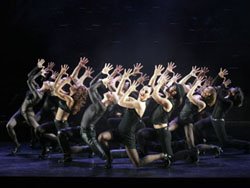
The appeal of this show is something that is impossible to capture on film with quite the same energy or excitement. Watching large clumps of people executing complex dance steps and making it look effortless is an experience not to be missed.

As Velma and Roxie, Terra C. MacLeod and Michelle DeJean are superb. In each there are echoes of Verdon and Rivera, and I found myself understanding that Fosse had these two specific women in mind when he originally choreographed this show, the moves seeming to be unique to each character, but specific to the style of dancer.

Greg Evigan is marvelous as the smooth, charming, yet slick lawyer, Billy Flynn, who knows how to work the press and, for a price, make his clients such sympathetic figures that no jury would convict them. Billy’s “All I Care About,” performed with several chorus girls armed with fans that would do credit to Sally Rand, is a knock out.

Carol Woods brings down the house with Matron “Mama” Morton’s “When You’re Good to Mama.” She’s a real powerhouse who received the biggest ovation at the end of the evening.

Roxie’s long-suffering husband, Amos Hart, the man who loves his wife no matter what, was given the appropriate downtrodden characterization by Kevin Carolan, but he has his moment to shine as he sings “Mr. Cellophane,” and shine he does.

There are marvelous ensemble numbers in this piece, which rely as much on choreography as they do on lyrics. The “Cell Block Tango,” where each woman explains how she happened to kill her husband/lover is marvelous, and “We Both Reached for the Gun,” where Billie coaches Roxie in how to give her court testimony are both outstanding.

Scenic design for this show is by John Lee Beatty, who places the orchestra center stage, with character entrances and exits over, under, around and through the orchestra box. Dramatic lighting is provided by Ken Billington and the costumes, elegant yet decadent, are by William Ivey Long.

Chicago is one of those musicals that will have you clapping enthusiastically, and then leaving the theater humming “All that Jazz,” and what more could one want from an evening’s entertainment?

Death of a Salesman

Last month, eight Nebraska meatpackers took a chance on a dream, plunked down money for the Powerball Lottery, and won the biggest jackpot in U.S. History.

The rise in popularity of insanely large lotteries, reality shows with millions of dollars in cash at the end of the road, and Internet get-quick schemes shows that the dream of the good life is as alive today as it was for Willy Loman in 1949 when Arthur Miller’s “Death of a Salesman” first debuted on Broadway. The UC Davis production, under the direction of Kent Nicholson, now playing on the Main Stage, will feel as up to date with today’s struggling families as it did to audiences nearly 50 years ago.

Tom McCauley, a working actor for more than 30 years, and now an MFA candidate, is an excellent choice for the role of Willy Loman, who has worked as a traveling salesman all of his life, but now, at 60, is wearing down and trying to decide how he’s going to support his family. McCauley has perfectly captured the look of a man beaten down by life, a little frightened of what lies ahead, but still trying to keep his dreams alive. Despite his disappointments in life, Willie takes pride in two things: First, his ability to make friends, and the host of friends he has made throughout his career (“I realized that selling was the greatest career a man could want. ’Cause what could be more satisfying than to be able to go, at the age of eighty-four, into twenty or thirty different cities, and pick up a phone, and be remembered and loved and helped by so many different people?”).

Willy’s second pride is the accomplishments of his oldest son Biff (Matt Rapore), former high school football star, who Willy is convinced is going to take the professional world by storm.

Biff’s problem is that he can’t possibly live up to Willy’s grandiose fantasies for him. He never received his high school diploma and has been fired from every job he’s held. All he really wants is to move out west and work with his hands. Rapore was off to a slow start as Biff, but as his confidence grew, he gave a powerful performance. The final showdown between Biff and Willy, is skillfully handled by both actors.

In the shadow of his brother is Happy Loman (Michael Yost), who shares Willy’s inflated image of his own importance and questionable moral choices. Yost is makes the audience feel Happy’s frustrating attempts to get his father to notice him.

Lisa Klein is Linda Loman, Willy’s long-suffering wife. Linda is the stereotypical wife of the 40s, taking care of her husband’s needs, supporting his dreams, but with her own frustrations. She mostly suffers in silence and it is her emotional strength which keeps the family together, until things finally explode beyond her ability to control them.

Matt Sullivan is Charlie, Willie’s next door neighbor, who owns a successful business and whose son Bernard ®. Andrew Hess) is a successful lawyer, who has always regarded Biff as his hero.

Willy’s boss, Howard Wagner (Dan Hakim) is a young man whom Willy has known since he was a baby, but Wagner regards Willy with condescension and when Willy goes to him, hoping for a change in his work conditions and perhaps an advance on his salary so he can pay the insurance bill, Wagner fires him.

Willy is losing his grip on reality, and his life seems to be played in the here and now, and in flashbacks to Biff’s glory days and to the days when his wealthy older brother Ben (John Crosthwaite), who recently died, was still alive.

Lighting designer Daniel Goldin uses cool tones for the “here and now” and warm tones for Willy’s flashbacks.

Scenic Designer, Martin Flynn has built a massive, functional set with a colorful backdrop showing the cramped neighborhood in which the Lomans live, and a multi-level house where the action can easily move from bedroom to kitchen to hotel.

In his director’s notes, Kent Nicholson points out that, like Willy Loman, many of us are embracing a system bent on destroying us. “Today there is a cultural obsession to get ahead no matter who we leave behind.”

We have not learned much in the past nearly 50 years. We are, most of us, still Willy Loman, trying to make it in a world that seems determined to keep beating us down.

Willy took comfort in the knowledge that if he had no money to show for his lifetime, at least he had a wealth of friends. The ultimate irony was that the only people at his funeral were his family and his one close friend.

Monday, March 06, 2006

Insides OUT!


Stop what you're doing right now, go to the telephone, call Sacramento Theater Company, and order tickets for the production of Insides OUT! the powerful one-woman show by Katie Rubin. It's that good.

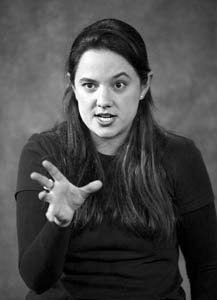
Insides OUT! is a no-holds barred, emotional, funny, gut-wrenching look at the 29 year old Rubin’s journey through alcoholism, drug addiction, sex addiction, food addiction, and self-loathing throughout her high school and college years and ultimately, to the path of recovery. While this sounds like a heavy evening – and, in spots it is – Rubin makes the one hour piece a mesmerizing experience. You’ll laugh, you’ll cry, you’ll cheer. Not bad for an hour’s work.

In a sort of prolog, Rubin talks with the audience and explains that in her study of Carl Jung, she learned that the human psyche is made up of several different archetypal characters. Rubin has identified seven different characters in her own psyche and has named most of them. As she begins the formal part of her program, Baby Katie (who is 6 years old) takes over to tell the story. She is joined by The Perfect Monster, whose job it is to remind Big Katie of what a terrible person she is, and that no matter what she does, it’s never good enough. Then there is Hank, “the Trickster,” who leads Big Katie to alcohol, drugs, food, and heavy partying, and in party mode Sylvia, “the Romantic,” takes over as the archetype who can’t get enough sex. Sylvia figures that if Katie can just find the right man, she’ll never have to work again.

Somewhere in the middle of all these conflicting characters, there is a “wise woman” whom Big Katie stumbles upon in a bathroom mirror one day, whom she gradually learns to trust, and who helps her to put all of the others in their place.

The piece itself uses comedy, poetry, song, improvisation and monologue to tell the story, and we see that, despite the criticism of The Perfect Monster, Rubin is more than adept in each area. Her singing voice is particular strong and her poetry is raw and filled with emotion.

She brings a message which will resonate with most people and she has such an open, likeable demeanor that she creates a safe place from which to begin to identify your own archetypal characters.

Rubin began her career as a comedic writer/performer at Amherst College with her first original piece, “PartyBoobyTrap.” Her second play was produced through the 2000 New York Fringe Festival. "Insides OUT!" is her third original piece and her first one woman show.

She is a graduate of the Theater and Dance program at Amherst College. She has studied at the Wynn Handman Studios, at Annie Bogart's SITI Company and has an MFA from UC Davis. Rubin’s involvement with recovery and the 12-step process has led her to perform this one-woman show at recovery centers.

The press release for this show warns that “Insides OUT! contains mature subject matter and language and is appropriate for high school and college age audiences and above.” Given the insecurities of high school students in general, and the difficult life decisions they are often forced to make, I feel this show is not only “appropriate” for high school students, but might go so far as to say attendance at this show should be encouraged for high school age students.

The show is booked for a nine-week run at Sacramento Theater Company. Following each performance there is a question and answer session with Katie Rubin, who creates a palpable bond with her audience, which makes in-depth questions safe to ask.

Run, don’t walk, to the Sacramento Theater Company and see this show. You won’t be sorry that you did.

Thursday, March 02, 2006

Titanic: The Feature

This article was originally supposed to run before the show opened, but space constraints necessitated that it not be run until the following week. This is the article I wrote about the projected opening of the show...

Steve Isaacson was like a little kid on Christmas morning. “What is finally starting to dawn on me is--this is our place,” Isaacson gushed. “This is ours! Look at all this ROOM! I am just so excited about this. My God this is real.”

He was giving me a backstage tour of the new Hoblit Theater for the Davis Musical Theater Company’s upcoming production of “Titanic: the Musical” which opens February 24. It is the largest show the company has ever presented, with 47 in the cast,

I made a comment to normally unflappable costumer, Jeanne Henderson about the number of costumes necessary for such a big show and how nice it must be to have the space to get them all done in a more timely fashion.

“It would be, except I had to move in the middle of it,” she said, rolling her eyes, explaining that now that the theater was completed and DMTC was moving out of its former storage unit, she had to move all of the costumes previously in storage over to the new building, at the same time that she was constructing new costumers for the current show.

Isaacson took me into the Barbara Jackson Costume Shop, which I had visited when the theater first opened. The cavernous space I had seen in November was now filled with costumes. Racks ran the entire length of the building, on both walls, two racks tall, the top rack nearly reaching the ceiling.

“It’s the largest walk-in closet in Davis,” Isaacson joked.

The racks were designed by Doug Hicke and Dixon High School shop class teacher, Bill Scott. The men designed a system which would allow the clothes to hang without touching the wall. The actual forming and welding of the “stand offs” was the final exam for Scott’s advanced class (80 students). The entire system was installed by Scott, Hicke and his father, and Henderson’s husband Alex. “For years the Davis Musical Theater Company has loaned costumes for Dixon High School drama productions,” said Scott. “I thought it was time for a little helping hand pay-back.”

As Isaacson and I passed to the other side of the theater, the cast was on stage rehearsing the opening number, while choreographer Ron Cisneros refined the blocking. Isaacson, who is also the musical director, stopped to listen. “We have some of the best singers we’ve ever had in this show,” he said, as the chorus reached the final notes of the number, the richness of the sound a wonderful demonstration of how full a chorus can sound when it includes 22 men (“that’s unheard of,” Isaacson said).

Some modifications had to be made to the open orchestra pit so that the stage could be moved forward, allowing the ship’s passengers to use a larger deck area. This resulted in cutting a hole in the floor for the conductor. “After my welcoming speech on stage, I turn and jump into the hole,” Isaacson laughed.

The special changes to the Hoblit Theater make it immediately obvious that “Titanic: The Musical” is a show which never could have been produced in DMTC’s former home, the Varsity Theater.

Time alone would have been a factor. The demands of such a huge show, with such a large, complicated set would never have been possible in a theater which the company only inhabited for a few weeks prior to opening. And then there are the kinds of semi-permanent changes which cannot be done in a rented space.

Technicians were nailing things to the specially built platforms on either side of the stage, which will act as the bridge and the first and 2nd class passengers’ decks. The two sections of the ship will be joined by a false proscenium (the arch that goes over the stage), tying the whole thing together into one big ship.

The set designer for “Titanic: the Musical” is Mike McElroy who, coincidentally, will also play Thomas Andrews, the builder of the Titanic, in the show itself. The multi-talented McElroy has performed in other shows, and designed lights for DMTC before, but this is his very first set design.

“I’ve worked on building a lot of sets,” he said, “but this is the first time I’ve ever designed a set.”

When the new season was announced last year, McElroy knew that this was a project he wanted to undertake. He also felt that he was ready.

“The last show I did was ‘Victor, Victoria,’ at Runaway Stage. It had a massive set. Watching the set designer there build that monstrosity was a big inspiration to me. It gave me a few ideas on construction techniques. I felt a lot more confident.”

McElroy began mentally planning his design nearly a year ago, although actual construction didn’t start until early January.

The tech crew is in the process of building the third piece of the set, a 35' by 12' wooden deck which will actually tilt as the ship begins to sink.

In preparation for sinking his Titanic, Isaacson has acquired a 6,000 lb winch that runs on a car battery. It’s his newest toy and Isaacson is very proud as he jokes about the technical workings, “It’s got gazunta circuitry. It’s got this giant thing so it unrolls and then you hook it up and then you just turn it and it has a remote control and it just pulls and lifts it.” (Got that?)

Again, this mechanical set-up would not have been possible at the Varsity Theater, as the winch must be firmly attached to the walls in order to begin to pull the large deck to a realistic slant.

“Let’s hope your set won’t sink, like the real Titanic,” I joked with McElroy

“Hopefully it will sink,” McElroy laughed, as he turned away from me, began singing, and walked onto the stage, to join the rest of the cast.

“Titanic: The Musical” opens on February 24 and runs weekends through March 19.

Wednesday, March 01, 2006

Mary, Mary

"Everytime I think I'm out, they pull me back in," must be how Alex Cross feels. Here he thought life was settling down, that he could stick around the FBI, be a Dad, take his kids to Disneyland, and then what happens? Someone starts cutting up pretty ladies and he's back on the case again.

This time he's on loan to the LAPD after the murder of an actress whose face was cut to ribbons so that she was nearly unrecognizable. This sets off a string of similar murders, each with an accompanying message to the local gossip columnist.

While Alex is looking for the bad guy or gal, he's also fighting his ex-wife for custody of their son. The custody battle seems a bit contrived, especially when it comes to the ultimate resolution.

But naturally Alex solves the case and Nana-Mama is there to scold him for putting the kids in danger yet again. He promises that he's finished with all the dangerous stuff for good...but is he? Only Patterson's next book knows for sure.

But once again, James Patterson has given us a page turner with sex and violence and home cooking, and isn't that what we expect of Patterson?

Tuesday, February 28, 2006

Derfs Cafe, Santa Barbara

Our previous experience at Derf's had been a good one, and we had no reason to believe that this would be any different.

Boy, were we wrong.

I suspect the main problem was the wait staff, who just didn't seem interested at all. The waitress took forever to even notice we had sat down, took forever to get us anything to drink, and then got the drink order wrong. She eventually took our food order and we waited a good 30-40 minutes for it to be delivered. Two of the six orders were also wrong.

It might, at one time, have been good food, but by the time our burgers arrived mine was barely warm, the meat had the consistency of cardboard, and the cheese, which had once been melted was now a congealed rubbery mass. The bun may have once tasted good, but because of sitting so long, it had dried out and even I, the bread maven of the world, didn't want to deal with it.

Santa Barbara is a town loaded with wonderful places to eat, so I think it's fair to say that we will look elsewhere the next time we are in town and looking for a place to have brunch.

Monday, February 27, 2006

Titanic

The shake down cruise of “Titanic: the Musical,” with story and book by Peter Stone, music and lyrics by Maury Yeston set sail at the Davis Musical Theater’s Hoblit Performing Arts Center on Friday night, under direction and musical direction of Steve Isaacson. Like the great ship whose story it tells, the production is not without its flaws. It has some fixable problems and some non-fixable problems, but in those moments when it all comes together it is downright glorious.

It is evident from the moment one enters the theater and sees the size and complexity of the set (designed by Michael McElroy, who also designed the lights and plays (appropriately) Thomas Andrews, the builder of the Titanic, in the show itself) that this is a show which could never have been produced at the old Varsity Theater. Even without all the technical elements necessary to sink a giant ocean liner several nights a week, the size of the set alone would not have been possible at the Varsity. The ability to affix things semi-permanently to the walls provided for a rock-solid set.

The 14 piece orchestra, under the direction of Jonathan Rothman, got off to a shaky start in the overture but quickly warmed to the task at hand as the show progressed.

Jeannie Henderson’s costumes are, as always, exquisite.

This is not a plot show. Well, other than the obvious plot about the ship itself. There are no characters in whose lives we get deeply involved. Nobody stands at the bow of the ship proclaiming himself to be “king of the world.” If there is hanky panky going on below deck, we don’t see it. It is more an opportunity to get a glimpse into the lives of the first, second, and third class passengers of the great ship, the meet its crew and then to see how they all handle the terrible tragedy that is about to befall them.

A show this big requires a big cast and DMTC may have assembled its biggest to date. There are 47 actors, some of them doing double duty to fill out the sound of choruses.

Collectively, they are exquisite. When all the passengers are ready to set sail and then launch into “Godspeed Titanic” I literally had tears in my eyes. I think it was a combination of the fact that it was such a full, beautiful sound--and the fact that these were people who were about to meet their death.

However, among the cast there are 44 named characters and many of those characters have either short solos or long solos. Some are not quite up to solo quality voices.

Ben Bruening as J. Bruce Ismay, owner of the Titanic, has never sounded better vocally, though I would have liked a bit less intensity in his portrayal of the man whose only thought was getting the ship to port in the fastest possible time and damn the passengers’ safety.

Richard Spierto was a properly regal Captain E. J. Smith. He has a commanding presence and a good voice and was a perfect choice for the role.

Brian McCann is excellent as Henry Etches, the 1st Class Steward, perhaps at his best “Doing the Latest Rag” (with choreography by Ron Cisneros).

It was fun seeing Davis theater veteran Jill Wright back on stage again as Caroline Neville. She’s as lovely and as talented as she ever was.

Lauren Miller was outstanding as Alice Beane, the starstruck wife of Edgar (Marc Valdez). Alice knows all the facts about all the 1st class passengers and it is her dream to rub elbows with the wealthy while aboard the ship.

There are many technical aspects to this show which simply didn’t work. I am assuming the glitches will be ironed out during the run of the show. An inordinate number of lighting mistakes were made on opening night, from lighting the wrong side of the stage to plunging the whole house into darkness to leaving a soloist in the dark as he sang his solo. It’s a complicated light plot, and I’m sure that this is going to begin to run more smoothly.

There are also video projections which didn’t work at all. The time line projected onto the proscenium was crooked and up much too high to be noticed, much less read, though this already appeared better by the second act. Likewise, there were various newspaper headline articles about the sinking of the ship which were projected onto the curtain and which were much too dark to be read from the audience.

There was also the matter of a stubborn tea cart which is the focus at a crucial moment, and which did not behave as it should.

But when things worked as intended, it was wonderful, and the sight of McElroy standing on the tilted deck of the ship he built trying to decide, in his last remaining moments of life, where he had gone wrong, it was worth it all.

Friday, February 17, 2006

Fears of Your Life (the stage show)

“Fears of Your Life, Study 1,” based on a book by San Francisco author Michael Bernard Loggins, and directed and choreographed by MFA Candidate Kim Epifano, is a true interactive work of theater.

As the audience enters the Mondavi Center, they are free to enjoy a display of artwork by members of Creativity Explored, a San Francisco-based visual art community for people with developmental disabilities, or watch portions of a video, “Life Itself,” by Francis Kohler and Todd Herman, about the life of Michael Bernard Loggins.

From there, the audience passes into the Mondavi Studio Theater, where everyone is invited to “leave their fears at the door,” by writing them on the large wall of butcher paper. The fears range from the serious (“Fear that my daughter will die,” “Fear that I will never again experience love”) to the less serious (“Fear of oversleeping,” “Fear of Dick Cheney”).

Next everyone is invited to choose from among a number of cartoon characters made of thick foam board, with velcro backing, and to, in essence, become part of the set-design team by placing the figures on the walls of set itself. The stage is lined with white felt, on which are drawn cartoonesque figures--a large television, which is running movie clips; a tall house, at the top of which is window in which sits actor Lonnie Ford, as Loggins himself, scribbling fears on pieces of paper, reading them aloud and then tossing them down onto the audience.

The audience is free to wander around the stage, picking up the pieces of paper, and reading Michael’s fears; examining the shoes on which are printed more fears; or checking out the larger than life puppets (designed and constructed by Michael Stasiuk), which will later become part of the choreography.

As starting time approaches, the lights begin to dim, the audience is invited to take their seats, and the show gets underway.

Ford, as Loggins, comes onto the stage with the dancers, members of Oakland’s Axis Dance Company – Judith Smith, Stephanie Bastos, Katie Faulkner, Sonsherée Gilese, Sean McMahon, and Renee Elisabeth Waters.

Inside the giant puppets, outside the giant puppets, on crutches, in wheelchair, running, dancing, leaping about, or rolling on the floor, the company energetically and effectively depicts the 138 fears listed in Loggins’ initial ‘zine. This is a work to which everyone can relate. Who hasn’t, at some time in their life, been afraid of a snake under the bed or going to the dentist?

“Fears of Your Life” is a multi-media event, incorporating movie projections (video design by Erich Bolton) and delightful animation by Todd Herman, bringing Loggins’ engaging drawings to life.

In spots there is definable music--songs written by Epifano and Katie Faulkner, and sung by Faulkner (accompanying herself on the guitar); in other spots there is what Epifano describes as “sound scape” or “vocal motion,” each type of music appropriate to the set of fears being examined. Sound designer Rick Scholwin does an exceptional job of handling the varied sounds.

Lighting plays an integral role in this production and Ron Reisner’s design beautifully portrays the mood, from the red color of traffic-related fears to the stark white fear of “panic attack,” or any of a number of moods in between, lighting only enhances the effect.

As for the performers themselves, they take us to familiar places, funny places, dark places, secret places. The combination of physically abled and disabled dancers, and of Michael Loggins, a developmentally disabled artist and writer, in such a seamless, beautiful manner erases the lines between our differences. We no longer see Michael, the disabled man. We see Michael the artist, the poet, the philosopher, the man. We don’t see physical disabilities of Judith and Stephanie, we see the beauty of dancers who move in a manner different from what we normally expect. We don’t see crutches, we see wings.

“Fears of Your Life, Study 1" is a unique theatrical piece which appeals to people on many different levels. It is a piece to which we can all relate and we leave the theater feeling a little less alone in our fears.

Which was, of course, why Michael Bernard Loggins wrote his little book in the first place.

Thursday, February 09, 2006

Death and the Ploughman

When a person dies in the prime of life, the natural tendency of the survivors is to rant and rave and perhaps curse God and question why their loved one had to die too young. These days friends understand what’s going on. We have bereavement counselors and people like Kubler-Ross letting us know that anger is one of the stages of grief and that it’s OK to be angry and to question the logic of God’s allowing a young person to die.

Back in 1401, when Johannes von Saaz’s beloved wife died in childbirth, people just didn’t go around questioning the Almighty. People were supposed to hunker down in their huge cathedrals and accept the will of God.

So von Saaz’s 34 chapter, “Death and the Ploughman,” which presents a grief-stricken ploughman engaging in a bitter dialogue with Death over the loss of his wife, was not widely known in the author’s time, and not translated from the German and presented on the stage until 1977.

A new translation by Michael West opened Wednesday night on the Main Stage at UCD, under the direction of Anne Bogart and performed by members of the SITI Company.

As the audience entered the theater, the three characters were already on stage, moving in a painstakingly slow, stylized manner to the relentless music of Nine Sili Nebesniya, composed by Sheremetieve, a tune which is not likely to be found on my iPod any time soon.

Death, looking like Rene Magritte’s Man in a Bowler Hat, is played by Stephen Webber, with Will Bond as the Ploughman and Ellen Lauren as the Woman.

The Ploughman opens the dialog with a gut wrenching monologue in which all of his pain and anger comes spewing forth as he curses Death, despairs of ever finding happiness again in this life, and demands retribution from Heaven for the joy that was taken from him.

As the 90 minute play progresses, each of the actors, in turn, have lengthy monologues. There is rarely any actual conversation. The woman alternates as the Ploughman’s wife and as a supportive voice for Death.

Death seems to have an almost amused reaction to the depth of Ploughman’s grief. “You have not drunk from the fountain of wisdom. This much is clear from your words,” he says on one occasion, and on another counsels that “‘This too shall pass’ should be in the mouth of every man,” seeming to feel that it is only a matter of time before Ploughman recovers.

He also points out that Ploughman’s grief is so great because his love was so great and that to remove the grief would necessitate removing the love as well, and he gives a recitation of the kinds of positive things that cannot exist without their negative components. "Suffering is the end of love, the end of joy is sorrow. After pleasure comes the loss of pleasure." Death tells the grieving man that if he did not want to feel pain, he should not have allowed himself to love.

The Ploughman continues to harp on the injustice of mortality, while Death shows him the all the ills of the world that his wife has been spared. She died young and beautiful would never know what it was like to experience old age and watch her body begin to deteriorate.

Movement in this production is at times almost balletic, with graceful, precise moves and elaborate gestures. The choreography was a collaborative effort of the actors and the director and arose out of the “dense, articulate” language, explained the cast at a Q&A following the opening night performance. There are also moments of visual levity to break the mood when things get too heavy.

The action takes place on a black stage, bordered with white, a design by James Schuette, which is complemented by the geometric lighting design of Brian H. Scott. The only set pieces are two metal tables and a small suitcase which the woman carries.

The debate between Death and the Ploughman concludes with the arrival of God, who renders judgement as to who was the winner and why.

Director Bogart explains that Death and the Ploughman was written at a time when the theretofore accepted medieval sensibilities were suddenly called into question--faith, the meaning of life, religious hierarchy, authority--leading to the start of the Renaissance. She points out that today we are undergoing another paradigm shift where religion, values and meaning must be examined from fresh new angles.

When one watches this play, one is struck with the sense that history does indeed go in circles, and that everything old is new again, sooner or later. The issues raised in Death and the Ploughman are as fresh today as they were in 1401.

Monday, February 06, 2006

Amadeus

As the old joke goes, when Mozart was my age, he’d been dead 28 years. In a mere 35 years of life, he composed so many pieces of music that it was not until 1862 (70 years after his death) that Ludwig von Kochel finally catalogued them all into a 551 page book. It’s enough to give a person an inferiority complex.

The composer was a bundle of contradictions, at the same time a child prodigy who never really grew up and who was reportedly loud, obnoxious and vulgar, and a brilliant musician who produced some of the most beautiful, profound, and memorable music of his day.

There are also contradictions in reports of his life. The manner of his death is a matter of debate. His burial place is unknown.

In the story of this multi-faceted genius, Peter Shaffer saw a great theatrical piece and his “Amadeus” was written in 1977 and first performed in London in 1980. It won 5 Tony awards on Broadway and the 1984 movie won 8 Academy Awards. The original stage work has undergone six revisions and the Sacramento Theater Company is presenting the latest version.

The story tells of a questionable relationship between Mozart and a lesser court composer, Antonio Salieri. It focuses on Salieri’s seething jealousy and hatred of the young genius, and his decision to destroy him. In actual history there is question of whether the two ever met, but it is of little consequence because Shaffer has made it a heck of a story.

Salieri is at the center of the work, the play beginning on what he says is to be the final night of his life. The action is mostly done in flashback, with occasional returns to the present as Salieri ticks off the remaining hours of his life.

Matt K. Miller may be playing the role of his life. He is simply magnificent as the tormented Salieri, making deals with God and then, when he feels the deals go sour, turning his back on God and embarking on a campaign to drive his nemesis to ruin. Salieri is on stage throughout the entire play, frequently delivering lengthy rapid-fire discourses. It’s an actor’s Olympic event and Miller handles it like the pro that he is.

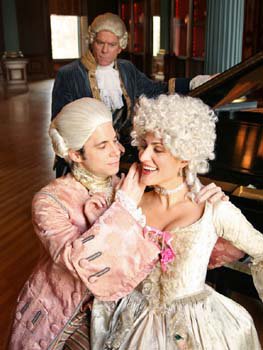
Derek Manson as Mozart is brilliant. He is very funny as the raucous, raunchy, spoiled wunderkind. But this is a man who spent his early years accompanying his father, being presented and performing for royalty, so he knows what is expected to succeed at court and he is able to change in an instant to a courtly gentleman, eager to please his emperor (Philip Charles Sneed).

As Constanze Weber, Saffon Henke nicely rounds out the trio of exceptional lead actors, as captivating as the innocent, giggily young girl being courted by “Wolfie” as she is effective as the life-weary wife, struggling to find enough money to feed her family.

Paul Richard Alary and former Acme member Andrew Conard have large roles as the two Venticelli (Salieri’s “ears,” -- the word “venticelli” means “little winds” -- who bring him all the latest gossip).

Others in this fine cast include Margie Roesser as soprano Katherine Cavalieri (mistress to both Mozart and Salieri), Greg Alexander as Count Johann Kilian von Strack, J.T. Holmstrom as Count Franz Orsini-Rosenberg, Thomas Engstrom as Baron Gottfried van Swieten.

The set, designed by Marion Williams, is perhaps more opulent than STC audiences are accustomed to, with its rich wood balconies and crystal chandeliers. Portions of the set move to partition off certain areas and it is hoped that the set crew can learn to do it a bit more quietly as the run progresses.

Clare Henkel is credited with costume design, working with costumes rented from the Ashland Shakespeare Festival. The look is luxurious and beautifully gives a feel for the period.

The recorded music (sound designer is Ned Jacobson) worked in some cases, not in others. During Katherine Cavalieri’s first act performance, she makes no attempt to lip synch to what is being played and, as her face is visible to the audience (though she is facing the emperor, who is seated upstage), the whole thing looks awkward and was distracting. By the same token, the choruses conducted by Mozart later in the play work quite well.

Lighting designer Pamila Z. Gray's design included (the pre-show talk informed the audience) over 300 light cues and nicely run the gamut from warm ambient lighting to spotlighted segments that set the actor off from the actual action on stage.

Director Peggy Shannon has created a gem of a production, opulent by STC standards, professional in every aspect, and certain to delight audiences. As the 250th anniversary of the birth of Wolfgang Amadeus Mozart rolls around, the Sacramento Theater Company’s production of “Amadeus” is a beautiful gem to add to all of the other observances in honor of the composer which are taking place worldwide.

Saturday, February 04, 2006

Fears of Your Life (the book)

Fears of your life is written by a developmentally disabled man named Michael Bernard Loggins. His work is being presented on stage in a couple of weeks and I will be reviewing it, but the choreographer gave me a copy of his book, so I could have an idea of what the show is about.

Michael has listed all of his many fears, along with cartoons which depict many of them. I can relate to a lot of them (like "monsters under the bed," my big fear all the years I was growing up).

I get the feeling that Michael has experienced much fear reaction on the part of other people. Several of his "fears" relate to how people perceive him. Fears 101 to 104 read:

101. What people think of when they see me coming up the streeet? What the first thing they can think of once they see a stranger like me coming in the direction I goes in? Nothing but fear!

102. Why do people when they see me coming what do they tell their friends? let's cross the street. I don't want to get hurt.

103. we better cross the street this man is following us and he wants to bother us whatwe ought to do is turn and go another direction Fear.

104. what does fear itself can do to make you afraid of a stranger and what does that fear tells you about that man and what fear cause you to think something may happen to you in just 5 seconds or 1 minute? does fear warns people to move away from ;him or is it that it's a warning system tells you that man is ready for an attack and harm you or what kind of danger your life is in when you or guys and girls think to do is it lot threatening or just a kind of situation you may face soon?

This book made me stop and think more often than not. It is available through Creativity Explored, a workshop for developmentally disabled people in San Francisco. I encourage people to check out their amazing web site.

Friday, February 03, 2006

Dancing on the Edge

How often do you get the chance to watch someone dance with a Sousaphone, while someone else roller blades around the stage? Not often, I suspect. If the notion intrigues you, get yourself to UCD’s Main Theater this weekend to see “Awake Now and Then,” the second half of a program called “Dancing on the Edge.”

“Dancing on the Edge” consists of two pieces by Granada Artists-in-Residence, Doug Varone and Joanna Haigood.

Varone’s piece, Fractured Lives, opens the 2 hour show. It is performed by Jennie Amaral, Mary Elizabeth Anderson, Kelsey Cassady, Robert Coverdell, Anna Feldman, Brennan Figari, Hector Marin-Rodas, Meghan Moyle, David Orzechowicz, Whitney Peterson, Brian Runstrom and Alice Vasquez and is described by Varone as being “loosely based on images from several films from the 1930s and 1940s film noir era.”

Costume and scenic designer Victoria Livingston-Hall and lighting Designer Javan Cayo Johnson played a big part in creating the film noir look. Costumes were all in black, white, or shades of grey. The set, an interior room, was all done in grey and white, and the lighting, most of it from the top straight down, cast shadows on the figures of the performers, which, again added to the film noir look.

There were two exceptionally moving points of this piece, one with a man and a woman on the floor, alternately tender and violent, painting a picture without words of the relationship between the two.

Later, there was a poignant moment when a man turns on a movie on the far wall of the room. The “movie” is a life figure of a woman he obviously loved, who has obviously died. The effect is beautifully haunting, as he approaches the “screen” and begins to interact with her, only to have to leave her there as he turns off the projector.

This was the outstanding moment of this piece for me.

The delightful “Awake Now and Then,” choreographed by Joanna Haigood in collaboration with dancers Rebecca Abdenour, Mary Elizabeth Anderson, Christina Fajardo, Anna Feldman, Meghan Moyle, Hector Marin-Rodas, Whitney Peterson, Mary Ann Reveles, Brian Runstrom, Derricka Smith and Alice Vasquez, opens on a half-bare stage, with pieces of the previous number and several ladders standing around. To the Ink Spots’ “My Shadow, My Echo and Me,” the set pieces begin to be moved off, the ladders moved around, and the dancing starts.

Haigood, director of San Francisco’s Zaccho Dance Theater, is known for her use of aerial flight and suspension and those elements are hinted at in her work.

The moving set, a play on ideas of states of consciousness, includes a series of ladders and doors that allows dancers to interact with the underlying mechanisms of the theater. As the music segues into “Begin the Beguine,” the light casts shadows of the dancers on the back wall.

It is at once a shadow puppet theater, a living M.C. Escher drawing, as the bodies climb stairs to nowhere, open doors that open on nothing, and climb down again, at odd angles, and a bit of a circus, with a Sousaphone player walking through the action while being circled by a woman on roller blades.

Somehow it just all works. It is original, quirky, beautifully executed, and a joy to watch.

“Dancing on the Edge” continues through February 5.

Wednesday, February 01, 2006

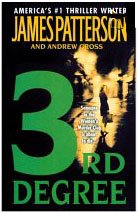
3rd Degree

The thing I love about James Patterson books, other than that he spins a mean yarn, is that he isn't stuck in one particular rut. He has two different sets of story lines going, the Alex Cross series, which centers on a detective working out of the D.C. area, and the Women's Murder Club series, set in San Francisco (which, being a native, I like).

This is the third of the Women's Murder Club books, written in conjunction with Andrew Gross. (The previous two were "1st to Die" and "2nd Chance").

The unlikely collaboration of friends, homicide lieutenant Lindsay Boxer (our heroine), an assistant DA, a medical examiner, and a crime reporter.

In this story, one of them will meet with foul play and it will be up to the other three to find out who is responsible. This particular story deals with a terrorist group calling itself "August Spies," and the fast-paced plot shows the very real posibility of the planting of incendiary devices or introducing the poisonous ricin into the environment, and the kind of response one might expect from the Department of Homeland Security.

This is a page turner, a roller coaster ride from beginning to end. There are enough twists and turns to warrant a dramamine.

Oh yeah--and there's a hint of sex too.

Monday, January 30, 2006

The Scottish Play


From its very first performance, several strange events have plagued Shakespeare's famous yet short play, Macbeth, a play that was supposedly written to please King James. It is said that practitioners of the black magic ritual depicted in Act 2 took exception to the exposure of their witchcraft and cast a spell on the play. There are instances of terrible consequences (or coincidences) which have befallen those connected with the play and it has become bad luck to even say the word “macbeth” in a theater, unless it is part of the script. There are complicated rituals involved with removing the curse should one forget and utter the word. Superstition is so strong that for many theater people, it is known simply as “The Scottish play,” to avoid saying the cursed word.

The cast of the UC Department of Theater and Dance’s current performance of the Scottish play must have been very diligent to limit their references to the title character to on-stage utterances, because there is nothing “bad luck” about this production, directed by MFA candidate Emily Davis, a production which ignores gender in the casting of the play (the majority of the roles are played by women) and concentrates instead on the best performances of its 15 person ensemble.

The Wyatt Pavilion does not lend itself easily to elaborate sets, but scenic designer Robert Broadfoot has worked miracles with twigs, giving one the sense of being in a forest. (He has designed a particularly interesting looking dining table and stools)

Costume Designer, Molly LeGoy, in conjunction with director Davis, has created an interesting look for the three witches. They appear at the start of the play, joined together to form a barren tree, their body suits show the bark of the tree, the branches are extensions of their fingers. Throughout the play, they break apart or come together, as the case warrants.

Art Grueneberger has added an interesting twist with “puppet elements” as part of the witches’ cauldron scene in Act 2.

Heading the cast are Paula Dawson as Macbeth and Ara Glenn-Johanson as Lady Macbeth (repeating a performance of the role she last did in the 5th grade).

Dawson has mastered the manly swagger, has a throaty voice, and she brings believability to the complexities of Macbeth’s personality, at the same time hungry for power, and wracked with guilt over what he does to obtain it. We watch Macbeth’s rapid transformation from an opportunist to someone who has destroyed himself and everything around him in his quest for power.

Glenn-Johanson is simply marvelous as Lady Macbeth, from the moment she reads her husband’s letter hinting at future greatness based on the prophesies of the three witches. She knows how to push her husband to grab the crown, and how to help him deal with what he must do to get it. “Leave the rest to me,” she tells her husband, taking charge of the plans for what must occur. We later watch her descent into madness as she comes to the realization that crime really doesn’t pay.

Travis Dukelow is a regal and likeable Duncan, who will meet a tragic end. Dukelow also appears in 3 other roles.

Sarah Cohen has an appropriate princely bearing as Malcolm, especially at the conclusion of the play when Malcolm assumes the crown following the death of Madbeth.

Jon Carlo Blumwald wields a mean sword, especially as he slays Macbeth.

All of the swordplay is quite realistic, thanks to the fight choreography of Gregory Hoffman, and the cast wield their huge, heavy swords expertly. The fight scenes make the most use of all of the stage and ramp areas of Wyatt Pavilion to good effect.

JT Reece offers comic relief as the Porter, clowning with members of the audience (even a dense reviewer who didn’t realize she was being asked to tie his shoe for him).

Andrea Guidry is particularly good as Lennox, and Franchesca Jimenez is a sensitive Banquo.

Shefali Nagrani has two small roles, as a gentlewoman and as Fleance and yet she makes an impact whenever she is on the stage.

This Macbeth is one worth checking out. It is a tale told in a manner which will appeal to both the die-hard Bard afficionados and yet not so stylized or esoteric that it becomes difficult for the neophyte to enjoy.

Saturday, January 28, 2006

Night


Oprah's pick for book of the month is Elie Wiesel's "Night," (which is not likely to be outed as untrue, unlike Frey's "A Million Little Pieces.")

As with Frey's book, this was presented as a page turner, something that everyone needed to read, something so shocking it would hold your attention to the end, something that would change your life.

I have always felt that if there is such a thing as reincarnation, then I am a recycled concentration camp occupant. The problem is that I don't know if I would have been a former prisoner, or guard. I have always fantasized that I must have been a prisoner ('cause I'm a good guy and can't imagine torturing people, even in a former life), but there is a part of me which has to accept that it might have been otherwise. But I have had a fascination for the Holocaust and stories of the Holocaust for as long as I can remember.

I suspect that the "shock" value of this book is more for people who perhaps have not thought or read much about the Holocaust. To read with brutal honesty what happened to human beings -- men, women and children -- in our world, in our lifetime (well, my lifetime anyway) is gut-wrenching.

"Night" tells in painful detail the story of Wiesel's life as an adolescent in a small village in Romania, living with his family, studying his religion and hearing tales of the approaching Nazi troops. We watch the family torn apart, shoved into boxcars and arriving at Auschwitz, where he sees his mother and sister for the last time, not knowing it was the last time.

The story follows the struggle of the young man and his father to stay alive, in Auschwitz, Buna, Buchenwald and Gleiwitz. It recounts the father's ultimate loss of his life, literally days before the camps were liberated. The book also tells of Wiesel's survivor guilt, being the only one in his family to have come out alive.

This book started Elie Wiesel's lifelong project to bear witness for those who died, stating that "to remain silent and indifferent is the greatest sin of all" (a message which rings as true today as it did then). His passion for bearing witness earned him the Nobel Peace Prize in 1986.

"Night" is, indeed, a gripping story, and mirrors so many other similar horror stories.
Let us remember, let us remember the heroes of Warsaw, the martyrs of Treblinka, the children of Auschwitz. They fought alone, they suffered alone, they lived alone, but they did not die alone, for something in all of us died with them.

Friday, January 27, 2006

Relatively Speaking

When you find you are still giggling about aspects of a show you’ve seen in Sacramento as you drive into your carport in Davis, you know that this was a fun show.

Davis’ Peter Mohrmann has directed “Relatively Speaking,” one of prolific British playwright Alan Ayckbourn’s earlier works for Capital Stage, on the Delta King, and he had ‘em rolling in the aisles throughout most of this face-paced two-act farce.

Ayckbourn explains that he wrote this play originally in 1965 following a request for a play “which would make people laugh when their seaside summer holidays were spoiled by the rain and they came into the theater to get dry.” As this play became Ayckbourn’s first really big hit, and remains popular small theater fodder today, he obviously was wildly successful in accomplishing this task.

There is little of substance here, but anyone who appreciates the fast pace and wry delivery of British humor will eat it up.

As the play opens, Gregory (the impossibly tall Gillen Morrison, who has one of the most expressive faces I’ve ever seen) is waking up in the apartment of Ginny (the delightful Heather Brooks), with whom he has been in a relationship for the past month. This is a first for Gregory, and definitely not a first for Heather.

Gregory is too smitten to care about the obvious signs that Heather has a few secrets and begs her to marry him. He seems unconcerned about the bouquets of flowers, the chocolates hiding in the bureau, the mysterious phone calls, and the men’s slippers he finds under her bed.

Ginny won’t give him an answer to his proposal, and he takes her at her word when she declares she must be off on a quick trip to visit her parents, but can’t invite him along because it would upset her mother if she brought someone home unexpectedly.

In reality Ginny is off to the home of her employer/lover Phillip (a blustery, red-faced Loren Taylor) and his wife Sheila (the delightfully clueless Gail Dartez, whose performances was very much reminiscent of a British Gracie Allen). There is some business about some love letters that Ginny needs to straighten out with Philip, but of course before that can happen, madness and mayhem ensue.

Ginny misses her train and Gregory, who is determined to meet her parents and convince both Ginny and her parents that he is perfect husband material has decided to surprise her by accompanying her “home.” Gregory arrives at the house first, to the surprise of Phillip and Sheila, who can’t quite figure out who he is. The dialog is filled with the typical misunderstanding, miscommunication, and double entendre that lead to all sorts of revolving ideas of who is what and to whom.

By the time Ginny finally shows up, Phillip is convinced that Gregory is his wife’s lover, Sheila is convinced that Gregory is there to speak with Phillip about some mysterious bit of business, and Gregory is convinced that Sheila and Phillip are Ginny’s parents.

There is the usual farcical use of entrances and exits to keep the misunderstandings intact, which become more complicated when Ginny herself shows up, astonished to find that Sheila is expecting her and is encouraging her to marry “him” (which Ginny, of course, takes to mean that Sheila knows of and approves her relationship with Phillip).

The end is predictable and at the same time surprising.

Mohrmann has deftly directed an engaging farce, with a pace that never stops, and a humor that keeps audiences laughing throughout.

Set design is by Jonthan Williams, whose rather plain (if messy) apartment for Ginny converts before our very eyes (thanks to David Ott and Tasha Strickland) into a lovely British garden, the pride of gardener Phillip.

Lighting design is by Jordan Burkholder. One might quibble with the fact that Gregory and Ginny keep running into a darkened kitchen in the first scene to make tea, but it’s a very small point.

Costume designer Nancy Pipkin has nicely recreated the feel of the 1960s with Ginny’s mini skirted dress, her thigh-hugging boots, and the pin-on beehive hair piece.

I have long been an unabashed Ayckbourn fan and it is delightful to see his work on the local stage, and handled so adroitly by Mohrmann and his talented cast. In its first appearance on the British stage, “Relatively Speaking” was deemed “deliciously heady,” “a near miracle,” and provoking “the proverbial gales of laughter.” It’s nice to see that 40 years have not dimmed its appeal.

Thursday, January 26, 2006

Little Shop of Horrors


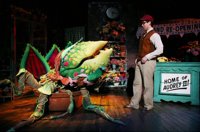
Bigger is not necessarily better, as anyone will learn who takes in “Little Shop of Horrors,” the current touring Broadway production at the Sacramento Community Theater, and watches the plant, Audrey II, begin to grow to gargantuan proportions.

Based on the Roger Corman 1960 film of the same name, the musical, with book and lyrics by the late Howard Ashman and music by Alan Menken, had its world premiere off Broadway in 1982, where it ran for more than 2200 performances. The musical music version, starring Rick Moranis and Steve Martin was produced in 1986 and in 2003, “Little Shop of Horrors” hit the big time with a real on-Broadway production.

The current production under the direction of Jerry Zaks shows the difference between a small theater off Broadway production and a splashy on Broadway one. Everything seems “bigger.” The choreography (by Kathleen Marshall) seems tighter, the performances broader, and skid row is glitzier (if possible) than ever.

The opening trio, Chiffon (Iris Burruss), Crystal (Badia Farha) and Ronnette (Latonya Holmes) are high school drop outs who hang around the buildings near Mushnik’s flower shop and act as a kind of “Greek chorus,” filling in the gaps in the story, and reminding us the unfolding emotions. Burruss, Farha and Holmes are each outstanding, and each gets her own chance to shine in solo bits.

Joe Farrell is Seymour Krelborn, the hero of the story, a clumsy, young man with a Dickensian upbringing, an orphan who had been taken in by Mr. Mushnik (Darin DePaul), the owner of a failing skid row flower shop, who let him sleep on the floor behind the desk and sweep up. But Seymour has a couple of secrets. He is hiding his love for the sweet, if a bit ditsy shop girl, Audrey (Liz Pearce), and he has been tending a strange and wonderful plant he picked up at an open air market. He feels he has discovered a new species and, in honor of the girl of his dreams, has named the plant Audrey II.

Unbeknownst to Seymour, Audrey II is actually a creature from outer space, with a taste for human blood, and its own nefarious plans for world domination. Seymour is the perfect foil.

The spectacular Audrey II puppet was designed by the Jim Henson Workshop and manipulated by Michael Latini, Marc Petrosino, and Anthony Asbury (who is credited in the program as its “midwife.”). Michael James Leslie gives Audrey II a booming voice, and also appears as a derelict on the street in earlier scenes, as do the other manipulators.

As for the rest of the cast, it would be difficult to find a flaw. Farrell’s Seymour was perfectly nerdy, struggling with the desire for the recognition that owning Audrey is beginning to give and anguish over what he must do to get it.

Liz Pearce’s Audrey, mincing about on impossibly high heels, in skin-tight clothes she considers to be stylish is just right without being over the top (though being “over the top” is pretty much what this show is about). She has no self esteem because she considers herself a “woman with a past,” and so she allows herself to be manhandled by her sadistic leather-clad, gas-sniffing biker/dentist boyfriend (Daniel C. Levine, who also appears in several other roles, each with its own bad wig) because she feels that’s all she deserves.

Audrey sings a wistful song about what her dream of the perfect life would be, living in a small tract house in the suburbs, “somewhere that’s green.” The play is set in the 1960s and so the lyrics reflect that time, but it did occur to me that I wonder how long references to “Lucy” and “Howdy Doody” will resonate with the young people who are just discovering this musical.

Audrey and Seymour also sing the shows signature song, “Suddenly Seymour,” as they discover their mutual love, and as Audrey discovers that with “sweet understanding” she can learn to be “more the girl that’s inside of me.”

Darin De Paul’s Mushnik is outstanding. With a commanding stage presence, he gives the character the kind of life one would find in a vaudeville comedian.

As Audrey continues to grow, Seymour becomes the neighborhood star and begins to have all the things he dreams of -- a real father, a real girlfriend, fame, riches. Unfortunately, he learns all too soon the price he must pay to make his dreams come true and is faced with making painful decisions.

There is no great message in this show, unless it’s “if you find a strange plant which appears suddenly following a total eclipse of the sun, walk by and leave it alone.” But this musical is fun for the whole family.