Sunday, May 28, 2006

The Venetian Twins

I desperately wanted to go home at intermission on opening night of Acme Theater Company’s production of Carlo Goldoni’s “The Venetian Twins,” on the Davis Art Center outdoor stage.

My desire to leave had nothing to do with the delightful slapstick comedy that was going on on stage, and everything to do with the fact that it was very, very cold in the outdoor amphitheater and I had not thought to bring warm enough clothing.

“The Venetian Twins” continues through Monday evening and while I encourage everyone to go and see this sparkling free production, I also advise warm clothes and a blanket. A thermos of hot coffee might not be such a bad idea either.

The Acme adaptation of Goldoni’s “twin play” is a rather loose one, explains director David Burmester. Before the cast got the script, he had already decided to add a second set of twins to the original story. He notes that “The script I handed the cast on the first day of rehearsal was a result of a severe working over of Goldoni, interjecting a number of modern turns of phrase and, of course, the new set of twins.”

Once the cast has the script they being to “riff on it.” “It never stops,” says Burmester. “Sometimes a great gag is the result of a serendipitous accident.”

Seeing these young actors on the stage, one cannot help but know that they are just having the time of their lives. Anyone who might be a devotee of the original Goldoni play might not quite recognize it in this form, but if the end justifies the means, the playwright himself would get a chuckle out of it. It’s more like the Marx Brothers and the Three Stooges go romping through the 18th century.

The story is not unfamiliar. A very funny flip chart lecture at the beginning by the character of Brighella (Zack Leuchars) gives everyone an overview of the lives of the characters to this point, in order to avoid having to do a lot of expository dialog throughout the play itself.

As for the story unfolding on stage, it tells the tale of long-separated identical twin brothers, who arrive in Verona on the same day, unbeknownst to each other. One has come to meet his wife-to-be (a marriage arranged by the Widow Balanzoni (Lisa Voelker); the other is meeting his fiancée, who has run away from her family to join him. Naturally all sorts of misunderstandings follow when jewels, money, and declarations of love are passed back and forth among the wrong people. There are sword fights, fistfights, seduction attempts, flirtations with incest, battles with the law and the endless confusions of identity.

Playing the twins, Zanetto (the rich, but dim-witted one) and Tonino (the poor but gentlemanly and honorable one) is Dara Yazdani in a role which is ready-made for him. With his long, lanky body which sometimes appears to have no bones, and his ability to get the most out of facial expressions, he was able to make Zanetto and Tonino completely different people in the blink of an eye. Zanetto’s last scene in the play was hilarious.

Madelyn Ligtenberg (Rosaura) and Fiona Lakeland (Beatrice) are the confused would-be fiancées to the twins.

Anthony Pinto has the plum role of Pancrazio, in love with Rosaura, to whom Zanetto is betrothed. Pinto is so talented he can play a wide range of characters, but he really shines at being the bad guy.

Tatiana Ray is Colombina, the brazen, man-crazed maid to Rosaura, who gets away with murder in the house because she knows Rosaura’s mother’s (Lisa Voelker) long-held secret.

Victoria Gimpelevich is Arlecchinetta, companion to Beatrice, masquerading as a man to act as her mistress’s protector. John Ramos is Arlecchino, her long-lost twin brother.

Josh van Eyken is the foppish Lelio and J.R. Yancher is Tonino’s confused pal Florindo, both hoping to win the hand of Beatrice away from Tonino.

There are several fun dance numbers (particularly one by porters Ernie Hernandez and Isaac Aldous) which pop up from time to time, and which do credit to choreographers Cami Beaumont and Laura Flanigan.

Josh van Eyken, J.R. Yanker and Dara Yazdani are credited with sword fight choreography and deserve high marks.

The first act of this production seems to run a little long, but it may have been because the wind had picked up again, but the second act zips by. Acme has again presented a delightful comedy which leave the audience laughing after the cast has taken its bows.

Don’t let the possibility of a cold evening keep you from this performance. But do remember to plan accordingly to enhance your enjoyment of the fun on stage.

Friday, May 26, 2006

Sanatorium Under the Sign of the Hourglass

“Sanatorium Under the Sign of the Hourglass” opens tonight for a two week run on the University Main Stage. Based on a story by Polish novelist and painter, Bruno Schulz, Sanatorium tells the story of a son who goes on a fantastical journey to save his father from death. Under the direction of Granada Artist-in-Residence, Helena Kaut-Howson, “Sanatorium”becomes a unique form of experimental theater which encourages collaboration among individual actors to establish an ensemble, wherein each actor creates his or her own character within the confines of the author’s words and the director’s vision.

This is a slightly more than two hour production, with no intermission, which opens with a brief skit, “The Other Jew,” based on Henryk Greenberg’s story, “Drohobycz Drohobycz.” This curtain riser features Lauri Smith as Ruth, a mother writing to her son, telling him of her search for information about the life and death of Bruno Schulz, and Paula Dawson as an older woman remembering what things had been like in the ghetto. Both women give superb performances. Dawson, in particular, who may be remembered for her outstanding “Macbeth,” creates a believable old woman with very simple facial expressions and body posture--not always quite so successful in younger actresses.

One play segues into the other with the entrance of the rest of the cast onto the stage: Dave Cantrell, Melisa Cavazos, Michelle Jackson, Jessica Rodriguez, Derricka Smith, and Christina Soliva, most of whom play more than one character. JT Reece is Joseph. Theater and Dance faculty member Sheldon Deckelbaum is his father, who explains that he was drawn to the role because of the challenge of working in the ensemble setting.

There is no real “plot” per se, but there are stunning visual images of the holocaust – smoke canisters, crowding into tiny spaces, and the presence of soldiers, all within the context of a sanatorium.

A very big part of the success of this piece is the contribution of the show’s designers--Robert Broadfoot (scenic and costume design), Brian Webber (lighting design), Kristin Orlando (sound design), Erich Bolton (Video design). Without the atmosphere these designers create, this show would have a significantly less powerful impact.

I caught this show in its preview performance and the director told me that it was still “a little rough.” I would be hard pressed to find any rough spots. This is a powerful production which contains partial nudity and is not designed for children, but packs a wallop and leaves a lasting impact.

Tuesday, May 23, 2006

Humble Boy

A mere glance at the program, which indicates that the two families involved in Charlotte Jones’ Play, “Humble Boy,” at the Delta King through June 25th, are named the Humbles and the Pyes tells the audience that it is in for a fun evening.

Though this is billed as a comedy, and though it is indeed very funny, there are times when it seemed to have an identity crisis--was it really a comedy, or was it really a drama? It has been said that it has overtones of Hamlet, and indeed it does. This story of twisted family relationships following the death of the father in the family, works as either comedy or drama, and, fortunately, under the direction of Stephanie Gularte, it works well as both.

Capital Stage managing director Peter Mohrmann is Felix Humble, the shy, somewhat rumpled, overweight Cambridge University astrophysicist who has returned to his Cotswold home following the death of his father, an entomologist and bee keeper. Being back in the family home, and at odds with his overbearing mother (who describes him as “fat and strange”), is a situation fraught with tension that brings back his annoying stutter and makes it impossible for him to deliver the eulogy at his father’s funeral.

Obviously a brilliant scientist, his stutter disappears and his self-confidence grows when he speaks of his research on “string theory” which will allow us to understand the universe, though he seems incapable of understanding his own life.

Mohrmann is simply outstanding – gawky, awkward, as he searches for the answers to the questions in a world that seems to be unraveling before him.

Janis Stevens, recently nominated for a New York Drama Desk award for her one-woman show, “Vivien”, based on the life of Vivien Leigh, plays Felix’s mother, Flora Humble. Her portrayal of the not-so-grieving widow is both icy and emotional, depending on the situation and Stevens handles both with aplomb.

Flora is “incandescent with rage” about her son’s departure from his father’s funeral and, as she speaks we learn very quickly that she wasn’t too fond of her dearly departed husband either. Immediately following his death, she got rid of his beloved bees and gave away his clothes to a local charity, without consulting Felix. She wraps her husband’s ashes up as a gift to give to the unsuspecting Felix, since she doesn’t want them and thinks he might like to have them.

Flora is having an affair with a lecherous old neighbor, George Pye (David Silberman), whom Felix hates, and who wants to marry Flora, now that she’s a widow.

The affair comes as news to Felix, though it has been going on for 10 years, he learns from George’s daughter, Rosie Pye (Kathleen Saumure), Felix’s former girlfriend and mother of the child he didn’t realize he had fathered. Rosie is a survivor and proud of having been a successful single mother, doing a good job of raising her daughter.

The delightfully fey Georgann Wallace plays Marcy Lott, a people-pleasing, scatterbrained family friend who wants to keep peace at all costs. Wallace is a wonderful comedienne who steals every scene she is in. Her touch up for the seasoning in the gazpacho she has made for a family meal will probably be the one scene that nobody will ever forget, though her monologue during grace at the same meal is an absolute show stopper, and wins applause.

Jim Lane is Jim, the mysterious Gardener, who has his own little secret and who isn’t quite what he seems. Lane gives his usual solid performance.

The set for this enjoyable show is by Stephen Jones, who has created a lush British garden, even if things spilled deliberately or accidentally onto the astroturf are somewhat difficult to clean up.

Costume design is by Rebecca Redmond, who has dressed Flora in some gorgeous costumes, including her funeral attire which, with the large dark glasses, give her the appearance of a Queen Bee, quite appropriate for this insulated little hive.

Playwright Charlotte Jones doesn’t have quite the light touch that one finds in an Alan Ayckbourn (to which she is sometimes compared), but the whole of “Humble Boy” is uniquely hers and is a thoroughly satisfactory and enjoyable piece of theatre.

Friday, May 19, 2006

The Island

In 1973, in pre-Apartheid South Africa, white playwright Athol Fugard collaborated with black actors John Kani and Winston Ntshona to produce a powerful play called “The Island,” based on events which took place at South Africa’s notorious Robben Island (where Nelson Mandela was incarcerated).

It was against the law for these men to meet, much less collaborate on what was a very subversive work, even given its vagueness, as to time, location, or specific events, and the three men were persecuted for years (Kani and Ntshona were jailed and Fugard had his passport revoked for a time).

More than thirty years after its debut, “The Island” still resonates as a work about honor and friendship and dignity under the most appalling of conditions.

Directed by Theater and Drama Department Chair Peter Lichtenfels, “The Island” opened for four performances only at Wyatt Pavilion, running through Sunday, May 21.

This two person play features Dahlak Brathwaite as John and James Marchbanks as Winston. Both men give powerful and memorable performances. Unfortunately, one of the production’s strengths is also one of its weaknesses. Under vocal and dialect coach Melanie Julian, the men speak with what I can only assume is an authentic South African accent which is often difficult to understand when the dialog gets emotional.

But there is no mistaking the chemistry. even when the words get lost. John and Winston spend most of their time locked together in a small cell, where they share one cup and one washcloth. They do backbreaking work in the local quarry, after which they are thrown back into their cell. Over the years, a strong friendship has grown between the two men, who support each other and try to keep each other’s spirits up as they dream about what they want when they are released (food, booze and women) and reminisce about life on the outside.

The men are rehearsing scenes from Sophocles’ “Antigone,” which they intend to perform for a prison talent show. The parallels between the ancient Greek tragedy and modern So. Africa are painfully apparent, though there is a lot of humor which is used to soften the message.

“The Island” is an all purpose production. It has very funny bits, it has heavy drama, and it has exceptionally fine acting in Brathwaite and Marchbanks. Plan to listen carefully to get past the accents, but once you get into it, the effort is all worth while.

Wednesday, May 17, 2006

Sly Fox

Larry Gelbart’s body of works reads like a who’s who of comedy, including such classics as Sid Caesar’s “Your Show of Shows,” “Tootsie,” “Oh, God!” “Three’s Company,” “The Danny Kaye Show,” and, of course “M*A*S*H,” among many, many other familiar titles.

Is it any wonder, then, that in the hands of Gelbart,“Volpone,” Ben Johnson’s 17th century social satire, could be so delightfully recreated as the 20th century “Sly Fox,” now playing at the Woodland Opera House, under the direction of Lydia Venables.

“Sly Fox” updates the setting from Renaissance Venice to 19th century San Francisco, and changes the tone from satire to bawdy farce, which occasionally has the feel of a Bob Hope stand up routine. It is 2 hours of non-stop knee-slappers and groaners, handled expertly by a strong cast, headed by Stephen Kauffman as Foxwell J. Sly, a rich man who lives for gold (“God, with an ‘L’”) and who has figured out a way to get his friends to bring him even more gold.

Sly’s accomplice is the dapper Simon Able (Dean Shellenberger), whose gambling debts have left him dependent on Sly, and left him with no alternative but to do his employer’s bidding. Shellenberger has a droll wit which suits him well in this role.

Sly’s plan is to let all of his rich friends know that he is at death’s door and that he has not yet decided who should be the beneficiary of his will. One by one, the “friends” show up, golden gifts in hand, hoping to curry favor with the man they think is dying, all the while continuing to fill his chest with more gold.

It’s difficult to tell whether Sly is having more fun watching his swelling coffers or making fools out of his neighbors. When he realizes that they are running out of real gold to bring him, in the hopes of becoming sole heir, Sly decides to show Simon the baser side of mankind by getting his accountant, Abner Truckle (Greg Collet) to offer his wife to the “dying” old man, for a little death bed fun in the sack. He also wants Simon to convince the miserly Jethro Crouch (Micail Buse) to name Sly as his only heir, effectively disinheriting his own son, Captain Crouch (David Cripe).

Collet and Buse are wonderful in their respective roles. Buse, particularly, as the doddering Crouch has the bird-like physique often caricatured for miserly old men and is very funny without taking it all over the top.

The women in the cast take smaller, though no less important roles. Lee Marie Kelly is very funny as Miss Fancy, a prostitute in the best Mae West tradition, who hopes to get a deathbed marriage out of the “dying” Sly. Her best scene, however, is with Jethro Crouch, a scene which seems to be lifted from Vaudeville stage, and which, along with the rather racy dialog throughout the show, would give it an “R” rating.

Alex Weir is the beautiful and virtuous Mrs. Truckle, ready to do anything for her husband, and again, her bedroom scene with Sly is worthy of a Vaudeville routine, and gets the predictable big laughs.

Gerald Ooley is very funny as the Chief of Police, who wants to wring every salacious moment out of the story of the goings on between Sly and Mrs. Truckle.

Don Myers is the befuddled Court Clerk, who transcribes at a snail’s pace. His timing is perfect and very funny.

Rounding out the cast are Jen Smuda Cotter and Lexie Kenyon as Sly’s two maids (who stay in character, even when helping to change set pieces in the dark) and Alan Smuda as the Bailiff.

Kauffman does double duty as both Sly and, in Act 2, as the bombastic hanging judge, Judge Bastardson.

Scenic and Lighting design is by Jeff Kean, who has created a solid feeling bedroom for Sly with a nebulous view out the window which is supposed to be turn of the century San Francisco, but which looks more like the rooftops of a Spanish or Greek coastal town.

Laurie Everly-Klassen designed the costumes, with her usual panache.

There is still a lot of 17th century feel to this farce, but Gelbart’s snappy dialog brings it up to date. “Sly Fox” is not a show to take the kiddies, but for an adult audience this fast-paced, very funny production will have you chuckling throughout and wondering how two hours passed by so quickly.

Monday, May 15, 2006

The Faith Project

The lines between religion and theater seems to be rapidly disappearing these days. In an effort to hang on to members, churches don’t just conduct “worship services,” now they come with balloons and bands and animal parades and anything that will entertain the congregation and keep them coming back each week.

When a minister like Joel Osteen, with full band and multi-voice choirs, can sell out Madison Square Garden for two performances and fill the enormous Lakewood Church in Houston each week, there has to be a lot of theater involved.

It is not surprising that someone would eventually erase the lines entirely and bring church into the theater.

Susannah Martin, an MFA directing candidate is that person. Her production, “The Faith Project” is that experiment. It will be running through next weekend at the Mondavi Studio Theater. Martin explains that the impetus for her project was “political, personal, and creative.”

She set out to ask what it would mean to create a theatrical liturgy. When is theater spiritual? When is a service theatrical?

The show is written, created and performed by Samantha Blanchard, Christopher Maikish, Karen Marek, Ashanti Newton, Michael Ortiz, Karuna Tanahashi, Natasha Tavakoli, Carolyn Thomas and Rosa Threlfall, with choreography by Kristin Heavy and musical composition and direction by Dave Malloy.

The structure for the performance is two nondenominational services, one (“Doubt”) held on Friday night and the second (“Faith”) on Sunday morning. The services come complete with a 5-piece band and four-voice choir.

Set designer Javan Cayo Johnson has created a unique environment. When one enters the theater, it is so much like entering church that one feels the need to whisper. While the audience sits in the seats which line the auditorium, there are huge pews, borrowed from the Unitarian Universalist Church which face a stark altar in the front.

There is a tape playing in the background, which consists of interviews about God and faith conducted with “clergy, scholars, and passersby.”

Martin conceived this piece as a reaction to 9/11 and the whole subject of religious extremism – the idea that it existed only “over there.” She says, “I kept hearing that America, by contrast, was the birthplace and paragon of religious tolerance.” But is it? In this land where the hotly contested issues of any election center around abortion and/or gay rights, where fanatics like Fred Phelps picket the funerals of American soldiers to “prove” that God is angry at this country for its tolerance toward homosexuality, where the President believes that God chose him specifically to lead the country, does this even come close to being a paragon of religious tolerance?

“I had a strong urge to get past propaganda and find out what people were really thinking about religion, belief and faith,” says Martin

The backgrounds and religious beliefs of the cast of this show, who each completed questionnaires to answer, as several incidents in Martin’s own life, were used in writing the script.

The main problem with this show is that it doesn’t seem, itself, to know whether it’s theater or church. We are left wondering about the ministers for the service, Darius (Michael Ortiz), a charismatic minister in the Osteen tradition, who, for reasons that are never explained, decides to leave the altar and sit in the congregation for the second service.

Likewise a second presider, Kavita (Karuna Tanahashi) seems to be edgy and upset through most of the “show,” but we never get a clue as to why.

We do get a glimpse into presider Diana’s (Samantha Blanchard) struggles with belief and her discoveries about herself, but we can see that there is a connection between Violet (Karen Marek) and Kate (Carolyn Thomas), a woman who has come to collect for the poor in Berkeley, but we are left wondering exactly what that connection is, as Violet becomes little more than someone to read announcements, while the focus is on Kate, her struggles in her personal life, and her ultimate surrender to God (an excellent performance by Thomas).

Another visitor, Kendra (Ashanti Newton) gives a powerful performance as a woman haunted by past experiences who is trying to find peace within herself, with the help of a God who sometimes seems to have forsaken her.

Michael (Christopher Maikish), a guest soloist in the choir, is struggling with his own identity issues and trying to find his place in the God community.

I left “The Faith Project” not really sure how I felt about it. It wasn’t exactly theater and it wasn’t exactly church, but something somewhere in between, with good music, lovely choreography (by Kristin Heavey), a nice dramatic element, but something missing at its core. And maybe that’s the whole message of this project after all.

Thursday, May 11, 2006

Bombay Dreams

Bombay Dreams, currently at the Convention Center, is based on an idea by Shekhar Kapur and Andrew Lloyd Webber (who may have been having a nightmare that night). The book was written by Meera Syal but rewritten, supposedly to simplify it for Americans, by Thomas Meehan (who should have the fleas of a thousand camels infest his armpits). Music is by A.R. Rahman, one of India’s most famous composers, with lyrics by Don Black.

At the conclusion of the show, a handful of people, scattered throughout the theater stood for the traditional standing ovation, proving my theory that Sacramento audiences will give a standing ovation for anything, no matter how little it deserves it.

To be fair, this is a visually rich show with a few very enjoyable musical numbers and an on-stage fountain for those looking for a wet-sari scene. But the story line makes you want to cringe. I would love to have seen the original version and give Syal’s original script a chance.

If I have it right, this is a play about the making of a movie about a play about the making of a movie. I think.

The program summarizes it well: “poor boy meets rich girl, they fall in love, a villain comes between them and our hero overcomes all obstacles to win the beautiful heroine with an approving node from his elders.” Add atrocious dialog that apparently is meant to parody Bollywood movies (movies made in India), lots of bare midriffs, sequins and glitter, and choreography with a lot of pelvic thrusts and you can save yourself the price of a ticket.

Sachin Bhatt plays Akaash, a boy from the slums, who has dreams of becoming a Bollywood star and saving his neighborhood, the Paradise slum, from being leveled to make way for a multiplex. Akaash’s best friend is “Sweetie,” the neighborhood eunuch (beautifully and sensitively played by Aneesh Sheth).

Enter Vikram (Deep Katdare), an attorney who represents the underprivileged of Bombay, who volunteers to help the residence of Paradise at no cost. Vikram’s fiancee Priya (Reshma Shetty), the daughter of washed-up film maker Madan (Suresh John) wants to be a film maker herself, and make films of importance, not the fluffy Bollywood fare. There is an instant attraction between Akaash and Priya (of course).

Through a twist of fate too complicated to explain, Akaash catches the eye of Rani (Sandra Allen), Bollywood’s reigning queen, who insists that he be her leading man in her next film. Madan casts him, on the condition that he never reveal that he is from the slums, feeling that an audience would never accept an “untouchable” as a movie star.

Not surprisingly, after a rocky beginning, Akaash becomes a huge star and wins not only the heart (or at least the body) of Rani, but the Bollywood equivalent of an Oscar as well. With all his slum friends there to cheer for him, Akaash denies his slum beginnings, turns his back on everyone including his grandmother (Marie Kelly), and goes to the award party.

Thankfully things seem to go faster in Act 2, where Akaash and Priya admit their feelings for each other, but admit that their love cannot be because of the disparity in their ranks. Vikram turns out to be the slimeball we all knew he was in Act 1 when it is revealed that he is the one behind the desire to destroy Paradise and build a multiplex. Things come to a crisis, the wedding of Vikram and Priya is interrupted, and almost everybody lives happily ever after.

Bombay Dreams was nominated for Tony awards for costumes and choreography, both nominations richly deserved. If there was ever a show that make it based on these two elements, this is the one. In fact, they would have done better to throw out all the dialog entirely and let the spectacle carry the show--it probably would have garnered better reviews.

If you get a little seat-weary and begin to sneak peeks at your watch wondering how much longer you have to sit there, check out the on-stage percussionists, Deep Singh and Dave Sharma, seated on platforms on opposite sides of the proscenium, each with a fascinating array of percussion instruments.

Bombay Dreams continues through May 21. There are plenty of tickets available.

I’m not surprised.

Monday, May 01, 2006

Taylor House B&B, Jamaica Plain

When we planned our trip to Boston, Jeri's sweetie Phil came across an ad for the Taylor House B&B just a couple of blocks from where he and Jeri live. It was more expensive than we are used to paying, but we bit the bullet and booked two rooms, for Walt and me and for my mother.

We could not have been more pleased with our accommodations. Walt and I had a small suite at the back of the house, overlooking the beautiful garden. My mother had a huge room in the front. There was a coffee station right outside our room, with freshly brewed coffee waiting when we got up, and a fridge stocked with soft drinks, water and yogurt for anyone who wanted it. There was also a large collection of VHS tapes and paperback books, for those who wanted something to read or watch at night!

The place is owned by Dave and Darryl, who are delightful guys who were extremely accommodating. They even provide a "Business Center," computer access for guests. I would sit at the computer in the dark when we came home each night and get my journal entry for the day written--I didn't need to lug that huge heavy laptop with me.

Best feature, though, are the "Goldens." They have two golden retrievers, Wags, who is the mother, and Parker, her son. They are beautiful animals, very friendly and well behaved, and they have learned how to guilt trip you into feeding them from the table (we never did feed them from the table, but sure did feel guilty about it, looking at Wags' hopeful eyes). The dog toys that we found lying around the house from time to time made it feel more like "home" than a "hotel."

I have a notoriously bad back and never ever plan to sleep well when we are traveling. To my delight, the beds were so comfortable that I slept all night long every night we were there, with nary a pain whatsoever. I was very sorry to leave!

Breakfast each morning was a gourmet treat. Darryl prepared fabulous breakfasts, each with a unique sort of flavor to it. There was pistachio granola, some cinnamon scones (fantastic), a delicious "egg wrap," with some of the best bacon I've ever tasted.

I loved the days when we got a late start in the morning and I would hear Darryl, a singer, vocalizing while he cleaned the house.

We had rented a car, but the B&B is perfectly located near public transportation, two blocks from the heart of Jamaica Plain, with its great restaurants and shops, and just a block from Jamaica Pond, which was wonderful for walking, running, or people-watching.

We had booked our rooms so late that we weren't able to book for the entire length of our stay, so had to find somewhere to go the last two nights. We went to a Holiday Inn about 10 miles away. Walt kept saying "Yeah, but it's only 1/3 the price..." In the end, when you factor in meals, the Taylor House wasn't that much more expensive and significantly more luxurious. We will definitely return.

I've posted a slide show here for anyone would would like to check out the photos that I took while there.

We will definitely be back.

4 stars out of 4 for this one!

The Wizard of Oz

I have a soft spot in my heart for “The Wizard of Oz,” so I was delighted to see that the Davis Musical Theater Company’s current production (in the newly-carpeted Hoblit Performing Arts Center through May 14) is mostly charming. The production brings the movie version of the L. Frank Baum story of the little girl from Kansas who is transported over the rainbow for adventures in the land of Oz to the stage, almost unchanged, with all the Harold Arlen and E.Y. Harburg songs (including “The Jitterbug,” cut from the movie) and dialog almost verbatim from John Kane’s screenplay.

Sadly, this is not DMTC’s finest orchestra. There are some serious problems with the music, but the splendid cast, direction (by Jan Isaacson), music direction (by Steve Isaacson), costumes (by Jeanne Henderson), choreography (by Dian Hoel), scenic design (by John Ewing) and lighting design (by Dannette Vassar) make it easier to ignore the sour notes coming from the pit.

Anyone familiar with the movie will remember the monochromatic Kansas scenes, which in this stage production are done in drab black and white, making the transition to the wildly colorful Oz that much more striking.

Alissa Steiner is almost perfect as Dorothy. She’s a bit tall and mature for the part, but the innocence she projects makes that not really a factor. Her “Over the Rainbow” is delivered in a clear, sweet voice that shows the longing of a young girl looking for a place where there isn’t any trouble.

“Leroy,” who plays Toto, is a lovable dog who can be a real scene stealer.

The rest of the cast is likewise excellent.

Kevin Carvavalho as the farmhand Hunk, and the Scarecrow has a child-like charm about him, and absolutely no bones at all, as befits a proper scarecrow.

Jason McDowell is Hickory the farmhand and also The Tinman. He clanks his way effectively around the stage and is at his most endearing when he learns that the heart for which he has so long hoped is capable of breaking.

And was there ever a better part for Steve Isaacson than that of the Cowardly Lion (also the farmhand, Zeke)? Isaacson presents his very best Bert Lahr impression and becomes an instant audience favorite.

Jill Wright was born to play Glinda, the good witch of the North. She is simply outstanding.

Buffee Ann Gillihan as Miss Gulch and the Wicked Witch gave the role her own interpretation which was, at the same time in jarring contrast to the familiar inflections from the rest of the cast, and refreshing that she made the role her own.

Auntie Em and Uncle Henry are solidly played by the familiar Mary Young and the newcomer Chuck Snipes. Professor Marvel/The Wizard of Oz was the entertaining Adam Sartain.

The children who play the Munchkins were adorable. Unnamed in the program, yet worthy of note were the three girls of the Lullaby League and the endearing three boys for the Lollipop Guild. The children also play the flying monkeys and look like they are having the time of their lives doing so.

This low budget production lacks a lot of the pizzazz that high tech special effects can add, but innovative and often clever substitutions are made. Instead of a razzle-dazzle tornado, we have storm dancers, instead of a yellow brick road we have – we’ll you’ll have to see the unique solution to that problem. Somehow it all just works, though sometimes lengthy scene changes slow the momentum. (And unless the orchestra can play in tune, the interim music should be done by keyboard alone.)

Scenic design was basic, but effective. Using an upper level for the Witch’s castle was perfect and one of the better scenes in the show. No specific credit is given for the construction of the mechanical Wizard, so I assume it was made by scenic designer Ewing. It was great!

With all of the innovative ways of dealing with special effects one scene is a puzzlement. When Dorothy, the Scarecrow and Tinman enter the forest where they encounter the Cowardly Lion, they shudder at how “dark and creepy” it is, though they are walking onto a brightly-lit stage with only a few bare trees for scenery. Later in the show, when they enter the witch’s forest, the lighting is spooky and there are dark branches overhead, so it is not beyond the designers’ abilities to create the “dark and creepy” forest described. The contrast between dialog and actual setting is jarring.

This is a show that will delight any audience, particularly children. One hopes that with a few shows under its belt the orchestra will come together, but the rest of the show is well worth the price of admission.

Friday, April 21, 2006

Spring Concert 2006

Choreographer’s Hilary Bryan’s “Sacred Space” is performed in front of the U.C.D. Main Theater as part of the Main Stage Dance/Theater Festival, running through April 23. This is a production which attempts to break down spatial borders between performance and everyday life.

In “Sacred Space,” five icosahedrons (a polyhedron having 20 faces) consist of pipes which each contain a complete diatonic scale (twelve tones). The 7 dancers each stepped inside one of the figures, which surround the draped egghead statues, and they began to dance, tapping the pipes to produce a lovely ethereal sound...which unfortunately competed with the drum group that was rehearsing somewhere on campus. 5 minutes into the 12-minute piece, the drums finally stopped and one could finally get the full effect of the lovely tones that were being played.

Eric Kupers’ “Catch Cradle” actually opened the evening at 7:30 at the Davis Commons (in front of Borders) and then moved to the theater for the second half of the “structured improvisational” piece, which by its very nature will change somewhat each night.

“Baú” followed, a lovely piece choreographed by Jennie Amaral. The visual for the piece was stunning. Sheer cloth panels, illustrated the “personal boxes” and experiences that we go through as we deal with our “entrapment.”

“Imagination: love”, choreographed by Whitney Peterson, is described as “coming from a place of imagination.” Peterson may have channeled Tim Burton because it had that quirky Burton look to it. The music by Claude Challe provided a great strident rhythm.

“Point Zero,” by Hector D. Martin-Rodas is loosely based the book “Woman at Point Zero,” by Nawal El-Saadawi, based on an interview with a woman on the eve of her execution. The story of her tragic life is beautifully portrayed in this number, where the dancers were coverings over their faces.

“Captured Movement,” choreographed by Rebecca Abdenour, is inspired by the paintings of Joan Miró, whose style is represented in the costumes by Molly LeGoy and in the abstract lines and angles created by the dancers.

“Sense (it’s an experience)” choreographed by Keith Hennessy is high-flying fun with the rap beat by Miss Elliot. An all-male cast, these are mostly inexperienced dancers, but accomplished athletes, showing that the line between sport and the arts is not that wide.

“Tour,” by Hilary Bryan was an interesting number, described by Bryan as “based on the Space Harmony work of Rudolf Laban together with his theories of Effort and Shape Qualities.” To this viewer, it looked like a group of people going on vacation to a foreign country and pointing out the sights.

Brian Runstrom’s “Cacaphony Undisclosed,” set to original music by Portia Njoku, “encompasses an exploration of humanity and truth and asks if truths can ever really be unmasked. Costume designer Jenny Foldenaur has created black costumes, each with its own decoration, but all faces covered.

Finally, “Pondering Tongue-tied Green Fragrances,” by William Anthony Munkacsy III sports a charming backdrop of a child’s drawing of home, by Lysandra Nelson. The dance expresses deep-seated loneliness and longing blended with a sense of hope and comedy.

Excerpts from the Main Stage Dance/Theatre Festival will be shown at the Davis Farmers’ Market from 10 to noon on Saturday, April 15, and at locations around the UC Davis campus on Picnic Day, Saturday, April 22

Tuesday, April 11, 2006

Cabaret

Midway through Act 1 of Studio 301's production of Cabaret, running at the Wyatt Pavilion through April 16, the Jewish grocer Herr. Schultz (Yahya Rouhani) hands his landlady, Fraulein Schneider (Melanie Levy) a pineapple, which is the impetus for “The Pineapple Song.” During the song, actress Levy kind of bobbles the pineapple accidentally and some fronds fly off of the top of it. I kept waiting for someone to pick up the pineapple fronds, but at the end of the show they were still there. Even when the chorus girls from the Kit Kat club were crawling around on the floor picking up currency during “The Money Song,” they left the pineapple fronds there. Nor did anybody pick them up during intermission.

In Act 2, in another scene between Schultz and Schneider, a broom and an orange are left on the floor. It took 3 scenes before anyone picked them up (they danced on top of the broom and over the orange during the song “If You Could See her”) and toward the end of Act 2, Sally Bowles (Jennifer Nelson) drops what looks like a pitch pipe as she makes her entrance. It didn’t get kicked off stage until the curtain call, though scenery was moved around it.

I mention these serious oversights because I’m having a difficult time knowing what to say about this show. Who can’t like “Cabaret,” right? It’s downright unAmerican.

In fact, I had high hopes for the show when I entered Wyatt Pavilion, which had been turned into the Kit Kat Club, a seedy nightclub in Berlin in the days when the Nazis were coming to power. I was impressed that the atmosphere was perfect, down to the missing and mismatched lightbulbs around the second floor platform where the orchestra sat. Matt Welch and Katie Baad are credited with “original set conception” and deserve high marks for their vision.

The chorus girls, in wonderfully decadent costumes designed by Alexandra Bergere were wandering around on stage prior to the start of the show and it added to the ambience before the lights ever went down.

(Someone should tell whoever printed the programs, however, that while purple is a nice paper color, when you try to read black letters on purple in a dimly lit theater, it just doesn’t work!)

The show’s real problems started with the overture.

I tried to decide how to handle this, and decided not to point fingers because, in truth, with the exception of Rouhani there was not ONE principal who managed to make it through a song without hitting at least a few sour notes, some tried several different keys before settling on one which matched the orchestra, and there was at least one song which was so bad that I don’t think the singer hit one note right throughout. The last two notes of the show caused me to visibly wince.

I am puzzled by why this is because it is obvious that each of the performers has strong vocal talent. I don’t know if having the orchestra seated above them was the reason, or if the fact that the orchestra was out of tune as often as the singers was to blame. But for whatever reason, this is a show with very strong music and vocal problems.

Alas, vocal problems are not the only ones. The decision to cast a woman (Jacquie Pospisil) as the Emcee was a curious one. Pospisil is a good actress and has a good voice, but the role is written for a man and the lines were not changed to indicate that the character was female, yet Pospisil was costumed decidedly feminine, which made the number “Two Ladies,” with Pospisil as the “man” and one of the chorus men as one of the “ladies” distinctly odd.

But the show’s choreography (for actors who aren’t primarily dancers) by Tori Terrell-Carazo was fine.

Jennifer Nelson was Sally Bowles and is obviously a fine actress, but can’t quite carry off the degree of decadence that makes us understand Sally’s Bohemian lifestyle.

Drew Phillips is Cliff Bradshaw. Phillips is another fine actor whom I have seen in other productions, but in this production, we don’t get believability in his sexual orientation. Is he gay? Is he straight? Is he bisexual? Is he sexual at all? There’s not a lot of chemistry between Cliff and Sally.

Another directing oversight has Cliff packing Sally’s clothes into a suitcase, which he then takes with him as he leaves Berlin.

Studio 301 is a student run and funded club, independent from the university’s Theater and Dance Department. Last year’s “Into the Woods” was a promising entree into the world of musicals for the fledgling group. Unfortunately, its second attempt is less so.

Sunday, April 09, 2006

Costume Guild Calls it Quits

Who will ever forget the image of Scarlet O’Hara taking the curtains down from the windows of Tara in order to make herself a fancy dress (or Carol Burnett’s parody of that same scene, complete with curtain rods)?

It was hard not to think of Scarlet O’Hara as I sat talking with Barbara Jackson, one of the few surviving members of the once very active Davis Theatrical Costumers Guild, now in the process of folding up its sewing machines, closing the door to its closet, and fading into the performing arts history of Davis. As Jackson and Charlotte French, the two remaining active members of the Costume Guild face decisions about what to do with the costumes which remain in storage, I met with each one of them to get their memories about 40 years of costuming history in Davis.

“In the early days, all the costumes were made out of people’s old draperies and tablecloths,” Jackson remembered. “We didn’t go buy fabric. The company didn’t have any money. So we really used everything we could get our hands on. We dyed things, used old sheets. There are still some petticoats and bloomers that we made for one of the Gilbert & Sullivan shows that were made out of my dining room curtains. They’ve gotten increasingly faded, but they are still there.” There are even a couple of men’s suits, from “The Gondoliers,” made from the old upholstery of Jackson’s couches, when she recovered the furniture.

Nobody set out to establish an official costume guild back in the 1950s, somebody just found a barn and decided to put on a show and it set the stage for several Davis institutions to be formed.

“The barn” was the school gym, when what is now City Hall was the high school. A group of people, headed by Dr. Robert Cello, then head of the Veterinary Medical Teaching Hospital, decided to put on a production of “The Pirates of Penzance.” Cello played the Major General, Joe Pence, DDS was the Captain of Police, and Marinka Phaff made the costumes. (All three, sadly, are no longer with us.)

Marinka Phaff had costume making experience in Europe prior to settling in Davis with her husband Hermann, professor of Food Science and Technology. (“I think she may have worked with the Ballet Russe,” speculated Charlotte French, adding that Phaff had been a very private person who did not like to discuss her life outside of the work she did with the other costumers. “‘Eccentric’ is a word that is just perfect for her. She never talked about herself. She would never talk about her past.”).

At the time of the “Pirates of Penzance” production, Phaff was working in the costume department at UC Davis. “Marinka was dedicated to costuming more than to anything else,” remembers Jackson.

Phaff and Jackson began to make costumes for Davis Art Center productions in the 1950s. The Art Center had no building at that time, but had office space behind McNeil’s Rugs and Draperies. Classes were held in various locations around town. Cello, who was on the Board of Directors of the Art Center with Jackson, was the inspiration for productions sponsored by the Art Center.

Jackson’s first show was “Brigadoon.” Eleanor Barnes was in charge of costumes, which were rented, but which came missing some integral pieces. Barnes called Jackson, to ask if she would be willing to make four dancers’ costumes for the show. “I said I’d be glad to do it if she would just bring me the fabric and measurements and patterns.” Barnes arrived with a stack of fabric and a playbill that had a 2x3 picture of a Scottish dancer on it. “I asked ‘where’s the pattern?’ She said ‘Bill Barbe (the director) said you don’t need a pattern.’”

Always up for a challenge, Jackson, who had never sewn without a pattern before, decided that if her mother could do it, she could do it. “I knew how a sleeve was shaped and a how a skirt was shaped, so it really wasn’t that complicated.” She learned about things like the “dancer’s gusset,” which allows a dancer to raise her arms while dancing without distorting the fabric. “I learned a lot of things,” she added.

When the Art Center stopped doing shows, Bob Cello wanted to form a company to do comic opera. (“They started with Gilbert & Sullivan because it’s cheap--no royalties,” Jackson pointed out) and the Davis Comic Opera Company (DCOC) was formed. Phaff was in charge of costumes. Jackson was working full time at the University for English, Dramatic Art and Speech. She continued to work on costumes in the evenings, picking up material from Phaff and bringing it home with her at night. This arrangement continued for many years.

When Jackson left the University, and the knit shop she later owned downtown, the Guild began making costumes in her home, which was more conducive to a large number of women with sewing machines going for hours on end. “In the early days we had a lot of people who helped. We put four sewing machines at my table and we put up card tables. They put a couple of machines on one table and then I had a sewing table that had two sewing machines on it and we sewed. I think that among all of the people who worked on costumes, the only real ‘professional’ among us was Marinka, so she took things home and did fancy things.”

In 1975, Charlotte French moved to Davis and got involved with “The Bad Actors,” which performed such memorable pieces as “I’m Sorry the Bridge Is Out, You’ll Have to Spend the Night” at the old Palms Playhouse. Phaff built costumes for this group as well.

French began making costumes because her mother ran a dance studio. “I made my own clothes from the time I was 12. It just seemed a natural thing to make costumes,” she explained.

French pointed out that though the Costume Guild has come to be associated primarily with the Davis Comic Opera Company, in the early years, when there were several theatrical groups performing in town, the Costume Guild worked with them all--the Art Center, the Davis Players, The Bad Actors, and even the high school. (The high school costumes for “Brigadoon” still hang in the costume shop.) Jackson also became the costumer for the Sacramento Opera.

The companies for which the costumes would be built paid for the fabric, the seamstresses donated their time. The costumes were also rented to companies outside of Davis--to Sacramento or to Stockton or to several companies in Solano county, and the proceeds of those rentals went for the upkeep of the costumes, and later for the necessary maintenance of the Costume Guild building.

French recalled some of the wonderful women who were part of the Costume Guild in its heyday.

“Toshi Jestes did the most beautiful work. Fabulous tiny stitches and very very persnickity. Barb McKinney and Grace Noda had both sewed with Marinka, so they were all part of that group. Molly Ann Lipelt did sewing for years, but her kids were little-ish at the time and so she preferred to take stuff home and work on it. Amy Patten never sewed, but Amy would come and cheer,” she laughed.

Jackson remembers Anne Ough, who suffered from emphysema which was so bad that she was forced to spend most of her time living over on the coast, where she could breathe more easily. But she continued to sew for the Costume Guild, taking specific pieces along with her, and was noted for her intricate detail work.

“Anne Ough was one of my best friends,” said Jackson, sadly. “She was so young when she died. She had a very creative mind.”

Jackson also complimented Charlotte French. “Charlotte does gorgeous hats. I think she prefers to do hats to doing any of the rest of it.”

“I like the craft side of it,” says French “I still love hat making. I really like the period hats, which are wonderfully fun to make, but nobody wears them now.”

French, a costume designer, returned the compliment. “I got real picky about who built my costumes. Barbara, of course, was wonderful. If Barbara would sew for me I was in heaven.”

At some point the Costume Guild, realizing that they could not continue to store costumes in people’s attics or basements, where they risked damage by the elements, and could get misplaced, decided they needed a building. The group incorporated and began holding fund-raising events to raise the money to build a real storage shed for costumes. “We did all manner of things to raise money,” said Jackson. They held dinners which the guild members cooked, in the Veterans Memorial building before DCOC shows, for example, and they made a special quilt.

Each square was the depiction of one of the characters in one of the shows, and it as made from the same fabric that the costume was made of. “There were several of us that did blocks for it and then I put it together,” said Jackson, noting that Ellie Glassburner won it. “We made quite a bit of money doing it. It was really a beautiful quilt.”

With enough money collected, and land behind the Veterans Memorial Theater loaned by the city of Davis, with the proviso that the land and building would revert to the city when the Costume Guild no longer needed it, a building was designed by Gale Sosnick, a cement floor was laid, Costume Guild husbands built the building, and the Guild members painted it. Jackson’s husband Turpie (historian W.Turrentine Jackson) and a cousin of his put together the racks for the costumes. It was dedicated in 1979 as the Marinka Phaff Costume Library.

Barbara Jackson and I met Enterprise photographer Alison Portello at the costume shop for a photo shoot for this article. It was a trip down memory lane for Jackson, as she remembered the circumstances of the building of so many costumes. She pulled out a can can dancer’s costume from “The Merry Widow,” displaying the multicolored ruffles on the inside of the skirt. “There are 90 yards of ruffles on each skirt,” she said. “Everybody hated me!”

She also showed me the size 12 white patent leather ladies shoes which had been donated by someone and which Malcolm MacKenzie wore as the Duke of Plaza Toro in “The Gondoliers.”

She pulled one of the Beefeater costumes off the rack. The Beefeater costumes present a special dilemma for her--they were so intricate and took hours of construction to make, authentic and durable.

“Somebody gave Marinka a bolt of white interior tape, just old white cotton tape, which Barbara McKinney took and dyed black and ironed. She ironed tape until she just could have thrown it at Marinka.,” laughed Jackson. “That’s what the Beefeater costumes are trimmed with. Barbara dyed and ironed every piece of it.”

Jackson wants to see them go to a good home, but who needs Beefeater costumes these days?

Portello asked Jackson to stand beside a Costume Guild banner which hung on the back wall. Jackson fingered the trim on the skirt of the figure on the banner, then looked closely. “Oh!” she said, “I think that was one of my scarfs.”

It is unlikely that we will ever see the likes of the Davis Theatrical Costumers Guild again. It is an organization of a different time. “Most people don’t value live theater today,” said French. “And the spirit of volunteerism isn’t there. Everybody wants to be paid. People who have the time, like the people who were involved in the costume guild, came from an era where the husband went off to work and the wife stayed home. They had the time to do it; now they don’t.”

The Davis Theatrical Costumers Guild is, perhaps, like the costumes they built--a period piece. But the unseen women who labored so long and so lovingly behind the scenes for so many years made it possible for theater to live and thrive in Davis. Without their expertise, the cultural life of this town would have been significantly different.

Thursday, April 06, 2006

Cul de Sac

Two things we know about Leonard are that he is gay and that he is dead.

We know Leonard is dead because he tells us. We know he is gay because he shows us (by pointing out his mannerisms and suggesting that life might have been different if he had learned to appreciate football.)

Leonard is the central figure of “Cul de Sac,” a remarkable 90 minute one-man show, presented without intermission at the Mondavi Center Studio Theater for three more performances, ending with a matinee on Sunday.

The creation of Canadian writer/actor/director Daniel MacIvor (who performs the work) and Daniel Brooks, “Cul de Sac” examines our place in the world and how that place changes with other people’s perceptions of us, or how we interact with each other.

(Think of the block on which you live. How well do you know your neighbors? Really know your neighbors? How well do they know you?)

Leonard lets us know that his death was sudden and unanticipated and then he introduces us to each of his neighbors, as they learn of his death. In “meeting” these neighbors (all of whom are played, brilliantly, by MacIvor), we learn their view of Leonard, and we watch as they distance themselves from his death.

As he steps into block-shaped pools of light which indicate the home of each of his neighbors, McIvor also steps into the bodies of his neighbors. So complete is the instant transformation, so rich the characterizations, that we have no difficulty picturing the residents of each house, even when they engage in rapid-fire dialogue with each other. (An unbelievable Christmas party takes place, where in MacIvor is all of the guests at once, jumping in and out of identities in the blink of an eye.)

We meet Joy, love-starved housewife from Minnesota who is constantly bickering with her husband Eddie.

Next door is Virginia, the haughty Gilbert & Sullivan diva who dabbles in nudism and was very close to Leonard’s former partner Robert, a social climber, but who, like the rest of his neighbors, didn’t really know Leonard very well.

Mr. Bickerson (or “Bick” as he was known when he played college football) is the crusty, toothless, old retired veterinarian who yells at kids to get off his lawn and who kills the neighborhood cats in his basement so he won’t forget how to do it.

Finally, there is 13 year old Madison, an anorexic budding author, who thinks oral sex isn’t really sex because President Clinton said so and “isn’t it in the Constitution or something?” Madison has been Leonard’s closest friend, who ultimately, unwittingly sets in motion the events leading up to his death.

One by one we watch them discussing Leonard’s death, there in the privacy of their own homes. We learn that none of them felt they knew Leonard well, so they don’t let his tragic death touch them too deeply.

As the reactions to Leonard’s death unfold, so, too do the lives and personalities of these inhabitants of the cul de sac which is really a “dead end” for all of them, in one way or another, as much as it was literally for Leonard.

The final person we meet is Eric, a prostitute Leonard picks up at a gay bar. Eric, who has a woman of his own, will do anything for money to feed his drug habit.

“Cul de Sac” mixes black humor and hard-hitting reality. In the Q&A following the performance, MacIvor described it as “Our Town” meets “Nightmare on Elm Street.”

With assistance of the powerful lighting design of Kimberly Purtell, effectively using harsh flashes of lightning, temporarily blinding the audience, and the sound and music design of Richard Feren (who was replaced by Michael Laird for this United States tour because Feren will not enter the U.S. while George W.Bush is in office), this becomes an unforgettable work which will have its impact on the audience.

This work may not be to the tastes of the more mainstream theater goer, but for those willing to step out of the box and try something a little different, the evening will have great rewards.

Monday, April 03, 2006

Taming of the Shrew

“Rip-roaring” and “rootin’ tootin’” are not usually adjectives one hears to describe a Shakespearean production, but that certainly fits the Sacramento Theater Company’s latest production of “The Taming of the Shrew,” under the direction of Peggy Shannon.

This tight, energetic, sprightly paced production is set in the Old West, with lots of boots, cowboy hats, whoops, hollers, and impeccable “Wild West accents.” And actually, therein lies its problem. The combination of rapid fire dialog and broad John Wayne western accents assume that the audience is already well-versed in the story and the dialog.

“It’s fun, but I can’t really understand most of what they say,” I overheard someone laughing at intermission.

It is a shame that so many marvelous lines get lost on those unfamiliar with the text, no matter how much they are enjoying the production as a whole. In spots some may have longed for supertitles. I saw children in the opening night audience. They were obviously enjoying the on-stage hijinks, but I really wondered how much “Shakespeare” they were getting.

That said, for those already familiar with the story and the dialog, this snappy production is a delight.

There are those who question the political correctness of performing this comedy in this day and age, since it seems so blatantly mysogenistic, the message being that harmony will only occur when wives accept the domination of their husbands. But there are various shades of interpretation that can be presented without compromising either the original script--or the sensibilities of feminists. Director Shannon has achieved this delicate balance.

At the helm of this production are two of STC’s most familiar faces. Saffron Henke is the feisty Katherina is a gun-toting tomboy who will take no guff from anyone. Matt K. Miller is her fortune-hunting suitor, Petruchio, who vows to tame this hellcat. The two actors have always had great on stage chemistry together and it is at its best here.

Philip Charles Sneed (who also does the pre-show lecture) is Katherina’s domineering father, Baptista, who refuses to allow his youngest daughter, the blonde, flirtatious Bianca (Michele Hillen) to marry until a groom is found for her bad-tempered older sister. Hillen plays the sweet little lady role to the hilt (think of a somewhat less endowed Dolly Parton).

While Petruchio has his hands full with his “Kate,” the young rich Lucentio (Kurt Johnson) finds himself smitten with Bianca. He trades places with his servant, Tranio (Michael Stevenson), and disguises himself as a poor teacher to gain an excuse to be in Bianca’s company, while Tranio, posing as Lucentio attempts to convince Baptista to let him marry his younger daughter. Johnson and Stevenson make a great pair and play off each other beautifully, and Johnson gentle, romantic lover for Bianca.

As Bianca’s older would-be suitors, Mark Standriff as Hortensio and Allen Pontes as Gremio are wonderfully silly. Kyle Hayden as Petruchio’s manservant Grumio is outstanding.

Marion Williams has created the Wild West in the sparest possible manner, using a bare stage with platforms, a couple of swinging barroom doors on the sides of the stage, and hanging interchangeable signs overhead to indicate change in location, setting all against a wide open sky with colorful clouds as one might find in a Montana sunset. It proves that with a good cast, you don’t need a fancy set to put you in the location.

Shannon makes the most use of the entire stage, frequently sending her actors out into the audience to exit out the back of the theater, which adds yet another element to the energy.

Petruchio puts Kate through the tortures of the damned, first being late for the wedding, arriving in a ridiculous outfit, forcing the bride to leave before the wedding feast, depriving her of food or sleep for several days. Ultimately his new bride will admit that the sun is really the moon...or is it the moon which is really the sun. She agrees that an old man is really a beautiful young woman, and she gives a long speech about the need for wives to obey their husband in all things.

However, at the hands of the talented Henke, is Kate really subjugating herself to her husband, or does that sly gleam in her eye indicate that she has just found a better way to keep peace and manipulate her husband? I’m betting on the latter.

For those who intend to see this delightful production, I would suggest you brush up your Shakespeare, if you are unfamiliar with the script, in order to get the most out of the production, but do go to see it. It will be time well spent.

Sunday, April 02, 2006

Kite Runner


When Lynn and I went searching for a copy of Quality of Care, she picked up this book and asked me if I'd read it. I'd never heard of it. She told me a friend had given it to her and that I needed to read it, so she bought it for me.

I took it to the theatre with me the night we saw Taming of the Shrew and one of the other reviewers came up to me at intermission and said, "You're reading that now, not last year, like you were supposed to."

Guess I was out of the loop when this book appeared on the scene. Even then, I'm not sure it was a book that I would have chosen to read. That would have been my loss.

This is the story of Amir, a young boy growing up in an affluent family in Kabul, playing with his best friend Hassan, the servant's son. The two have a very special bond and the story of their life together in pre-Taliban Afghanistan gives the reader a look at what life was like before the Russians invaded the country, and then the continuing destruction of the country under the Taliban.

A tragic incident changes the relationship between Amir and Hassan forever, which is not resolved for decades. Even then, the ultimate resolution takes twists and turns that are tragic and unexpected.

This is a gripping tale that will keep you turning pages, even while trying to watch Desperate Housewives (LOL)

Friday, March 31, 2006

Ascending / Descending

“Ascending / Descending In Spite of, Despite, and Anyway” is the title of the Pamela Trokanski Dance Theatre’s Spring Concert, in the Dance Workshop Theater on Del Rio Pl. The show lasts for an hour and a half, without intermission and features dancers Nicole Bell, Caitlin Barale, Lisa Lin, Katy Lundgren, Rosie Shelton-Mottsmith and Trokanski herself.

The recorded music for this concert is by English composer Peter Gabriel, noted for his world music, described as “pictorial and imaginative.”

The concert is divided into six sections, each inspired by a piece of poetry. The first was “Treasure Hunt” by Robert Penn Warren (Hunt, Hunt again. If you do not find it, you will die.) Prior to the start of the concert, I had been reading a story in which the hero was searching through a grove of trees for the lost treasured memories of his youth, and so as this number started, with three pairs of dancers, one standing, one lying curled around the standing dancer, the visual image evoked a grove of trees through which one might be searching for lost treasured memories of youth, especially as the standing dancer began to “unfold,” much as a tree coming into bloom.

The music becomes more strident, with a Middle Eastern sound to it, the dancers moving with such precision that at times it is like one body with 12 arms and 12 legs.

For a section inspired by Kahlil Gibran’s “On Death,” the dancers were joined by Ashlyn Savidge and Phoebe Anderson, who represented youth and age, respectively. “For life and death are one, even as the river and the sea are one,” writes Gibran. “And when the earth shall claim your limbs, then shall you truly dance.” The dancers, in their black leotards and red vests presented a vision of dancing to life.

Matthew Arnold’s “Dover Beach” speaks of the roar of the waves and “ignorant armies” clashing at night. As the piece opened, the strident, rhythms of the music and the mechanical look to the choreography was reminiscent of the feel of a robot factory and segued into the dancers pairing off, one pounding another into submission, and then raising the “fallen” dancer back again.

“35/10" based on a poem by Sharon Olds was a lovely piece where in the passage of time and the shift from generation to generation, the underlying theme of “replacement,” was shown in the simple act of brushing another’s hair. It was also a beautiful reminder that dancers bodies come in all shapes and sizes and ages.

There was a return to Gibran with a piece based on “On Joy and Sorrow,” showing that “your joy is your sorrow unmasked.” As the piece begins, the dancers present mirror images of each other, showing the yin and yang that are sorrow and joy, that one is merely a manifestation of the other, that without sorrow there is no joy, and vice versa.

Bringing the work full circle was the closing segment based on e.e. cummings’ “Oh Sweet Spontaneous” a joyous celebration of Spring, in which the dancers, joined again by Anderson and Savidge, return to the visual imagery of the tree in the first segment.

The lighting design of Myvanwy Morgan added greatly to the ambience of each of the pieces.

The Spring Concert runs for two more performances, March 31 and April 1 at 8 p.m.

Tuesday, March 28, 2006

Man of La Mancha

The Broadway hit, “Man of La Mancha,” by Dale Wasserman, Mitch Leigh and Joe Darion, currently at the Woodland Opera House, delivers a simple message which should resonate with anyone today who is overwhelmed by all the negative that surrounds us--war, famine, pestilence, floods, fires, the incompetence of world leaders... “Man of La Mancha” reminds us that with so much darkness in the world, humanity continues to hope.

Director Bob Cooper’s excellent production rises above the level of most community theater productions, with an outstanding cast, without a weak link in the bunch.

Rodger McDonald combines all of the qualities that the principal role demands. He is uneasy as Miguel de Cervantes, the prisoner, awaiting trial by the judges of the Inquisition for daring to assess a tax against a Catholic church, and commanding as Miguel de Cervantes, writer and actor, who agrees to present an entertainment for his fellow prisoners as his “defense” for the trail that will determine whether he gets to keep his belongings or not. He is the befuddled Alonso Quijana, an old man losing a grip on reality who has become an embarrassment to his family, and he is dashing and noble as Don Quixote de La Mancha, the imaginary character Quijana becomes, who tilts at windmills, thinking they are dragons, and who fights for the virtue of his Lady.

One expects a stirring performance of the show’s signature song, “The Impossible Dream,”and is not disappointed, but is just as moved by the sweet “Dulcinea,” sung to Aldonza, a serving wench and town whore whom Quixote insists on treating with dignity, gentleness and respect.

As Quixote’s friend and manservant, Sancho Panza, Paul Fearn is funny without being a caricature. He is slavishly devoted to his friend and would lay down his life for--or with--him, if need be.

Michelle Drever brings a sultry seductiveness and a world-weary attitude to Aldonza, who is puzzled by, irritated by, and intrigued by this stranger’s vision of her. She finds depths in herself that she did not know were there...and is uncomfortable by her discoveries. Drever has a powerful voice which can also achieve a soft gentleness that would melt the hardest of hearts.

Veteran actor and film critic for the “News and Review,” Jim Lane, adds another feather to his cap with a strong performance as the prison “Governor,” who becomes the Innkeeper in Cervantes’ play.

Andrea St. Claire does well with the smaller role of Antonia, Alonso’s niece, who is concerned about his fading competency and, more importantly, what will happen to his estate. St. Claire has a beautiful, strong voice and is able to change her persona when she moves from prisoner attire into the gown of the noblewoman, Antonia. She is another asset to this strong cast.

The “bad guy” is Matthew Abergel in the triple roles of the Duke, Dr. Carrasco, and the Knight of Mirrors. He is cruel and sardonic and handles the role well.

This show actually has a pit orchestra, under the direction of Dan Pool, which adds great depth to the sound and with stage mics (so much less distracting than body mics) there was no problem at all being heard over the instruments. With a fine orchestra in the pit, however, it was a bit puzzling as to why the director felt the need to use recorded music for mood at times.

Jeff Kean created a beautifully massive, impressive set which very realistically depicted a dungeon holding cell. However, the illusion was broken twice, once by flying in a windmill for the scene where Don Quixote has mistaken the windmill for a monster of some sort, and once when a confessional was flown in at the start of Act 2. Since all of the action takes place in the dungeon, the use of these realistic set pieces momentarily shatters the illusion that has been created thus far. It would have been much better to go with the descriptive passages, have Quixote’s battle take place off stage, and fashion a confessional out of something within the cell itself, as they did Alonso’s bed at the end of the show.

Kean’s lighting design, however, worked well, using cool tones for the real-time prison setting and warmer tones for the fantasy of the play-within-a-play.

Costume design by Laurie Everly-Klassen was, as always, excellent. The pull over gown for Antonia was particularly lovely.

This “Man of La Mancha” is an outstanding production which gives hope for good things happening in the world, despite often overwhelming odds.

Thursday, March 23, 2006

Quality of Care


"Quality of Care" is a first novel by Elizabeth Letts, a midwife with whom I worked in an ob/gyn office many years ago.

In truth, this probably is not a book I would have picked up to read, just because it's not the sort of book that I read recreationally. But when my friend, another midwife, was here visiting, she and all of the hospital staff who had known Elizabeth were buzzing about it because, of course, everyone had read it (and my friend Lynn is one of the people acknowledged in the book for having taught Elizabeth about "the quality of care.")

And so I bought it.

I expected it to be good, based on the response from everyone who had read it, and it was. It's the story of Clara, a doctor who is being investigated for an unfortunate tragedy which occurred on her watch, but the tragedy sets off an interesting journey into Clara's past to get answers and to find direction.

This is an easy read, but a real page turner. I discovered that once I was into the story, I couldn't put the book down until I finished.

As soon as I finished, I ordered Elizabeth's just-published second novel, "Family Planning" and am looking forward to seeing if the quality displayed in this first book continues to grow in her second.

Thursday, March 09, 2006

Chicago

Murder, greed, corruption, violence, exploitation, adultery, and treachery have come to Sacramento and it all takes place across the street from the capitol. I’m sure there is a joke in there somewhere.

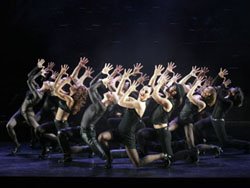
Razzling and dazzling the opening night audience, John Kander and Fred Ebb’s Tony award winning musical, “Chicago” returned to The Broadway Series at the Sacramento Community Theater for a limited two-week engagement.

“Chicago” points the finger at this country’s perennial fascination with bad boys (and girls) and our raising them to near cult status, as we salivate over every gory detail, the more salacious the better. Think Bonnie and Clyde, Al Capone, O.J. Simpson.

This musical is based on actual events during the 1920s, when reporter Maurine Dallas Watkins reported on the trial of a young woman (Beaulah Annan, “the prettiest murderess”) who killed her boyfriend and then called her husband to tell him, as a popular fox trot record played in the background. As Beaulah sat awaiting trial, she announced that she was pregnant, prompting the headling, “Beaulah Annan Awaits Stork, Murder Trial.”

Years later, William Wellman turned the story into a satirical movie called “Roxie Hart,” starring Ginger Rogers, in which the heroine, to kick-start her show business career, confesses to a Chicago murder. Funny man Phil Silvers played her lawyer.

This movie was the inspiration for choreographer Bob Fosse’s collaboration with Kander and Ebb to produce “Chicago, the Musical,” which opened on Broadway in 1975, with Gwen Verdon and Chita Rivera as the the two jailbirds competing for publicity for their respective crimes. The show closed after a two year run, unable to compete with “A Chorus Line,” but was brought back again in 1996, under the direction of Walter Bobbie with choreography by Ann Reinking (in the style of Bob Fosse) when it won 6 Tony Awards, Drama Critics Circle Awards, Astaire Awards, Olivier Awards, Helpman Awards and a Grammy for best cast recording (among many other accolades). The 2003 movie won the Academy Award for best picture.

The appeal of this show is something that is impossible to capture on film with quite the same energy or excitement. Watching large clumps of people executing complex dance steps and making it look effortless is an experience not to be missed.

As Velma and Roxie, Terra C. MacLeod and Michelle DeJean are superb. In each there are echoes of Verdon and Rivera, and I found myself understanding that Fosse had these two specific women in mind when he originally choreographed this show, the moves seeming to be unique to each character, but specific to the style of dancer.

Greg Evigan is marvelous as the smooth, charming, yet slick lawyer, Billy Flynn, who knows how to work the press and, for a price, make his clients such sympathetic figures that no jury would convict them. Billy’s “All I Care About,” performed with several chorus girls armed with fans that would do credit to Sally Rand, is a knock out.

Carol Woods brings down the house with Matron “Mama” Morton’s “When You’re Good to Mama.” She’s a real powerhouse who received the biggest ovation at the end of the evening.

Roxie’s long-suffering husband, Amos Hart, the man who loves his wife no matter what, was given the appropriate downtrodden characterization by Kevin Carolan, but he has his moment to shine as he sings “Mr. Cellophane,” and shine he does.

There are marvelous ensemble numbers in this piece, which rely as much on choreography as they do on lyrics. The “Cell Block Tango,” where each woman explains how she happened to kill her husband/lover is marvelous, and “We Both Reached for the Gun,” where Billie coaches Roxie in how to give her court testimony are both outstanding.

Scenic design for this show is by John Lee Beatty, who places the orchestra center stage, with character entrances and exits over, under, around and through the orchestra box. Dramatic lighting is provided by Ken Billington and the costumes, elegant yet decadent, are by William Ivey Long.

Chicago is one of those musicals that will have you clapping enthusiastically, and then leaving the theater humming “All that Jazz,” and what more could one want from an evening’s entertainment?

Death of a Salesman

Last month, eight Nebraska meatpackers took a chance on a dream, plunked down money for the Powerball Lottery, and won the biggest jackpot in U.S. History.

The rise in popularity of insanely large lotteries, reality shows with millions of dollars in cash at the end of the road, and Internet get-quick schemes shows that the dream of the good life is as alive today as it was for Willy Loman in 1949 when Arthur Miller’s “Death of a Salesman” first debuted on Broadway. The UC Davis production, under the direction of Kent Nicholson, now playing on the Main Stage, will feel as up to date with today’s struggling families as it did to audiences nearly 50 years ago.

Tom McCauley, a working actor for more than 30 years, and now an MFA candidate, is an excellent choice for the role of Willy Loman, who has worked as a traveling salesman all of his life, but now, at 60, is wearing down and trying to decide how he’s going to support his family. McCauley has perfectly captured the look of a man beaten down by life, a little frightened of what lies ahead, but still trying to keep his dreams alive. Despite his disappointments in life, Willie takes pride in two things: First, his ability to make friends, and the host of friends he has made throughout his career (“I realized that selling was the greatest career a man could want. ’Cause what could be more satisfying than to be able to go, at the age of eighty-four, into twenty or thirty different cities, and pick up a phone, and be remembered and loved and helped by so many different people?”).

Willy’s second pride is the accomplishments of his oldest son Biff (Matt Rapore), former high school football star, who Willy is convinced is going to take the professional world by storm.

Biff’s problem is that he can’t possibly live up to Willy’s grandiose fantasies for him. He never received his high school diploma and has been fired from every job he’s held. All he really wants is to move out west and work with his hands. Rapore was off to a slow start as Biff, but as his confidence grew, he gave a powerful performance. The final showdown between Biff and Willy, is skillfully handled by both actors.

In the shadow of his brother is Happy Loman (Michael Yost), who shares Willy’s inflated image of his own importance and questionable moral choices. Yost is makes the audience feel Happy’s frustrating attempts to get his father to notice him.

Lisa Klein is Linda Loman, Willy’s long-suffering wife. Linda is the stereotypical wife of the 40s, taking care of her husband’s needs, supporting his dreams, but with her own frustrations. She mostly suffers in silence and it is her emotional strength which keeps the family together, until things finally explode beyond her ability to control them.

Matt Sullivan is Charlie, Willie’s next door neighbor, who owns a successful business and whose son Bernard ®. Andrew Hess) is a successful lawyer, who has always regarded Biff as his hero.

Willy’s boss, Howard Wagner (Dan Hakim) is a young man whom Willy has known since he was a baby, but Wagner regards Willy with condescension and when Willy goes to him, hoping for a change in his work conditions and perhaps an advance on his salary so he can pay the insurance bill, Wagner fires him.

Willy is losing his grip on reality, and his life seems to be played in the here and now, and in flashbacks to Biff’s glory days and to the days when his wealthy older brother Ben (John Crosthwaite), who recently died, was still alive.

Lighting designer Daniel Goldin uses cool tones for the “here and now” and warm tones for Willy’s flashbacks.

Scenic Designer, Martin Flynn has built a massive, functional set with a colorful backdrop showing the cramped neighborhood in which the Lomans live, and a multi-level house where the action can easily move from bedroom to kitchen to hotel.

In his director’s notes, Kent Nicholson points out that, like Willy Loman, many of us are embracing a system bent on destroying us. “Today there is a cultural obsession to get ahead no matter who we leave behind.”

We have not learned much in the past nearly 50 years. We are, most of us, still Willy Loman, trying to make it in a world that seems determined to keep beating us down.

Willy took comfort in the knowledge that if he had no money to show for his lifetime, at least he had a wealth of friends. The ultimate irony was that the only people at his funeral were his family and his one close friend.