This appeared in The Davis Enterprise on 7/31/2006
When I interviewed Erik Daniells last month about his fledgling company, “Artistic Differences,” he indicated that his goal was to produce small, lesser-known shows, and to cast them with top notch performers from all over the Davis-Sacramento area, in the hopes of creating quality theater that everyone would want to see.
If the first production, “Falsettos,” now playing at the Hoblit Performing Arts Center, is any indication, “Artistic Differences” should have a long and successful life. Each of the 7 actors is outstanding, the stage direction by Michael RJ Campbell is tight and keeps the show moving at crisp pace.
Gino Platina’s choreography is a delight, from the opening “Four Jews in a Room Bitching” to the hilarious “March of the Falsettos.”
“Falsettos” is, in actuality, the second and third acts (“March of the Falsettos” and “Falsettoland”) of the 1992 Tony Award winning musical, “Marvin Trilogy,” by William Finn. It tells the story of Marvin (Craig Howard), a 30-something Jewish man who has admitted to himself (and to his wife and son) that he is gay. He has taken a lover, Whizzer (Jerry Lee), but because Marvin is a good family man, he decides that Whizzer should move into the family home with his wife Trina (Margaret Hollinbeck) and that they all live as one big happy family. (“I want a tight-knit family,” sings Marvin.)
Not surprisingly, this sets up some conflicts for son Jason (Joey Harris), which brings all into therapy with psychiatrist Mendel (Kevin Caravalho), a situation further complicated by Mendel and Trina becoming romantically involved. Soon Trina and Mendel are engaged, and Whizzer leaves Marvin, which leaves Marvin feeling his perfectly constructed little world is falling apart.
Confused? Don’t be. The plot all hangs together. It’s a show about growing up, whether that takes place at 13 or at 30. It’s sweet and funny, touching, and full of heart. Musically, it’s a knockout.
This cast is exceptional. Craig Howard, as Marvin, handles his complex character with aplomb. Marvin is a man who, over the course of two hours, must grow from an irresponsible, eternally boyish man to one who one who embraces the maturity that the situations in his life demand. His relationship with Whizzer is tender and believable, particularly in their final scene, and he has strong, solid voice.
Jerry Lee is a handsome and endearing Whizzer, who brings depth and realism to the role, particularly “You Gotta Die Sometime,” the defiant cry of a man in his prime facing his own mortality.
Kevin Caravalho as the perpetually addled psychiatrist Mendel radiates electricity on stage. With his goofy glasses and expressive face, he’s provides the perfect comic relief from the very first note. Though supposedly the only “sane” one in the cast, he is riddled with his own eccentricities.
Marvin’s wife Trina is played by Margaret Hollinbeck, who also serves as the show’s vocal director, and may deliver the strongest musical performance of the show. She gives a bravura performance in “I’m Breaking Down,” which displays a wide range of talents, from the comedic to the dramatic.
Joey Harris is charming as Jason, trying to come to grips with the fact that “My father’s a homo,”and watching his family fall apart around him, all the while they are trying to plan his bar mitzvah. Harris is quite convincing as a troubled child trying to make sense of a quirky family.
The lesbians next door, don’t appear until act two. Jessica Stein is the kosher caterer Cordelia, always there to offer hors d’oeuvres to anyone in need. Kristen Wagner is her partner, the doctor, who notes that “something very bad is happening,” hinting at the age of AIDS, without actually saying the word (“Bachelors arrive sick and frightened/They leave, weeks later, unenlightened.”) The two characters add some needed additional humor to the darkening mood of Act 2.
The “teeny tiny band,” under the direction of Erik Daniells provide the perfect accompaniment to the action.
Falsettos is the story of immature people of all ages, with perhaps more quirks than most, confronting difficult situations and learning that one must grow up in order to deal with them.
The cast of the newborn“Artistic Differences” handles this situation with professionalism, maturity and a level of talent which predicts a successful life for the company.

Monday, July 31, 2006


Thursday, July 27, 2006
South Pacific
“Some Enchanted Evening,” “Bloody Mary,” “There is Nothing Like a Dame,” “Bali Hai,” “Younger than Springtime.” The list reads like a section from Broadway’s All-Time Greatest Hits, and that’s only Act 1.
Rodgers and Hammerstein’s 1950 Tony-Award winning musical (based on James Michener’s Pulitzer Prize winning novel “Tales of the South Pacific”), which opened Tuesday night at Music Circus’ well-air conditioned Wells Fargo Pavilion, is an old war horse, but its popularity has not dimmed. At times the plot of this musical seems very dated. At other times, one marvels at (and is perhaps depressed by) the consistent timeliness of its message.
Amidst a backdrop of military hijinks on a Pacific island, it tells the more serious story of two couples -- Nurse Nellie Forbush in love with the French expatriate Emile de Becque, and the young Marine Lieutenant Joseph Cable in love with Liat, a Tonkinese woman -- and the racial prejudices that affect all four of them.
Leland Ball, returning for the first time since 2005's “King and I,” has directed a first-rate production, with an outstanding cast.
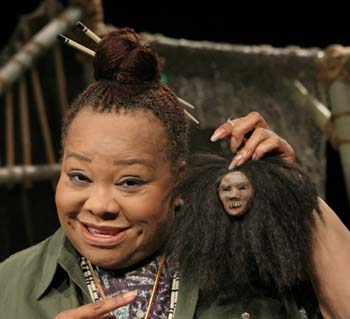
Kerry O’Malley is an absolute delight as Nellie. She has a sparking effervescence that explodes off the stage. Her internal struggles over her attraction to a man who is so different from herself, her joy at discovering her love for him, and her later pain upon learning about de Becque's Polynesian children (Justin Schuyler and Heidi Schuyler) are sincere and believable. She also does a great shower scene (“I”m gonna wash that man right out of my hair”) and her talent show number, “Honey Bun” was delightful.
Samuel Smith is better known for his operatic roles, so he brings the same kind of operatic basso to the character of Emile de Becque that Ezio Pinza did to the original. He gives the role power and dignity. He may be a little lacking in the “suave” department, but this is more than compensated for when he opens his mouth to sing tunes like “Some Enchanted Evening.”
Will Ray is a handsome Lt. Joe Cable with a beautiful voice for “Younger than Springtime,” who effectively displays the bitterness of a conflicted man who realizes that though he loves a woman, his upbringing won’t let him get past the color of her skin (“You’ve Got to be Carefully Taught.”)
Leanne Cabrera is Liat, the young girl, who has almost no lines and no songs, but who makes an impression just for being an endearing young girl swept away by a tall, handsome military man. Since there is a language barrier between the two, her part is mostly pantomime, yet somehow it feels bigger.
The Liat-Joe plot line feels strikingly inappropriate in this day and age, where there is such emphasis on sexual exploitation of innocent young girls. The lieutenant is taken to a remote location by the girl’s mother, where he finds a very young girl for what becomes an instant physical encounter. As the two embrace for the first time (this being a show from 1949, the manner of the encounter is only hinted at, when the lights go down and then come up on a shirtless Joe lying in the lap of a happy-looking Liat), there is such depth to the emotion that it does not ring true. But the plot line has been playing successfully for more than 50 years, so the audience must not mind.
Armelia McQueen is superb “Bloody Mary,” the wise-cracking, betel-nut chewing native woman selling cheap trinkets to the military, speaking broken English and cackling in delight with the seabees, yet she gives a haunting rendition of “Bali Hai,” as she describes the mysterious island just off shore, just out of reach. Mary is a wheeler-dealer who will even prostitute her daughter in the hope of making a good marriage for the young girl.
Simply outstanding is the performance of Robert Creighton as the scheming entrepreneurial seabee Luther Billis, always looking to make a deal, desperate to find a woman. A highlight was his performance of “Honey Bun” at the camps Thanksgiving talent show.
The ensemble is excellent, particularly the seabees, a group of men who each have small solos to sing and who each seem to have principal quality voices.
“South Pacific” is a show which addresses the issue of racial prejudice head on, in a blatantly dated manner, but which evokes situations and emotions still prevalent today. In the end, it is through the children that we see hope for a more tolerant tomorrow. A tomorrow for which we are still waiting, 55 years later.
Wednesday, July 26, 2006
A Flag Touched the Ground
The folks at Barnyard Theater, now celebrating its third season at historic Schmeiser’s Barn, off Rd. 31, had the decided misfortune to open its new production, “A Flag Touched the Ground, or Thorlock’s Tale” by local playwright Nicholas Herbert, during the hottest week of the year.
The price of admission to the play includes free spritzing with bug spray to ward off bugs attracted to the light inside the building, but there is, unfortunately, nothing that can be done to cool off a hot barn, except offer ice cold bottled water at the concession stand and sturdy programs which nicely double as fans.
Temperatures had dropped slightly by Act 2, but not much.
Playwright (or “Dramaturge”) Herbert, who also plays Thorlock, gives his thought process in writing this play.
“‘A Flag touched the Ground’ takes place in Sebess, a city-state which exists in an alternative reality,” he explains, “which echoes, but does not necessarily parallel, our own. The play is not an allegory about the current war in Iraq, Afghanistan, or 9-11. ... [it] employs a wider concept of war - as both cyclical and escalating - as a way of exploring not only our current world, but the historical relationships between war-torn countries and their people.”
The temptation for the audience is to assume that the situation in the Middle East was the inspiration for the show, but as the action proceeds and we watch the orders given to the soldiers, it quickly becomes obvious that this could be any country and any war.
Chris Shepard, who plays The General, stands on a platform shouting encouragement to his troops and you realize he could be Gen. George Patton, Adolf Hitler, Osama bin Laden, or George Bush. The message is the same, the enemy is the same, the encouragement is the same. “They” are a danger to our community and “we” have to attack them, and too bad about the civilians who must die in the process.
Thorlock is a good man who lives with his daughter and his aging father (Josh Nielsen), a tyrant who feels Thorlock is a coward. Herbert’s performance as Thorlock is good in his interactions with the troops (all 4 of them), but is less convincing in the home scenes. Perhaps, as the author of the piece, he’s too close to it.
Fifteen year old Lila Wicker Hunt, the youngest person in the production, had some projection problems in the opening scenes, but she became more understandable later on. She had the unenviable task of spending much of the evening lying under a blanket.
At some point in the past, Thorlock’s wife Alice (Beth Bishop) “disappeared” after going out to the garden to pick mushrooms (in high heels...but let’s not quibble about costuming). Thorlock’s present life is a hunt for the missing Alice, whom he is sure he is going to find somewhere. The search for Alice drives his battle with the enemy.
I have to be honest. I didn’t much like this play. I felt much of the dialogue seemed stilted, though I freely admit that my discomfort in the heat of the barn may have contributed to my negative opinion about the show in general.
Performances overall were adequate, but did not live up to the promise of “My Avisia Winger,” this company’s first show, 2 years ago. Only Zoe Sophia Garcia, in the role of “The Chorus,” the narrator of the piece, rose above adequate. She gave her character a real sparkle.
In addition to those actors already mentioned, the Soldiers of Sebess were played by: Nathan Strickland, James Burchill, Mark Carpenter, Davis Wurzler and Lucas MacDonald.
The one part of the show that gets an unqualified rave is the scene change. I don’t know if the credit belongs to Set Designer Ian Wallace or someone else, but it’s brilliant. To explain it would be to spoil the surprise, so I won’t, but I think it’s fair to say that the audience has probably never seen anything like it before, at least not in this area.
“A Flag Touched the Ground” continues weekends through August 13.
The price of admission to the play includes free spritzing with bug spray to ward off bugs attracted to the light inside the building, but there is, unfortunately, nothing that can be done to cool off a hot barn, except offer ice cold bottled water at the concession stand and sturdy programs which nicely double as fans.
Temperatures had dropped slightly by Act 2, but not much.
Playwright (or “Dramaturge”) Herbert, who also plays Thorlock, gives his thought process in writing this play.
“‘A Flag touched the Ground’ takes place in Sebess, a city-state which exists in an alternative reality,” he explains, “which echoes, but does not necessarily parallel, our own. The play is not an allegory about the current war in Iraq, Afghanistan, or 9-11. ... [it] employs a wider concept of war - as both cyclical and escalating - as a way of exploring not only our current world, but the historical relationships between war-torn countries and their people.”
The temptation for the audience is to assume that the situation in the Middle East was the inspiration for the show, but as the action proceeds and we watch the orders given to the soldiers, it quickly becomes obvious that this could be any country and any war.
Chris Shepard, who plays The General, stands on a platform shouting encouragement to his troops and you realize he could be Gen. George Patton, Adolf Hitler, Osama bin Laden, or George Bush. The message is the same, the enemy is the same, the encouragement is the same. “They” are a danger to our community and “we” have to attack them, and too bad about the civilians who must die in the process.
Thorlock is a good man who lives with his daughter and his aging father (Josh Nielsen), a tyrant who feels Thorlock is a coward. Herbert’s performance as Thorlock is good in his interactions with the troops (all 4 of them), but is less convincing in the home scenes. Perhaps, as the author of the piece, he’s too close to it.
Fifteen year old Lila Wicker Hunt, the youngest person in the production, had some projection problems in the opening scenes, but she became more understandable later on. She had the unenviable task of spending much of the evening lying under a blanket.
At some point in the past, Thorlock’s wife Alice (Beth Bishop) “disappeared” after going out to the garden to pick mushrooms (in high heels...but let’s not quibble about costuming). Thorlock’s present life is a hunt for the missing Alice, whom he is sure he is going to find somewhere. The search for Alice drives his battle with the enemy.
I have to be honest. I didn’t much like this play. I felt much of the dialogue seemed stilted, though I freely admit that my discomfort in the heat of the barn may have contributed to my negative opinion about the show in general.
Performances overall were adequate, but did not live up to the promise of “My Avisia Winger,” this company’s first show, 2 years ago. Only Zoe Sophia Garcia, in the role of “The Chorus,” the narrator of the piece, rose above adequate. She gave her character a real sparkle.
In addition to those actors already mentioned, the Soldiers of Sebess were played by: Nathan Strickland, James Burchill, Mark Carpenter, Davis Wurzler and Lucas MacDonald.
The one part of the show that gets an unqualified rave is the scene change. I don’t know if the credit belongs to Set Designer Ian Wallace or someone else, but it’s brilliant. To explain it would be to spoil the surprise, so I won’t, but I think it’s fair to say that the audience has probably never seen anything like it before, at least not in this area.
“A Flag Touched the Ground” continues weekends through August 13.
Wednesday, July 19, 2006
Aida
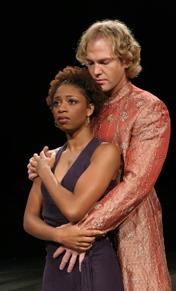 Nobody had a bigger smile on her face at the curtain call than Montego Glover. The actress, playing the title role in Elton John and Tim Rice’s “Aida,” this week’s Music Circus production, had every reason to smile. She had just turned in a mesmerizing performance as the fiery Nubian princess, captured by Egyptian soldiers, who falls in love with her captor, Army captain Radames (Michael Hunsaker).
“Aida” probably has no songs you’ve heard before, but Glover gives a stunning, emotional performance of the first act finale, “The gods love Nubia” and a song from prison, “Easy as Life.”
As her lover, Hunsaker is a strong, virile, handsome man torn between his love of Aida and his duty to his father, Zoser (Adrian Zmed), whose dream is to see his son on the throne of Egypt and who, to that end, has arranged for his son to marry the daughter of the Pharoah (Mark La Mura)
The third member of this love triangle is Radames’ fiancee, Amneris, the Egyptian equivalent of a “Jewish American princess,” a woman best known for her “beauty, her wisdom, and her accessories,” who also acts as a narrator to the story. Kelli Provart is from the Broadway and touring productions of “Aida” and is simply excellent. She brings a comic touch to the tragic tale, but is also regal as the daughter of the Pharoah, who will assume her father’s throne upon his death and bring peace to the region.
An outstanding trio "A Step Too Far," which opens the second act with the three principal characters describing how they find themselves entangled in conflicted loyalties and emotions.
Though the story will be familiar to opera goers, John and Rice have introduced a new character, Mereb, the wise-cracking Nubian slave who delivers Aida from the slave ship to the palace, and suddenly recognizes her as his princess ("How I know you"). Edward M. Barker gives Mereb a nice balance between wheeler-dealer who really kind of likes his life at the palace, and dedicated Nubian who will protect his princess and his king at all costs.
In the small role of Aida’s father, Amonasro is popular local actor, James Wheatley, who gives a somewhat over the top performance, but who makes a fantastic escape in a boat designed by Michael Schweikardt.
Choreography by Todd L. Underwood is energetic, particularly in the Nubian dance sequences.
This is not a “happily ever after” story, the lovers meeting a tragic end, of course, but as a Disney production the writers can’t let people leave the theater depressed, so they cop out and toss in a “what if...?,” “maybe...” sort of ending to give everyone hope.
With all that is going on in the middle east this week, it seemed odd to be watching this musical, where so many of the lines seem applicable to the Israel-Lebanon conflict.
Thursday, July 13, 2006
Artistic Differences

It is rare that one looks to the field of pharmacology for theatrical inspiration, but if it weren’t for the fact that the girlfriend of Davis Musical Theater Company music director Erik Daniels was attending pharmacology school in Stockton, we might not be looking at the birth of “Artistic Differences,” the latest Sacramento area theater company to get its start in Davis.
Daniels, a 23 year old music student in piano performance at Sac State, has been in theater most of his life. He played his first show with the DMTC’s Young Performer’s Theater at the age of 12. By age 13 Steve Isaacson had hired him as the resident accompanist for DMTC. For the past 10 years he has been musical director for most of the DMTC shows. He has also worked with the Woodland Opera House and the Runaway Stage, and produced shows at the Natomas Charter School.
But that didn’t seem to be enough. On his long drives back and forth to Stockton, he began to think of all the under-produced shows that he would like to produce himself. “I hadn’t really intended to start a theater company. It kind of happened in reverse,” he said.
“I’d be on these long drives and think that I wanted to produce a show. I had a list of 5-10 shows, some of which were a little ambitious (like “A Little Night Music”). A friend suggested ‘Falsettos.’ and I thought ‘It’s the perfect show.’
Daniels had seen the show at UC Davis and fell in love with it. “The score is incredible and it has a strong message about family and people overcoming obstacles, about life and death. I think the show is as relevant now as ever, talking about ‘what is a family?’ It may even be more relevant now than it was originally. And the music is wonderful.”
Once he’d chosen a show, ideas for a new theater company began to flow. He invited people he had worked with in other companies to audition for the 7-member cast. “I want to have a lot of actors from different areas, not just Davis.” Joining the cast for Falsettos, then, were Margaret Hollenbeck from Runaway Stage, Kevin Carvalho, Jessie Stein and Kristen Wagner, from DMTC, Greg Howard who has worked in Sacramento and at the Woodland Opera House, Jerry Lee, from Magic Circle in Roseville, and as Jason, who is the young boy in the show, newcomer, Joey Harris.
Finding a venue was never a problem. DMTC had blocks of time between productions, and Steve Isaacson was glad to give his young protege, whom he describes as “incredibly talented” an opportunity to mount his show at the Hoblit Performing Arts Center.
Speaking like a proud Papa, Isaacson said, “Doc Larsen at Sac State said something wonderful to his alumni: ‘go out and do theater.’ Jan and I have been able do that and now we can help give a venue to help other people grow and express themselves creatively.”
With the show chosen and cast, someone asked Daniels, “what’s the next show your company is doing?” “I thought ‘Oh--I’m not really a company, but ...oh...that’s an interesting idea...’” Just like that a company was born.
The fledgling company didn’t have a name, other than the unimaginative “Erik Daniels Productions.” “We went through some jokes and I suggested “how about ‘Artistic Differences’ because it implies conflict and why would you want to have that message? and I thought--wait! I actually like that name.’ So we stuck with it and here we are.”
To get the word out and publicize the upcoming production, Daniels staged a special preview show at the Hoblit Performing Arts Center, featuring songs from the upcoming production of “Falsettos,” as well as songs from a wide range of musicals from the contemporary: Tony Award winner “Urinetown”; the newly emerging: “The Last Five Years” and “A New Brain”; to the rarely produced: “Chess” and Stephen Sondheim’s Tony Award winning classics, “A Little Night Music” and “Assassins.”
“It’s not that we’re competing with other theater companies for audience,” said Daniels. “We’re more set to complement other companies’ shows.”
The preview show was a great success.
“I accomplished what I wanted, which was to to educate people. There are so many shows out there that no one knows. I want to spread the awareness that there is more to theater than ‘Annie.’ People were coming up to me and saying ‘I’ve never heard of this show. I love it! I want to buy the soundtrack.’”
Despite his young age, Daniels has a solid head on his shoulders, and many years watching what works and doesn’t work in theater. He has set the wheels in motion for choosing an artistic committee to decide on future shows. He also knows he cannot function without a Board of Directors to handle the financial side. “One thing with the board is they have to agree not to be in a show. I definitely want someone who loves theater and wants to see this succeed, but who doesn’t want to be on stage. Someone very business minded who has new ways to make a theater company work. We have to do a lot of work with grant writing, so we have to spend a lot of time on that.”
Historically, Davis has provided a wonderful atmosphere for encouraging artistic enterprises and many a theater company has started small and gone on to flourish in this nurturing environment, (and some have not). Whether “Artistic Differences” will be one of those companies which “make it” or whether it will be short-lived remains to be seen, but if enthusiasm and organization have anything to do with it, I feel that we will see a lot more of “Artistic Differences,” as it settles into the theatrical community of Davis.
Tuesday, July 11, 2006
Fiddler on the Roof
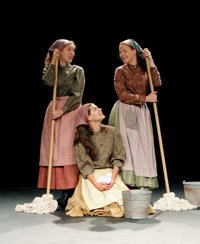 There are a lot of flashy ways to open a musical show. Some use glitz to capture the audience’s attention from the start. One of the most famous stage and film musicals, “Fiddler on the Roof,” Music Circus’ opening production, opens, with a brief introduction by the milkman, Tevye (Ron Orbach) followed by a simple circle dance. “Tradition,” is the simple number in which all Jewish members of the small pre-revolution Russian village of Anatevka join hands and dance around the stage as each group describes its role in the life of the village (Papa earns the money, leads the prayers, and has the final say in family matters; Mama runs the house and tries to make life peaceful for Papa; the son studies and waits for the family to find a bride for him; the daughter learns the ways of running a house and also waits for the family to choose her spouse).
I have seen the circle dance dozens of times and I would be hard pressed to explain why I found this Music Circus staging so special, but it just stuck out for me. It foreshadowed the high energy production to follow.
“Fiddler on the Roof,” based on the 1949 stories of Sholem Aleichem, the 1965 Tony award winner for best musical, with music by Jerry Bock, lyrics by Sheldon Harnick, and libretto by Joseph Stein, is a study in contrasts. There is the fun of Tevye’s personal conversations with God, the innocence of his daughters imagining their future husbands, the antics of the town matchmaker, the tenderness of first love and discovered old love, all contrasted with the bleakness of life in the village, the antagonism between the Jewish community and their Russian overlords. This isn’t a lighthearted comedy, but neither is it a story that is filled with nothing but sadness.
Ron Orbach’s Teveye is a bit more bombastic than I am accustomed to, but he handles the role well.
His wife Golde is played by Valerie Perri, who is quite surprised to discover, after 25 years of marriage that yes, she probably DOES love her husband. (“Do You Love Me?”)
Shannon Warne gives a strong performance as the oldest daughter, Tzeitel, the first in her family to break with tradition by marrying the man she loves (Motel the Tailor – Richard Israel) rather than, Lazar Wolf, the Butcher (Barry Pearl), chosen for her by Yente the matchmaker (an outstanding performance by Helen Geller). Warne and Israel are beautiful together and Motel’s “Miracle of Miracles” is a real ode to joy. Teveye’s love for his daughter is palpable as he gives in to her when she cries that if she marries Lazar Wolf she will be unhappy all of her life.
Tzeitel’s sisters give equally strong performances, Bets Malone as Hodel, who gives her heart to Perchik, the student (Shannon Stoeke) who moves into Tevye’s home to give lessons to his two youngest daughters, Shprintze (Francesca Arostegui) and Bielke ( Harper Junior High student Camille Totah, who will be familiar to Davis audiences); and Julianne Katz as Chava, her father’s favorite, who enrages him by giving her heart to the Russian soldier, Fyedka.
Director Glenn Casale has created a production, with many memorable visual moments. The Sabbath scene is particularly lovely, with Tevye and his family at a table on stage, singing the Sabbath prayers, while the stage rotates, and other members of the town joining in from all around the aisles of the theater.
Michael Schweikardt is credited with scenic design and his on-stage work is good (particularly the roof on which the fiddler (Ivory McKay) plays in the opening scene. Homes in the village are suggested by roofs hung from the rigging above the stage, but they are hung much too high to even be noticed, unless one is looking for them. Greenery, which is supposed to suggest outdoor scenes, is almost invisible and seems hardly worth the trouble to hang.
Choreographer Bob Richard gives us some delightful moments. The dance of the daughters as they sing "Matchmaker, Matchmaker" is fun, and the bottle dance at the wedding of Motel and Tzeitel is always a crowd pleaser. The dream sequence where Tevye convinces Golde that he has seen her grandmother, who disapproves of Tzitel’s marriage to Lazar wolf is great fun.
After a shocking end to Act 1, Act 2 is the darker act, when the reality of the condition of the people of Anatevka comes to light and the happy community is broken up.
This is not a "happily ever after" show, but it demonstrates the resilience of the human spirit and at its core is a salute "to life!"
Thursday, June 29, 2006
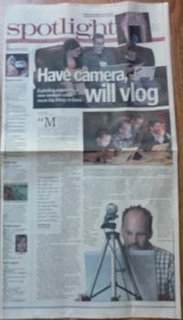
Have Camera, Will Vlog
The following is the article I submitted to The Davis Enterprise for a Spotlight piece. It was edited slightly, for clarity, but is basically the way I originally wrote it...
 "Missbhavens" (who prefers to be known by her internet name) is a labor and delivery nurse who is trying to clean up the home she owns in New Orleans, which was flooded during Katrina. She makes videos where she talks about the bugs which have taken up residence in her home since the hurricane and her feelings of frustration about her job.
Linda McClure, from Palm Springs is retired. She loves golf and her dog Pumpkin and she likes to take videos featuring both.
Ravi Jain, with help from his wife Sonia, conducts interviews with interesting people in his car, as he drives to and from work in the Boston area and posts the interviews to his web site.
In January of 2005, Steve Garfield and his wife Carol started their own "Steve and Carol Show," a "dramady" that ran weekly for a year. Steve has also become a reporter for the popular "Rocketboom," an internet news program, hosted by Amanda Congdon, which provides a daily report on things that are happening in the "vlogosphere."
Not wanting to be left out, I take videos of my SPCA foster puppies, and have a wealth of old home movies my kids made 20 years ago that are getting new life by being posted on the net.
What do we all have in common?
We are all pioneers in the exploding new field of "vlogging."
"Vlogging" is the compressed form of the phrase "video blogging," yet another Lewis Carrollean portmanteau word that typifies Internet jargon. Similarly, a "blog" -- blended from "Web log" -- is like a daily diary that is posted on the Interneet for anybody with a computer and online access to read; a video blog is a norma blog, with video added.
San Francisco’s Schlomo Rabinowitz, one of the organizers of Vloggercon 06, the second annual international vlogging convention, held in San Francisco last week, pointed out that a year and a half ago, there were approximately 100 vloggers on the net--and nobody had heard the term “vlog” before.
A Google search I ran today came up with 6,300,000 entries for the term "vlog.”
Part of the explosion came about because of the creation of sites like Blip.TV or YouTube, video sharing sites which offer free video publishing services to people who have no other way of putting video onto the Internet, and FreeVlog, the brainchild of Michael Verdi and Ryanne Hodson (authors of the newly released “Secrets of Videoblogging”), which gives simple, detailed step-by-step instructions for total neophytes to learn how to create and post their videos.
Vloggercon 06 was attended by nearly 500 people, who came from all over the world. Paul Knight, from Nottingham in England, who was making his first visit to the United States, came only for the weekend, simply to meet his vlogger friends.
Videoblogging is for everyone, of any age. Rainlin, a 7 year old using her mother’s camera, has started her own video blog. Caleb Shickles, a 94 year old retired minister and self-described "Baptist Buddhist," posts weekly videos to his "Hug Nation."
"I’m a creator and an artist," says New York artist, Jan McLaughlin. " To me video blogging is anything I want it to be."
"It’s making something of beauty and sharing it with the world," added Knight.
The two day event reflected a sense of trying to decide where we are and where we are going as a fledgling community. The sessions spanned the level of technology from the very basic to the very technical and showed that while you can get as technical as you want, you really don’t need more than a simple camera that can take videos, a computer, internet access, and a little bit of simple instruction to join the fun.
"A lot of us say that it’s cheap and it’s easy to get into," said Carl Weaver, a teacher from Worcester, Mass. "It is, but only if you’ve already sunk the money into a computer and a camera.
"It’s accessible in the sense that it’s not hard to do. It allows most people to do this relatively easily, and relatively cheaply. It’s still not cheap, but it’s cheaper than it’s ever been before. And it’s getting cheaper.
"That’s a powerful thing."
Kari Peterson, who recently left her long-held position with Davis Community Television and is now working on digital media projects with other community media organizations, including Davis Community Network, was one of the presenters in a panel on public access television. I caught up with her on Sunday morning before her session. She was so excited she was ready to burst.
The day before, she had attended a session on community vlogging and she saw this as an ideal way for Davis residents to come together in a community internet collaboration.
"Public access TV has long been a vehicle for self-expression and self-representation in a medium that is otherwise controlled by commercial and corporate forces," she explained. "Video blogging offers the same thing, but is not encumbered by many of the factors that make television an unlikely medium for the average person.”
Peterson also noted that people’s media consumption habits are changing significantly, making short video blogs more accessible for viewing than longer television shows that have limited airtime.
She questions how best to use this new medium to make a difference in people’s communities.
"It might be used to bring people of like minds together around certain issues,” she said. “Yesterday I sat in meetings about vlogging for political purposes. That resonated with me because we do a lot of that in community media, using the medium to mobilize and educate people, organize them around social issues."
Here's an example: Peace Corps worker Melody Jenkins, in collaboration with world traveler Jon Rawlinson, for example, started a community vlog which brings the world news of Nata, Botswana (described as “nothing more than a dust hole”), where the population is 5,000 and 37% are infected with the AIDS virus.
Through frequent videos, they are making the world aware of the fight in this one tiny corner of Africa.
Peterson also recognizes that video blogging can be so much more.
For Erin Nealey, a stay at home mom from South Carolina, video blogging started out as being a way to communicate with close friends and family, and to let the grandparents watch the kids grow. Later, as she began to make friends with other vloggers, it became a way to connect with people and share ideas.
Josh Leo a 22 year old from Grand Rapids, Michigan echoes that sentiment. "It’s sharing your life and forming relationships by doing that."
Susan Kitchens is using video blogging to create an oral history project and to help people gather their own family histories.
"Digital storytelling, oral history projects and videoblogging have a lot to offer each other," she explains. "At their best, the best video blogs are about personal storytelling. New advances in capturing oral histories add another dimension to the story."
Richard Hall, from the Missouri Ozarks, looks at it more technically, and in a manner likely to make a casual listener's eyes glaze.
"A traditional thing with video blogs is that they have syndication so that you can use an RSS reader so you can use RSS with enclosures. To me it’s kind of a technical bit to define it technically."
That sort of response may turn off people who have no idea what "video syndication" is, or what an RSS feed is, but the variety of responses I got to my question about what constitutes a video blog shows how there is something for everyone, and that even those involved in doing it aren’t exactly sure how to define it.
The ideas are limitless.
"It is like the wild west," said Rabinowitz, describing his vision of this pioneering art form. "All of us are just trying to figure out where you make the streets and where you set up a house and that sort of thing. We want to do that now, which is very important, before some professional corporation walks in and buys the block.
"Now is our time. If we did this in a year from now or two years from now we would be walking into this strip mall that we didn’t help create. We might as well create our own town here."
Kari Peterson’s immediate dream is to get together with people of all ages in the Davis Community who are either vlogging or interested in learning more about vlogging. She sees Davis as creating our own subdivision of this wild west town Rabinowitz describes. With its long tradition of oral history, with political activism, and with its openness to new things, she feels that Davis is perhaps the perfect community to design and implement a community video blog, learning as we go along exactly how that can benefit the community at large.
Anyone who would like more information on this project, contact Kari Peterson (kapeters@dcn.org) or myself (basykes@dcn.org).

 "Missbhavens" (who prefers to be known by her internet name) is a labor and delivery nurse who is trying to clean up the home she owns in New Orleans, which was flooded during Katrina. She makes videos where she talks about the bugs which have taken up residence in her home since the hurricane and her feelings of frustration about her job.
 Linda McClure, from Palm Springs is retired. She loves golf and her dog Pumpkin and she likes to take videos featuring both.
Ravi Jain, with help from his wife Sonia, conducts interviews with interesting people in his car, as he drives to and from work in the Boston area and posts the interviews to his web site.
In January of 2005, Steve Garfield and his wife Carol started their own "Steve and Carol Show," a "dramady" that ran weekly for a year. Steve has also become a reporter for the popular "Rocketboom," an internet news program, hosted by Amanda Congdon, which provides a daily report on things that are happening in the "vlogosphere."
Not wanting to be left out, I take videos of my SPCA foster puppies, and have a wealth of old home movies my kids made 20 years ago that are getting new life by being posted on the net.
What do we all have in common?
We are all pioneers in the exploding new field of "vlogging."
"Vlogging" is the compressed form of the phrase "video blogging," yet another Lewis Carrollean portmanteau word that typifies Internet jargon. Similarly, a "blog" -- blended from "Web log" -- is like a daily diary that is posted on the Interneet for anybody with a computer and online access to read; a video blog is a norma blog, with video added.
San Francisco’s Schlomo Rabinowitz, one of the organizers of Vloggercon 06, the second annual international vlogging convention, held in San Francisco last week, pointed out that a year and a half ago, there were approximately 100 vloggers on the net--and nobody had heard the term “vlog” before.
A Google search I ran today came up with 6,300,000 entries for the term "vlog.”
Part of the explosion came about because of the creation of sites like Blip.TV or YouTube, video sharing sites which offer free video publishing services to people who have no other way of putting video onto the Internet, and FreeVlog, the brainchild of Michael Verdi and Ryanne Hodson (authors of the newly released “Secrets of Videoblogging”), which gives simple, detailed step-by-step instructions for total neophytes to learn how to create and post their videos.
Vloggercon 06 was attended by nearly 500 people, who came from all over the world. Paul Knight, from Nottingham in England, who was making his first visit to the United States, came only for the weekend, simply to meet his vlogger friends.
Videoblogging is for everyone, of any age. Rainlin, a 7 year old using her mother’s camera, has started her own video blog. Caleb Shickles, a 94 year old retired minister and self-described "Baptist Buddhist," posts weekly videos to his "Hug Nation."
"I’m a creator and an artist," says New York artist, Jan McLaughlin. " To me video blogging is anything I want it to be."
"It’s making something of beauty and sharing it with the world," added Knight.
The two day event reflected a sense of trying to decide where we are and where we are going as a fledgling community. The sessions spanned the level of technology from the very basic to the very technical and showed that while you can get as technical as you want, you really don’t need more than a simple camera that can take videos, a computer, internet access, and a little bit of simple instruction to join the fun.
"A lot of us say that it’s cheap and it’s easy to get into," said Carl Weaver, a teacher from Worcester, Mass. "It is, but only if you’ve already sunk the money into a computer and a camera.
"It’s accessible in the sense that it’s not hard to do. It allows most people to do this relatively easily, and relatively cheaply. It’s still not cheap, but it’s cheaper than it’s ever been before. And it’s getting cheaper.
"That’s a powerful thing."
Kari Peterson, who recently left her long-held position with Davis Community Television and is now working on digital media projects with other community media organizations, including Davis Community Network, was one of the presenters in a panel on public access television. I caught up with her on Sunday morning before her session. She was so excited she was ready to burst.
The day before, she had attended a session on community vlogging and she saw this as an ideal way for Davis residents to come together in a community internet collaboration.
"Public access TV has long been a vehicle for self-expression and self-representation in a medium that is otherwise controlled by commercial and corporate forces," she explained. "Video blogging offers the same thing, but is not encumbered by many of the factors that make television an unlikely medium for the average person.”
Peterson also noted that people’s media consumption habits are changing significantly, making short video blogs more accessible for viewing than longer television shows that have limited airtime.
She questions how best to use this new medium to make a difference in people’s communities.
"It might be used to bring people of like minds together around certain issues,” she said. “Yesterday I sat in meetings about vlogging for political purposes. That resonated with me because we do a lot of that in community media, using the medium to mobilize and educate people, organize them around social issues."
Here's an example: Peace Corps worker Melody Jenkins, in collaboration with world traveler Jon Rawlinson, for example, started a community vlog which brings the world news of Nata, Botswana (described as “nothing more than a dust hole”), where the population is 5,000 and 37% are infected with the AIDS virus.
Through frequent videos, they are making the world aware of the fight in this one tiny corner of Africa.
Peterson also recognizes that video blogging can be so much more.
For Erin Nealey, a stay at home mom from South Carolina, video blogging started out as being a way to communicate with close friends and family, and to let the grandparents watch the kids grow. Later, as she began to make friends with other vloggers, it became a way to connect with people and share ideas.
Josh Leo a 22 year old from Grand Rapids, Michigan echoes that sentiment. "It’s sharing your life and forming relationships by doing that."
Susan Kitchens is using video blogging to create an oral history project and to help people gather their own family histories.
"Digital storytelling, oral history projects and videoblogging have a lot to offer each other," she explains. "At their best, the best video blogs are about personal storytelling. New advances in capturing oral histories add another dimension to the story."
Richard Hall, from the Missouri Ozarks, looks at it more technically, and in a manner likely to make a casual listener's eyes glaze.
"A traditional thing with video blogs is that they have syndication so that you can use an RSS reader so you can use RSS with enclosures. To me it’s kind of a technical bit to define it technically."
That sort of response may turn off people who have no idea what "video syndication" is, or what an RSS feed is, but the variety of responses I got to my question about what constitutes a video blog shows how there is something for everyone, and that even those involved in doing it aren’t exactly sure how to define it.
The ideas are limitless.
"It is like the wild west," said Rabinowitz, describing his vision of this pioneering art form. "All of us are just trying to figure out where you make the streets and where you set up a house and that sort of thing. We want to do that now, which is very important, before some professional corporation walks in and buys the block.
"Now is our time. If we did this in a year from now or two years from now we would be walking into this strip mall that we didn’t help create. We might as well create our own town here."
Kari Peterson’s immediate dream is to get together with people of all ages in the Davis Community who are either vlogging or interested in learning more about vlogging. She sees Davis as creating our own subdivision of this wild west town Rabinowitz describes. With its long tradition of oral history, with political activism, and with its openness to new things, she feels that Davis is perhaps the perfect community to design and implement a community video blog, learning as we go along exactly how that can benefit the community at large.
Anyone who would like more information on this project, contact Kari Peterson (kapeters@dcn.org) or myself (basykes@dcn.org).

Tuesday, June 20, 2006
Oklahoma!
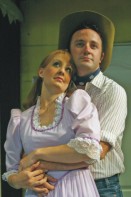
The Davis Musical Theater Company has closed out its first full season at the new Hoblit Performing Arts Center with a sparkling, energetic production of the classic “Oklahoma!” produced by Jan and Steve Isaacson, Directed and staged by Michael Manley, with musical direction by Steve Isaacson and Choreography by Dian Hoel.
“Oklahoma!,” the first musical collaboration of Rodgers and Hammerstein, who later brought the world the likes of “Carousel,” “South Pacific,” “The King and I” and “Sound of Music,” changed the face of musical theater history when it debuted in 1943, for telling an emotional story through music, lyrics and dance as had never been before. Based on the play “Green Grow the Lilacs” by Lynn Riggs, “Oklahoma!” brought something akin to folk art to professional theater and won the Pulitzer prize for drama in 1944.
One dare not look too closely at the “plot” of this musical, for there is little there. At a time where we have come to follow heavy themes like “Les Miserables” or “Evita” or “Titanic,”, the story of a boy and a girl, their friends and a lunch box social is not exactly likely to provoke much psychological introspection.
The story is set in the Oklahoma territory, in 1907, the days just before statehood, and touches ever so lightly on the ongoing feud between farmers and cattlemen, though that definitely takes a back seat to the story of Curly, a cattleman, in love with Laurey, who lives on a farm with her Aunt Eller and the hired man, Jud Fry, the dark character who has his eye on Laurey, while Laurey has her eye on Curly.
Brennen Cull heads a strong cast in the role of Curly while Claire Lawrence is Laurey. Cull and Lawrence are just wonderful together. Both are blessed with strong, clear voices. The sparks fly when they argue, making the chemistry when they are emotionally together believable.
Mary Young is the perfect Aunt Eller, and you just haven’t lived until you’ve seen Young as a gun-totin’ senior citizen.
Jaime Tvrdik gives Jud Fry a sympathetic persona that we don’t often see (Steve Isaacson, doing the role decades ago, had that same touch). Fry is desperately in love with Laurey, but doesn’t know how to treat a woman and frightens her more than anything else.
Lauren Miller is an adorable hormone-charged Ado Annie, who falls in love with any guy who sweet talks her. Miller’s Annie is at the same time coy, flirtatious, and sometimes the stereotypical blonde airhead and she carries it off beautifully.
Hoping to save $50 so he can marry Annie is Will Parker (Brad Bong). Will and Annie are intellectually matched, and Bong gives a strong performance, imbued with a simple innocence, which works because he is as cute as he is talented.
Robert Bugg is Ali Hakim, the peddler whose eye is also set for Annie, though not in quite the same way as the lovestruck Will. Eddie Albert played this role in the 1955 movie and Bugg’s performance is every bit as good.
Dian Hoel and Ryan Adame are “Dream Laurey” and “Dream Curly” in the Act 2 ballet.
The DMTC Orchestra is under the direction of Kate Jansen and is one of the better orchestras I’ve heard since DMTC moved into its new theater.
Costumes are by Jeanne Henderson, who has created a beautiful rainbow of colors for both the women and for the men. Henderson works so hard at making her costumes authentic, that it is a bit of a puzzlement to know why she puts Laurey in bib overalls in the opening scene. Though Claire Lawrence is cute as a button in them, the effect is jarring, seems contrary to the period, and contrasts negatively with all the frills and lace of her friends, or the utilitarian work skirt of Aunt Eller.
Jennifer Bonomo did the scenic design, including a beautiful rolling hill scene at the back. It is unfortunate that more care was not taken to make sure that the pieces of the wood lined up, as the gaps where the pieces did not meet properly were distracting.
Dannette Vasser, however, has done a beautiful job of lighting, especially the lovely sunrise which opens the show.
The Davis Musical Theater Company has settled into its new home and things are all coming together. This is the first show that didn’t feel “almost, but not quite ready” on opening night. There wasn’t even a crowd in the lobby waiting for the doors to open, 5 minutes before the publicized start of the performance.
With things finally coming together so nicely, it bodes well for an exciting 2006-2007 season.
Thursday, June 15, 2006
Dr. Dolittle
 Besides being a multi talented choreographer, director and actor who has, over his career won some 9 Tony awards, Tommy Tune, now appearing as Dr. Dolittle in the musical of the same name (a show which he is credited with staging) at the Sacramento Community Center, has the longest legs in show biz. Whether he is towering over the chorus, or draping his legs over the arm of his plush chair as he decides to learn how to “talk with the animals,” you are always aware of those long, long legs (accentuated by the costumer’s [Dona Granata] choice of bold stripes for the actor’s pants.)
“Dr. Dolittle” was originally scheduled for earlier in the season, but had production problems to work out, and so was brought in to close out the Broadway Series for this year. It’s a 90 minute bit of fluff, performed without intermission (so be sure to make a pit stop on the way into the theater), based on the Oscar award winning movie of the same name, starring Rex Harrison in the title role, and based on Hugh Lofting’s “The Voyages of Dr. Doolittle,” a six book set, the first of which was written in 1920.
It is obvious that this show is based on a series of short stories, as there is no real “flow” from beginning to end, with individual scenes that could easily stand alone, and only the flimsiest of plots. It is designed to appeal to children, and children will love the colors, the animals, and the action, but may get bored in the more serious moments – Dolittle’s song of farewell to Sophie the Seal, for example, and his brief almost-romantic scenes with Lady Fairfax (Dee Hoty). Adults may feel that it drags in spots, but will find enough charm to keep the interest alive through to the end--and Tune’s overly long curtain speech about how much he loves Sacramento and how he will be happy to autograph his $20 lithographs on sale in the outer lobby.
Some songs may be familiar – the aforementioned “Talk with the animals,” and “Fabulous Places” (which those who don’t recognize the title will recognize as soon as it begins), others are forgettable and slow the pace, but then along comes “Monkey-Monkey Island Dance,” with enough tap dancing to satisfy any devotee and the show is right back on track again.
The story follows John Dolittle, a physician who realizes that he is not very good with people, but wonderful with animals, so decides to become a veterinarian instead. His “stable” of patients is delightful. Jip, the shaggy dog (operated by Allan Mangaser and Jessica Wu), Polynesia the operatic macaw (Sandi DeGeorge), Toggle, the extremely sway-back, nearsighted horse (David F.M. Vaughn and Erin Webley), and my personal favorite Gub-Gub, the overweight pig (Matthew Crowle). Each of these animals is a puppet of sorts, while Chee-Chee, the monkey is played by costumed 12 year old Aaron Burr, whom Tune described as “America’s best tap dancer” when he discovered him on “Good Morning, America.”
As the show progresses, more animals are added to the mix. Sophie (Elisa Van Duyne and Steven Wenslawski) is a lovesick sea lion, who longs to return to her fiancé, Ernie (Joe Jackson).
And of course there is the famous Pushmi/Pullyu, the coming-or-going llama (Scott Leindecker and Jonathan Richard Sandler) who becomes a circus star under the Ringmaster, Blossom (Joel Blum), who gives an energetic and outstanding performance.
Rounding out the menagerie are the fantastical giant snail, Jean-Pierre (Jonathan Richard Sandler), who speaks only “ancient escargot” and the Giant Lunar Moth (Elisa Van Duyne), who flies Dolittle from Monkey Island back to his town of Puddleby-on-the-Marsh.
There are some nice special effects in the show, such as a perilous shipwreck and, more subtle, a lovely waterfall on Monkey Island (scenery designed by Kenneth Foy).
Adults who have seen Tune throughout his long career may have wished for a bit more dancing (he does most of “Talk to the Animals” sitting in a chair, for example), but he has been dancing across the stage for more than forty years now and seems thrilled to be passing the torch on to young Burr. Their tap-dancing duet in the “Monkey-Monkey Island Dance” was delightful.
Musical Direction is by Michael Biagi, who wears several different hats (literally) throughout the performance.
“Dr. Dolittle” isn’t the best show you’re going to see all year, but it is charming, entertaining, and with all that is going on visually and musically, there is something for just about everyone to like.
Sunday, May 28, 2006
The Venetian Twins
 I desperately wanted to go home at intermission on opening night of Acme Theater Company’s production of Carlo Goldoni’s “The Venetian Twins,” on the Davis Art Center outdoor stage.
My desire to leave had nothing to do with the delightful slapstick comedy that was going on on stage, and everything to do with the fact that it was very, very cold in the outdoor amphitheater and I had not thought to bring warm enough clothing.
“The Venetian Twins” continues through Monday evening and while I encourage everyone to go and see this sparkling free production, I also advise warm clothes and a blanket. A thermos of hot coffee might not be such a bad idea either.
The Acme adaptation of Goldoni’s “twin play” is a rather loose one, explains director David Burmester. Before the cast got the script, he had already decided to add a second set of twins to the original story. He notes that “The script I handed the cast on the first day of rehearsal was a result of a severe working over of Goldoni, interjecting a number of modern turns of phrase and, of course, the new set of twins.”
Once the cast has the script they being to “riff on it.” “It never stops,” says Burmester. “Sometimes a great gag is the result of a serendipitous accident.”
Seeing these young actors on the stage, one cannot help but know that they are just having the time of their lives. Anyone who might be a devotee of the original Goldoni play might not quite recognize it in this form, but if the end justifies the means, the playwright himself would get a chuckle out of it. It’s more like the Marx Brothers and the Three Stooges go romping through the 18th century.
The story is not unfamiliar. A very funny flip chart lecture at the beginning by the character of Brighella (Zack Leuchars) gives everyone an overview of the lives of the characters to this point, in order to avoid having to do a lot of expository dialog throughout the play itself.
As for the story unfolding on stage, it tells the tale of long-separated identical twin brothers, who arrive in Verona on the same day, unbeknownst to each other. One has come to meet his wife-to-be (a marriage arranged by the Widow Balanzoni (Lisa Voelker); the other is meeting his fiancée, who has run away from her family to join him. Naturally all sorts of misunderstandings follow when jewels, money, and declarations of love are passed back and forth among the wrong people. There are sword fights, fistfights, seduction attempts, flirtations with incest, battles with the law and the endless confusions of identity.
Playing the twins, Zanetto (the rich, but dim-witted one) and Tonino (the poor but gentlemanly and honorable one) is Dara Yazdani in a role which is ready-made for him. With his long, lanky body which sometimes appears to have no bones, and his ability to get the most out of facial expressions, he was able to make Zanetto and Tonino completely different people in the blink of an eye. Zanetto’s last scene in the play was hilarious.
Madelyn Ligtenberg (Rosaura) and Fiona Lakeland (Beatrice) are the confused would-be fiancées to the twins.
Anthony Pinto has the plum role of Pancrazio, in love with Rosaura, to whom Zanetto is betrothed. Pinto is so talented he can play a wide range of characters, but he really shines at being the bad guy.
Tatiana Ray is Colombina, the brazen, man-crazed maid to Rosaura, who gets away with murder in the house because she knows Rosaura’s mother’s (Lisa Voelker) long-held secret.
Victoria Gimpelevich is Arlecchinetta, companion to Beatrice, masquerading as a man to act as her mistress’s protector. John Ramos is Arlecchino, her long-lost twin brother.
Josh van Eyken is the foppish Lelio and J.R. Yancher is Tonino’s confused pal Florindo, both hoping to win the hand of Beatrice away from Tonino.
There are several fun dance numbers (particularly one by porters Ernie Hernandez and Isaac Aldous) which pop up from time to time, and which do credit to choreographers Cami Beaumont and Laura Flanigan.
Josh van Eyken, J.R. Yanker and Dara Yazdani are credited with sword fight choreography and deserve high marks.
The first act of this production seems to run a little long, but it may have been because the wind had picked up again, but the second act zips by. Acme has again presented a delightful comedy which leave the audience laughing after the cast has taken its bows.
Don’t let the possibility of a cold evening keep you from this performance. But do remember to plan accordingly to enhance your enjoyment of the fun on stage.
Friday, May 26, 2006
Sanatorium Under the Sign of the Hourglass
 “Sanatorium Under the Sign of the Hourglass” opens tonight for a two week run on the University Main Stage. Based on a story by Polish novelist and painter, Bruno Schulz, Sanatorium tells the story of a son who goes on a fantastical journey to save his father from death. Under the direction of Granada Artist-in-Residence, Helena Kaut-Howson, “Sanatorium”becomes a unique form of experimental theater which encourages collaboration among individual actors to establish an ensemble, wherein each actor creates his or her own character within the confines of the author’s words and the director’s vision.
This is a slightly more than two hour production, with no intermission, which opens with a brief skit, “The Other Jew,” based on Henryk Greenberg’s story, “Drohobycz Drohobycz.” This curtain riser features Lauri Smith as Ruth, a mother writing to her son, telling him of her search for information about the life and death of Bruno Schulz, and Paula Dawson as an older woman remembering what things had been like in the ghetto. Both women give superb performances. Dawson, in particular, who may be remembered for her outstanding “Macbeth,” creates a believable old woman with very simple facial expressions and body posture--not always quite so successful in younger actresses.
One play segues into the other with the entrance of the rest of the cast onto the stage: Dave Cantrell, Melisa Cavazos, Michelle Jackson, Jessica Rodriguez, Derricka Smith, and Christina Soliva, most of whom play more than one character. JT Reece is Joseph. Theater and Dance faculty member Sheldon Deckelbaum is his father, who explains that he was drawn to the role because of the challenge of working in the ensemble setting.
There is no real “plot” per se, but there are stunning visual images of the holocaust – smoke canisters, crowding into tiny spaces, and the presence of soldiers, all within the context of a sanatorium.
A very big part of the success of this piece is the contribution of the show’s designers--Robert Broadfoot (scenic and costume design), Brian Webber (lighting design), Kristin Orlando (sound design), Erich Bolton (Video design). Without the atmosphere these designers create, this show would have a significantly less powerful impact.
I caught this show in its preview performance and the director told me that it was still “a little rough.” I would be hard pressed to find any rough spots. This is a powerful production which contains partial nudity and is not designed for children, but packs a wallop and leaves a lasting impact.
Tuesday, May 23, 2006
Humble Boy
 A mere glance at the program, which indicates that the two families involved in Charlotte Jones’ Play, “Humble Boy,” at the Delta King through June 25th, are named the Humbles and the Pyes tells the audience that it is in for a fun evening.
Though this is billed as a comedy, and though it is indeed very funny, there are times when it seemed to have an identity crisis--was it really a comedy, or was it really a drama? It has been said that it has overtones of Hamlet, and indeed it does. This story of twisted family relationships following the death of the father in the family, works as either comedy or drama, and, fortunately, under the direction of Stephanie Gularte, it works well as both.
Capital Stage managing director Peter Mohrmann is Felix Humble, the shy, somewhat rumpled, overweight Cambridge University astrophysicist who has returned to his Cotswold home following the death of his father, an entomologist and bee keeper. Being back in the family home, and at odds with his overbearing mother (who describes him as “fat and strange”), is a situation fraught with tension that brings back his annoying stutter and makes it impossible for him to deliver the eulogy at his father’s funeral.
Obviously a brilliant scientist, his stutter disappears and his self-confidence grows when he speaks of his research on “string theory” which will allow us to understand the universe, though he seems incapable of understanding his own life.
Mohrmann is simply outstanding – gawky, awkward, as he searches for the answers to the questions in a world that seems to be unraveling before him.
Janis Stevens, recently nominated for a New York Drama Desk award for her one-woman show, “Vivien”, based on the life of Vivien Leigh, plays Felix’s mother, Flora Humble. Her portrayal of the not-so-grieving widow is both icy and emotional, depending on the situation and Stevens handles both with aplomb.
Flora is “incandescent with rage” about her son’s departure from his father’s funeral and, as she speaks we learn very quickly that she wasn’t too fond of her dearly departed husband either. Immediately following his death, she got rid of his beloved bees and gave away his clothes to a local charity, without consulting Felix. She wraps her husband’s ashes up as a gift to give to the unsuspecting Felix, since she doesn’t want them and thinks he might like to have them.
Flora is having an affair with a lecherous old neighbor, George Pye (David Silberman), whom Felix hates, and who wants to marry Flora, now that she’s a widow.
The affair comes as news to Felix, though it has been going on for 10 years, he learns from George’s daughter, Rosie Pye (Kathleen Saumure), Felix’s former girlfriend and mother of the child he didn’t realize he had fathered. Rosie is a survivor and proud of having been a successful single mother, doing a good job of raising her daughter.
The delightfully fey Georgann Wallace plays Marcy Lott, a people-pleasing, scatterbrained family friend who wants to keep peace at all costs. Wallace is a wonderful comedienne who steals every scene she is in. Her touch up for the seasoning in the gazpacho she has made for a family meal will probably be the one scene that nobody will ever forget, though her monologue during grace at the same meal is an absolute show stopper, and wins applause.
Jim Lane is Jim, the mysterious Gardener, who has his own little secret and who isn’t quite what he seems. Lane gives his usual solid performance.
The set for this enjoyable show is by Stephen Jones, who has created a lush British garden, even if things spilled deliberately or accidentally onto the astroturf are somewhat difficult to clean up.
Costume design is by Rebecca Redmond, who has dressed Flora in some gorgeous costumes, including her funeral attire which, with the large dark glasses, give her the appearance of a Queen Bee, quite appropriate for this insulated little hive.
Playwright Charlotte Jones doesn’t have quite the light touch that one finds in an Alan Ayckbourn (to which she is sometimes compared), but the whole of “Humble Boy” is uniquely hers and is a thoroughly satisfactory and enjoyable piece of theatre.
Friday, May 19, 2006
The Island
 In 1973, in pre-Apartheid South Africa, white playwright Athol Fugard collaborated with black actors John Kani and Winston Ntshona to produce a powerful play called “The Island,” based on events which took place at South Africa’s notorious Robben Island (where Nelson Mandela was incarcerated).
It was against the law for these men to meet, much less collaborate on what was a very subversive work, even given its vagueness, as to time, location, or specific events, and the three men were persecuted for years (Kani and Ntshona were jailed and Fugard had his passport revoked for a time).
More than thirty years after its debut, “The Island” still resonates as a work about honor and friendship and dignity under the most appalling of conditions.
Directed by Theater and Drama Department Chair Peter Lichtenfels, “The Island” opened for four performances only at Wyatt Pavilion, running through Sunday, May 21.
This two person play features Dahlak Brathwaite as John and James Marchbanks as Winston. Both men give powerful and memorable performances. Unfortunately, one of the production’s strengths is also one of its weaknesses. Under vocal and dialect coach Melanie Julian, the men speak with what I can only assume is an authentic South African accent which is often difficult to understand when the dialog gets emotional.
But there is no mistaking the chemistry. even when the words get lost. John and Winston spend most of their time locked together in a small cell, where they share one cup and one washcloth. They do backbreaking work in the local quarry, after which they are thrown back into their cell. Over the years, a strong friendship has grown between the two men, who support each other and try to keep each other’s spirits up as they dream about what they want when they are released (food, booze and women) and reminisce about life on the outside.
The men are rehearsing scenes from Sophocles’ “Antigone,” which they intend to perform for a prison talent show. The parallels between the ancient Greek tragedy and modern So. Africa are painfully apparent, though there is a lot of humor which is used to soften the message.
“The Island” is an all purpose production. It has very funny bits, it has heavy drama, and it has exceptionally fine acting in Brathwaite and Marchbanks. Plan to listen carefully to get past the accents, but once you get into it, the effort is all worth while.
Wednesday, May 17, 2006
Sly Fox
 Larry Gelbart’s body of works reads like a who’s who of comedy, including such classics as Sid Caesar’s “Your Show of Shows,” “Tootsie,” “Oh, God!” “Three’s Company,” “The Danny Kaye Show,” and, of course “M*A*S*H,” among many, many other familiar titles.
Is it any wonder, then, that in the hands of Gelbart,“Volpone,” Ben Johnson’s 17th century social satire, could be so delightfully recreated as the 20th century “Sly Fox,” now playing at the Woodland Opera House, under the direction of Lydia Venables.
“Sly Fox” updates the setting from Renaissance Venice to 19th century San Francisco, and changes the tone from satire to bawdy farce, which occasionally has the feel of a Bob Hope stand up routine. It is 2 hours of non-stop knee-slappers and groaners, handled expertly by a strong cast, headed by Stephen Kauffman as Foxwell J. Sly, a rich man who lives for gold (“God, with an ‘L’”) and who has figured out a way to get his friends to bring him even more gold.
Sly’s accomplice is the dapper Simon Able (Dean Shellenberger), whose gambling debts have left him dependent on Sly, and left him with no alternative but to do his employer’s bidding. Shellenberger has a droll wit which suits him well in this role.
Sly’s plan is to let all of his rich friends know that he is at death’s door and that he has not yet decided who should be the beneficiary of his will. One by one, the “friends” show up, golden gifts in hand, hoping to curry favor with the man they think is dying, all the while continuing to fill his chest with more gold.
It’s difficult to tell whether Sly is having more fun watching his swelling coffers or making fools out of his neighbors. When he realizes that they are running out of real gold to bring him, in the hopes of becoming sole heir, Sly decides to show Simon the baser side of mankind by getting his accountant, Abner Truckle (Greg Collet) to offer his wife to the “dying” old man, for a little death bed fun in the sack. He also wants Simon to convince the miserly Jethro Crouch (Micail Buse) to name Sly as his only heir, effectively disinheriting his own son, Captain Crouch (David Cripe).
Collet and Buse are wonderful in their respective roles. Buse, particularly, as the doddering Crouch has the bird-like physique often caricatured for miserly old men and is very funny without taking it all over the top.
The women in the cast take smaller, though no less important roles. Lee Marie Kelly is very funny as Miss Fancy, a prostitute in the best Mae West tradition, who hopes to get a deathbed marriage out of the “dying” Sly. Her best scene, however, is with Jethro Crouch, a scene which seems to be lifted from Vaudeville stage, and which, along with the rather racy dialog throughout the show, would give it an “R” rating.
Alex Weir is the beautiful and virtuous Mrs. Truckle, ready to do anything for her husband, and again, her bedroom scene with Sly is worthy of a Vaudeville routine, and gets the predictable big laughs.
Gerald Ooley is very funny as the Chief of Police, who wants to wring every salacious moment out of the story of the goings on between Sly and Mrs. Truckle.
Don Myers is the befuddled Court Clerk, who transcribes at a snail’s pace. His timing is perfect and very funny.
Rounding out the cast are Jen Smuda Cotter and Lexie Kenyon as Sly’s two maids (who stay in character, even when helping to change set pieces in the dark) and Alan Smuda as the Bailiff.
Kauffman does double duty as both Sly and, in Act 2, as the bombastic hanging judge, Judge Bastardson.
Scenic and Lighting design is by Jeff Kean, who has created a solid feeling bedroom for Sly with a nebulous view out the window which is supposed to be turn of the century San Francisco, but which looks more like the rooftops of a Spanish or Greek coastal town.
Laurie Everly-Klassen designed the costumes, with her usual panache.
There is still a lot of 17th century feel to this farce, but Gelbart’s snappy dialog brings it up to date. “Sly Fox” is not a show to take the kiddies, but for an adult audience this fast-paced, very funny production will have you chuckling throughout and wondering how two hours passed by so quickly.
Monday, May 15, 2006
The Faith Project
 The lines between religion and theater seems to be rapidly disappearing these days. In an effort to hang on to members, churches don’t just conduct “worship services,” now they come with balloons and bands and animal parades and anything that will entertain the congregation and keep them coming back each week.
When a minister like Joel Osteen, with full band and multi-voice choirs, can sell out Madison Square Garden for two performances and fill the enormous Lakewood Church in Houston each week, there has to be a lot of theater involved.
It is not surprising that someone would eventually erase the lines entirely and bring church into the theater.
Susannah Martin, an MFA directing candidate is that person. Her production, “The Faith Project” is that experiment. It will be running through next weekend at the Mondavi Studio Theater. Martin explains that the impetus for her project was “political, personal, and creative.”
She set out to ask what it would mean to create a theatrical liturgy. When is theater spiritual? When is a service theatrical?
The show is written, created and performed by Samantha Blanchard, Christopher Maikish, Karen Marek, Ashanti Newton, Michael Ortiz, Karuna Tanahashi, Natasha Tavakoli, Carolyn Thomas and Rosa Threlfall, with choreography by Kristin Heavy and musical composition and direction by Dave Malloy.
The structure for the performance is two nondenominational services, one (“Doubt”) held on Friday night and the second (“Faith”) on Sunday morning. The services come complete with a 5-piece band and four-voice choir.
Set designer Javan Cayo Johnson has created a unique environment. When one enters the theater, it is so much like entering church that one feels the need to whisper. While the audience sits in the seats which line the auditorium, there are huge pews, borrowed from the Unitarian Universalist Church which face a stark altar in the front.
There is a tape playing in the background, which consists of interviews about God and faith conducted with “clergy, scholars, and passersby.”
Martin conceived this piece as a reaction to 9/11 and the whole subject of religious extremism – the idea that it existed only “over there.” She says, “I kept hearing that America, by contrast, was the birthplace and paragon of religious tolerance.” But is it? In this land where the hotly contested issues of any election center around abortion and/or gay rights, where fanatics like Fred Phelps picket the funerals of American soldiers to “prove” that God is angry at this country for its tolerance toward homosexuality, where the President believes that God chose him specifically to lead the country, does this even come close to being a paragon of religious tolerance?
“I had a strong urge to get past propaganda and find out what people were really thinking about religion, belief and faith,” says Martin
The backgrounds and religious beliefs of the cast of this show, who each completed questionnaires to answer, as several incidents in Martin’s own life, were used in writing the script.
The main problem with this show is that it doesn’t seem, itself, to know whether it’s theater or church. We are left wondering about the ministers for the service, Darius (Michael Ortiz), a charismatic minister in the Osteen tradition, who, for reasons that are never explained, decides to leave the altar and sit in the congregation for the second service.
Likewise a second presider, Kavita (Karuna Tanahashi) seems to be edgy and upset through most of the “show,” but we never get a clue as to why.
We do get a glimpse into presider Diana’s (Samantha Blanchard) struggles with belief and her discoveries about herself, but we can see that there is a connection between Violet (Karen Marek) and Kate (Carolyn Thomas), a woman who has come to collect for the poor in Berkeley, but we are left wondering exactly what that connection is, as Violet becomes little more than someone to read announcements, while the focus is on Kate, her struggles in her personal life, and her ultimate surrender to God (an excellent performance by Thomas).
Another visitor, Kendra (Ashanti Newton) gives a powerful performance as a woman haunted by past experiences who is trying to find peace within herself, with the help of a God who sometimes seems to have forsaken her.
Michael (Christopher Maikish), a guest soloist in the choir, is struggling with his own identity issues and trying to find his place in the God community.
I left “The Faith Project” not really sure how I felt about it. It wasn’t exactly theater and it wasn’t exactly church, but something somewhere in between, with good music, lovely choreography (by Kristin Heavey), a nice dramatic element, but something missing at its core. And maybe that’s the whole message of this project after all.
Thursday, May 11, 2006
Bombay Dreams
 Bombay Dreams, currently at the Convention Center, is based on an idea by Shekhar Kapur and Andrew Lloyd Webber (who may have been having a nightmare that night). The book was written by Meera Syal but rewritten, supposedly to simplify it for Americans, by Thomas Meehan (who should have the fleas of a thousand camels infest his armpits). Music is by A.R. Rahman, one of India’s most famous composers, with lyrics by Don Black.
At the conclusion of the show, a handful of people, scattered throughout the theater stood for the traditional standing ovation, proving my theory that Sacramento audiences will give a standing ovation for anything, no matter how little it deserves it.
To be fair, this is a visually rich show with a few very enjoyable musical numbers and an on-stage fountain for those looking for a wet-sari scene. But the story line makes you want to cringe. I would love to have seen the original version and give Syal’s original script a chance.
If I have it right, this is a play about the making of a movie about a play about the making of a movie. I think.
The program summarizes it well: “poor boy meets rich girl, they fall in love, a villain comes between them and our hero overcomes all obstacles to win the beautiful heroine with an approving node from his elders.” Add atrocious dialog that apparently is meant to parody Bollywood movies (movies made in India), lots of bare midriffs, sequins and glitter, and choreography with a lot of pelvic thrusts and you can save yourself the price of a ticket.
Sachin Bhatt plays Akaash, a boy from the slums, who has dreams of becoming a Bollywood star and saving his neighborhood, the Paradise slum, from being leveled to make way for a multiplex. Akaash’s best friend is “Sweetie,” the neighborhood eunuch (beautifully and sensitively played by Aneesh Sheth).
Enter Vikram (Deep Katdare), an attorney who represents the underprivileged of Bombay, who volunteers to help the residence of Paradise at no cost. Vikram’s fiancee Priya (Reshma Shetty), the daughter of washed-up film maker Madan (Suresh John) wants to be a film maker herself, and make films of importance, not the fluffy Bollywood fare. There is an instant attraction between Akaash and Priya (of course).
Through a twist of fate too complicated to explain, Akaash catches the eye of Rani (Sandra Allen), Bollywood’s reigning queen, who insists that he be her leading man in her next film. Madan casts him, on the condition that he never reveal that he is from the slums, feeling that an audience would never accept an “untouchable” as a movie star.
Not surprisingly, after a rocky beginning, Akaash becomes a huge star and wins not only the heart (or at least the body) of Rani, but the Bollywood equivalent of an Oscar as well. With all his slum friends there to cheer for him, Akaash denies his slum beginnings, turns his back on everyone including his grandmother (Marie Kelly), and goes to the award party.
Thankfully things seem to go faster in Act 2, where Akaash and Priya admit their feelings for each other, but admit that their love cannot be because of the disparity in their ranks. Vikram turns out to be the slimeball we all knew he was in Act 1 when it is revealed that he is the one behind the desire to destroy Paradise and build a multiplex. Things come to a crisis, the wedding of Vikram and Priya is interrupted, and almost everybody lives happily ever after.
Bombay Dreams was nominated for Tony awards for costumes and choreography, both nominations richly deserved. If there was ever a show that make it based on these two elements, this is the one. In fact, they would have done better to throw out all the dialog entirely and let the spectacle carry the show--it probably would have garnered better reviews.
If you get a little seat-weary and begin to sneak peeks at your watch wondering how much longer you have to sit there, check out the on-stage percussionists, Deep Singh and Dave Sharma, seated on platforms on opposite sides of the proscenium, each with a fascinating array of percussion instruments.
Bombay Dreams continues through May 21. There are plenty of tickets available.
I’m not surprised.
Monday, May 01, 2006
Taylor House B&B, Jamaica Plain
 When we planned our trip to Boston, Jeri's sweetie Phil came across an ad for the Taylor House B&B just a couple of blocks from where he and Jeri live. It was more expensive than we are used to paying, but we bit the bullet and booked two rooms, for Walt and me and for my mother.
We could not have been more pleased with our accommodations. Walt and I had a small suite at the back of the house, overlooking the beautiful garden. My mother had a huge room in the front. There was a coffee station right outside our room, with freshly brewed coffee waiting when we got up, and a fridge stocked with soft drinks, water and yogurt for anyone who wanted it. There was also a large collection of VHS tapes and paperback books, for those who wanted something to read or watch at night!
The place is owned by Dave and Darryl, who are delightful guys who were extremely accommodating. They even provide a "Business Center," computer access for guests. I would sit at the computer in the dark when we came home each night and get my journal entry for the day written--I didn't need to lug that huge heavy laptop with me.
Best feature, though, are the "Goldens." They have two golden retrievers, Wags, who is the mother, and Parker, her son. They are beautiful animals, very friendly and well behaved, and they have learned how to guilt trip you into feeding them from the table (we never did feed them from the table, but sure did feel guilty about it, looking at Wags' hopeful eyes). The dog toys that we found lying around the house from time to time made it feel more like "home" than a "hotel."
I have a notoriously bad back and never ever plan to sleep well when we are traveling. To my delight, the beds were so comfortable that I slept all night long every night we were there, with nary a pain whatsoever. I was very sorry to leave!
Breakfast each morning was a gourmet treat. Darryl prepared fabulous breakfasts, each with a unique sort of flavor to it. There was pistachio granola, some cinnamon scones (fantastic), a delicious "egg wrap," with some of the best bacon I've ever tasted.
I loved the days when we got a late start in the morning and I would hear Darryl, a singer, vocalizing while he cleaned the house.
We had rented a car, but the B&B is perfectly located near public transportation, two blocks from the heart of Jamaica Plain, with its great restaurants and shops, and just a block from Jamaica Pond, which was wonderful for walking, running, or people-watching.
We had booked our rooms so late that we weren't able to book for the entire length of our stay, so had to find somewhere to go the last two nights. We went to a Holiday Inn about 10 miles away. Walt kept saying "Yeah, but it's only 1/3 the price..." In the end, when you factor in meals, the Taylor House wasn't that much more expensive and significantly more luxurious. We will definitely return.
I've posted a slide show here for anyone would would like to check out the photos that I took while there.
We will definitely be back.
4 stars out of 4 for this one!
The Wizard of Oz
 I have a soft spot in my heart for “The Wizard of Oz,” so I was delighted to see that the Davis Musical Theater Company’s current production (in the newly-carpeted Hoblit Performing Arts Center through May 14) is mostly charming. The production brings the movie version of the L. Frank Baum story of the little girl from Kansas who is transported over the rainbow for adventures in the land of Oz to the stage, almost unchanged, with all the Harold Arlen and E.Y. Harburg songs (including “The Jitterbug,” cut from the movie) and dialog almost verbatim from John Kane’s screenplay.
Sadly, this is not DMTC’s finest orchestra. There are some serious problems with the music, but the splendid cast, direction (by Jan Isaacson), music direction (by Steve Isaacson), costumes (by Jeanne Henderson), choreography (by Dian Hoel), scenic design (by John Ewing) and lighting design (by Dannette Vassar) make it easier to ignore the sour notes coming from the pit.
Anyone familiar with the movie will remember the monochromatic Kansas scenes, which in this stage production are done in drab black and white, making the transition to the wildly colorful Oz that much more striking.
Alissa Steiner is almost perfect as Dorothy. She’s a bit tall and mature for the part, but the innocence she projects makes that not really a factor. Her “Over the Rainbow” is delivered in a clear, sweet voice that shows the longing of a young girl looking for a place where there isn’t any trouble.
“Leroy,” who plays Toto, is a lovable dog who can be a real scene stealer.
The rest of the cast is likewise excellent.
Kevin Carvavalho as the farmhand Hunk, and the Scarecrow has a child-like charm about him, and absolutely no bones at all, as befits a proper scarecrow.
Jason McDowell is Hickory the farmhand and also The Tinman. He clanks his way effectively around the stage and is at his most endearing when he learns that the heart for which he has so long hoped is capable of breaking.
And was there ever a better part for Steve Isaacson than that of the Cowardly Lion (also the farmhand, Zeke)? Isaacson presents his very best Bert Lahr impression and becomes an instant audience favorite.
Jill Wright was born to play Glinda, the good witch of the North. She is simply outstanding.
Buffee Ann Gillihan as Miss Gulch and the Wicked Witch gave the role her own interpretation which was, at the same time in jarring contrast to the familiar inflections from the rest of the cast, and refreshing that she made the role her own.
Auntie Em and Uncle Henry are solidly played by the familiar Mary Young and the newcomer Chuck Snipes. Professor Marvel/The Wizard of Oz was the entertaining Adam Sartain.
The children who play the Munchkins were adorable. Unnamed in the program, yet worthy of note were the three girls of the Lullaby League and the endearing three boys for the Lollipop Guild. The children also play the flying monkeys and look like they are having the time of their lives doing so.
This low budget production lacks a lot of the pizzazz that high tech special effects can add, but innovative and often clever substitutions are made. Instead of a razzle-dazzle tornado, we have storm dancers, instead of a yellow brick road we have – we’ll you’ll have to see the unique solution to that problem. Somehow it all just works, though sometimes lengthy scene changes slow the momentum. (And unless the orchestra can play in tune, the interim music should be done by keyboard alone.)
Scenic design was basic, but effective. Using an upper level for the Witch’s castle was perfect and one of the better scenes in the show. No specific credit is given for the construction of the mechanical Wizard, so I assume it was made by scenic designer Ewing. It was great!
With all of the innovative ways of dealing with special effects one scene is a puzzlement. When Dorothy, the Scarecrow and Tinman enter the forest where they encounter the Cowardly Lion, they shudder at how “dark and creepy” it is, though they are walking onto a brightly-lit stage with only a few bare trees for scenery. Later in the show, when they enter the witch’s forest, the lighting is spooky and there are dark branches overhead, so it is not beyond the designers’ abilities to create the “dark and creepy” forest described. The contrast between dialog and actual setting is jarring.
This is a show that will delight any audience, particularly children. One hopes that with a few shows under its belt the orchestra will come together, but the rest of the show is well worth the price of admission.
Friday, April 21, 2006
Spring Concert 2006
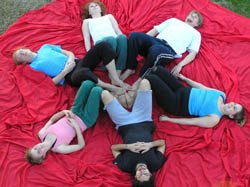 Choreographer’s Hilary Bryan’s “Sacred Space” is performed in front of the U.C.D. Main Theater as part of the Main Stage Dance/Theater Festival, running through April 23. This is a production which attempts to break down spatial borders between performance and everyday life.
In “Sacred Space,” five icosahedrons (a polyhedron having 20 faces) consist of pipes which each contain a complete diatonic scale (twelve tones). The 7 dancers each stepped inside one of the figures, which surround the draped egghead statues, and they began to dance, tapping the pipes to produce a lovely ethereal sound...which unfortunately competed with the drum group that was rehearsing somewhere on campus. 5 minutes into the 12-minute piece, the drums finally stopped and one could finally get the full effect of the lovely tones that were being played.
Eric Kupers’ “Catch Cradle” actually opened the evening at 7:30 at the Davis Commons (in front of Borders) and then moved to the theater for the second half of the “structured improvisational” piece, which by its very nature will change somewhat each night.
“Baú” followed, a lovely piece choreographed by Jennie Amaral. The visual for the piece was stunning. Sheer cloth panels, illustrated the “personal boxes” and experiences that we go through as we deal with our “entrapment.”
“Imagination: love”, choreographed by Whitney Peterson, is described as “coming from a place of imagination.” Peterson may have channeled Tim Burton because it had that quirky Burton look to it. The music by Claude Challe provided a great strident rhythm.
“Point Zero,” by Hector D. Martin-Rodas is loosely based the book “Woman at Point Zero,” by Nawal El-Saadawi, based on an interview with a woman on the eve of her execution. The story of her tragic life is beautifully portrayed in this number, where the dancers were coverings over their faces.
“Captured Movement,” choreographed by Rebecca Abdenour, is inspired by the paintings of Joan Miró, whose style is represented in the costumes by Molly LeGoy and in the abstract lines and angles created by the dancers.
“Sense (it’s an experience)” choreographed by Keith Hennessy is high-flying fun with the rap beat by Miss Elliot. An all-male cast, these are mostly inexperienced dancers, but accomplished athletes, showing that the line between sport and the arts is not that wide.
“Tour,” by Hilary Bryan was an interesting number, described by Bryan as “based on the Space Harmony work of Rudolf Laban together with his theories of Effort and Shape Qualities.” To this viewer, it looked like a group of people going on vacation to a foreign country and pointing out the sights.
Brian Runstrom’s “Cacaphony Undisclosed,” set to original music by Portia Njoku, “encompasses an exploration of humanity and truth and asks if truths can ever really be unmasked. Costume designer Jenny Foldenaur has created black costumes, each with its own decoration, but all faces covered.
Finally, “Pondering Tongue-tied Green Fragrances,” by William Anthony Munkacsy III sports a charming backdrop of a child’s drawing of home, by Lysandra Nelson. The dance expresses deep-seated loneliness and longing blended with a sense of hope and comedy.
Excerpts from the Main Stage Dance/Theatre Festival will be shown at the Davis Farmers’ Market from 10 to noon on Saturday, April 15, and at locations around the UC Davis campus on Picnic Day, Saturday, April 22
Tuesday, April 11, 2006
Cabaret
 Midway through Act 1 of Studio 301's production of Cabaret, running at the Wyatt Pavilion through April 16, the Jewish grocer Herr. Schultz (Yahya Rouhani) hands his landlady, Fraulein Schneider (Melanie Levy) a pineapple, which is the impetus for “The Pineapple Song.” During the song, actress Levy kind of bobbles the pineapple accidentally and some fronds fly off of the top of it. I kept waiting for someone to pick up the pineapple fronds, but at the end of the show they were still there. Even when the chorus girls from the Kit Kat club were crawling around on the floor picking up currency during “The Money Song,” they left the pineapple fronds there. Nor did anybody pick them up during intermission.
In Act 2, in another scene between Schultz and Schneider, a broom and an orange are left on the floor. It took 3 scenes before anyone picked them up (they danced on top of the broom and over the orange during the song “If You Could See her”) and toward the end of Act 2, Sally Bowles (Jennifer Nelson) drops what looks like a pitch pipe as she makes her entrance. It didn’t get kicked off stage until the curtain call, though scenery was moved around it.
I mention these serious oversights because I’m having a difficult time knowing what to say about this show. Who can’t like “Cabaret,” right? It’s downright unAmerican.
In fact, I had high hopes for the show when I entered Wyatt Pavilion, which had been turned into the Kit Kat Club, a seedy nightclub in Berlin in the days when the Nazis were coming to power. I was impressed that the atmosphere was perfect, down to the missing and mismatched lightbulbs around the second floor platform where the orchestra sat. Matt Welch and Katie Baad are credited with “original set conception” and deserve high marks for their vision.
The chorus girls, in wonderfully decadent costumes designed by Alexandra Bergere were wandering around on stage prior to the start of the show and it added to the ambience before the lights ever went down.
(Someone should tell whoever printed the programs, however, that while purple is a nice paper color, when you try to read black letters on purple in a dimly lit theater, it just doesn’t work!)
The show’s real problems started with the overture.
I tried to decide how to handle this, and decided not to point fingers because, in truth, with the exception of Rouhani there was not ONE principal who managed to make it through a song without hitting at least a few sour notes, some tried several different keys before settling on one which matched the orchestra, and there was at least one song which was so bad that I don’t think the singer hit one note right throughout. The last two notes of the show caused me to visibly wince.
I am puzzled by why this is because it is obvious that each of the performers has strong vocal talent. I don’t know if having the orchestra seated above them was the reason, or if the fact that the orchestra was out of tune as often as the singers was to blame. But for whatever reason, this is a show with very strong music and vocal problems.
Alas, vocal problems are not the only ones. The decision to cast a woman (Jacquie Pospisil) as the Emcee was a curious one. Pospisil is a good actress and has a good voice, but the role is written for a man and the lines were not changed to indicate that the character was female, yet Pospisil was costumed decidedly feminine, which made the number “Two Ladies,” with Pospisil as the “man” and one of the chorus men as one of the “ladies” distinctly odd.
But the show’s choreography (for actors who aren’t primarily dancers) by Tori Terrell-Carazo was fine.
Jennifer Nelson was Sally Bowles and is obviously a fine actress, but can’t quite carry off the degree of decadence that makes us understand Sally’s Bohemian lifestyle.
Drew Phillips is Cliff Bradshaw. Phillips is another fine actor whom I have seen in other productions, but in this production, we don’t get believability in his sexual orientation. Is he gay? Is he straight? Is he bisexual? Is he sexual at all? There’s not a lot of chemistry between Cliff and Sally.
Another directing oversight has Cliff packing Sally’s clothes into a suitcase, which he then takes with him as he leaves Berlin.
Studio 301 is a student run and funded club, independent from the university’s Theater and Dance Department. Last year’s “Into the Woods” was a promising entree into the world of musicals for the fledgling group. Unfortunately, its second attempt is less so.
Subscribe to:
Posts (Atom)