Friday, March 30, 2007

Spring Concert 2007

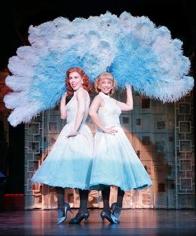
Pamela Trokanski, who has been entertaining Davis Audiences for over twenty years, is examining life, love, sex, relationships -- and voice mail.

The Pamela Trokanski Dance Theatre’s Spring Concert 2007 continues March 30, 31, and April 6 at 8 p.m. at the Performing Arts Center, 2720 Del Rio Place in Davis. The concert is performed by members of the theater (Caitlin Barale, Nicole Bell, Robin Carlson, Katy Lundgren, Bekah Shepard, Cindy Robinson and Trokanski herself) and members from “Third Stage,” Northern California’s only multi generational contemporary dance company. Maj Hapworth, Allegra Silberstein and Claire Finn join in on the second of three pieces.

The evening opens with a delightful (if overly long) look at voice mail hell and everyone in the audience will be able to relate to the relentless telephone sound (Hank Lawson is credited with “music,” though this isn’t exactly “music”) and with the recorded announcements from the disembodied operator, who wants to assure the dancers that their call is very important to her.

The piece is clever and funny and the robotic movements of the dancers match the mood perfectly, though it runs something like 16 minutes and the humor begins to wear thin at about 10 minutes.

The second piece is entitled “Singing Over Bones.” The original cast of dancers is joined by Claire Finn, with Hapworth and Silberstein playing the roles of old village women who gather wolf bones and sing over them, the legend being that as the songs build in intensity, the bones reconstitute, fill in with muscles skin and fur and the wolves run off in the direction of the forest. Those who make it to the trees are reborn into women, women who know where they come from and women who can laugh.

Lighting designer Myvanwy Morgan creates a mystical place for women to gather. The older women are circled by women in purple who dance in slow, sensuous movements, much like harem dancers. As the chorus and rhythm (music also by Hank Lawson) builds they are joined by the rest of the group, dressed in red, the lights become warmer and you feel as if you are watching a very special ritual, which is primitive, uniquely female, and reminiscent of drum circles.

After a brief intermission the original group is back with the premiere of “Come Naked, Bring Beer,” which examines the who, what, when, where and how of courtship, defined as “the process of selecting and attracting another for an intimate relationship such as love, sex, commitment, living together, marriage, and having children, or any combination of these. Courtship may last days, months, or even years, but some lovers skip courting altogether as in cases of (mutual) love at first sight, casual sex or arranged marriage.”

The sense of a “hunt” is depicted by the animal print added as sleeves to the original costume, sleeves which later extend to floor length and move as wings in describing courtship rituals and comparing them to bower birds.

The various little things that a woman is looking for a mate are described in intimate detail through music by Lawson, Crash Test Dummies, and They Might be Giants. Guest Dancer Bill Tuck joins the women as “Superman,” and the piece concludes with the realization that a man’s wants and desires are much less complex and much more basic.

Wednesday, March 21, 2007

Othello

Revenge! Passion! Lust! Greed!...and Love.

Shakespeare’s great tragedy “Othello” has it all, and the Sacramento Theater Company’s sparkling new production, under director Peggy Shannon serves it well, from the magnificent set designed by Marion Williams, to the powerful performances delivered by the members of the cast.

While the play centers around Othello (Marc Antonio Pritchett), the noble Moor and general in the defense forces, who has just eloped with the lovely Desdemona (Michele Hillen), Act 1 really belongs to Iago (Matt K. Miller), a 17th century Karl Rove who manipulates all action, convinces people to do terrible things and traps them in an intricate web of lies, while all the while feigning innocence and friendship with Othello himself.

Iago is angry because he feels he has been passed over for promotion in favor of young Cassio (Brett Williams) and so he sets in motion an elaborate plot to convince Othello that his young bride has been unfaithful, which ultimately results in the demise of just about everybody.

Miller’s Iago is more mischievous than villainous as he plots to bring down Othello. There is always a smirk on his face and a twinkle hidden somewhere in his eye even while he is doing the most dastardly deeds or expressing his hatred of Othello. It is easy to see why everyone believes him and is taken in by his manipulation. He’s a likeable bad guy.

Iago’s character resonates strongly in this day and age, where jumping to conclusions and acting on those misguided conclusion can have lasting negative effects.

Pritchett is subdued, almost an afterthought, in the first act. His Othello seems to be little more than a prop off of which Iago plays. His love of Desdemona is obvious, though gentle, without any foreshadowing of the rage he will develop in Act 2 at the suspicion that his wife has been dallying with another man.

He comes into his own, however, in Act 2, fulfilling the promise of passions only hinted at in Act 1. He displays genuine anguish at the thought of his wife’s unfaithfulness, and deep remorse following her murder. Pritchett doesn’t exactly take command of the stage so that you center on him, but he has flashes of smoldering intensity.

Desdemona is exquisitely played by Michele Hillen, who gives her a sweet and innocent persona. She exudes a gentle love for Othello. In this production, theirs is a quiet love, not a sizzling passionate love, and she feels true confusion at his later accusations of her infidelity with Cassio (Brett Williams).

Williams is the perfect hero, tall and handsome, intense, and exuding sexuality. His principles crumble when Iago gets him drunk, which results in Othello stripping him of his rank.

Marie Bain turns in a memorable performance as Iago’s wife Amelia, who unwittingly gets drawn into the plot to bring down Othello, yet displays a feisty personality unafraid to stand up to either her husband or to Othello himself.

Brian Rivera is the hapless Roderigo, in love with Desdemona and fooled into thinking Iago is helping him press his suit, while all the while being drawn into Iago’s plot to destroy Othello. Rivera gives his character an endearing gullibility which gives him deep pockets for Iago’s greed.

The atmosphere is aided by the lush costumes of Todd Roehrman and the somber lighting design of Arthur Rotch. Michele Hillen doubled as dance choreographer for the belly dancers, and Marc Antonio Pritchett also choreographed the fight scenes.

While not, perhaps, an “Othello for the ages,” this is a very accessible Othello which will keep one enthralled from start to finish.

Tuesday, March 13, 2007

Let's Murder Marsha

This review appeared in The Davis Enterprise on 3/13/07.

Monk Ferris may not exactly be a household name.

“Monk Ferris” is the nom de plume of a writer named Jack Sharkey, who started his career as a copy writer for Sears Roebuck, went on to write novels, science fiction, humor articles, and mysteries, and ultimately began writing stage plays. Prior to his death in 1992, Sharkey had written some 82 plays under his own name and four other names, one of which was Monk Ferris.
As “Mike Johnson” Sharkey wrote stage thrillers; as “Monk Ferris” he wrote comedies.

“Let’s Murder Marsha,” written in 1984 and currently running at the Winters Community Theater, under the direction of Trent Beeby, seems to be a blend of stage thriller and comedy which spoofs the world of campy murder mystery novels.

The script is never going to win any writing awards. There are lots of inconsistencies, lots of things that happen just because they need to get characters off stage for a few minutes (how many of you take your guests into the dining room “to show them where they are going to eat”?), and it seems to fizzle out in the overly long second act, but none of that mattered to the audience, which laughed appreciatively at the funny one-liners and the ludicrous situations and seemed to be having a great time.

Marsha Gilmore (Joanie Bryant) is the wife of wealthy stockbroker Tobias (Greg Lanzaro). Marsha’s secret passion is “sleazy slasher novels,” which she hides because her husband disapproves of their content. As the play opens, she is concerned because she has lost her current novel, “The Creeping Slasher,” which is overdue at the library. She enlists the aid of her maid, Bianca (Janette Dahn) and there follows a series of comings and goings and misheard conversations worthy of a French bedroom farce, which all lead to Marsha coming to the conclusion that her husband is plotting to kill her, with the assistance of his new girlfriend.

In truth, Tobias has purchased a sea plane as a birthday gift for his wife (though it is impossible to imagine the air-headed Marsha as the pilot of a plane. That is only one of the points where the audience is asked to suspend disbelief!). To assist him in the surprise, Tobias has hired interior decorator Persis Devore (Jenell Novello), to help with the design of the plane’s interior (we also aren’t sure how Tobias can be choosing upholstery the night before he is to give the plane to his wife...but let that pass too).

The cast seems unsure of whether Devore is pronounced with a silent e at the end or not and I was convinced that once she had been invited to stay for dinner, as a cover-up for the real reason why she was in the apartment, that she would be required to eat with her leather coat on, as nobody ever seemed to ask her to remove it.

The maid suggests that Marsha enlist the aid of a neighbor, Virgil Baxter (Jim Hewlett), a pharmacist who has his own secrets, with the murder of her husband, which she feels is her only defense against her own untimely demise. Baxter agrees to concoct some sort of odorless, tasteless poison which will leave no clues for police following the poisoning of Tobias and his assumed mistress.

Again there are more comings, goings, prop switches and the entrance of Marsha’s mother, Lynette Thoren (Germaine Hupe) to further confuse things.

Over the course of the evening, the cast attempts to eat dinner several times, never all at the same time (and all off stage). I lost track of whether the soup was supposed to be hot or cold, actually.

Conveniently, after Bianca accidentally drinks the poison (or so everyone thinks), her boyfriend shows up. Ben Quade (Ben Moroski) just happens to be driving a police ambulance in which he can carry whichever people need to be transported, whether for medical attention or arrest.

It’s all very silly, makes no sense whatsoever, and yet many in the audience were still chuckling as they filed out of the auditorium.

And isn’t that what theater is all about? Leaving them all entertained?

Kudos to the costume crew, which is listed as “the cast, JoAnn May, and Trent Beeby.” It was fun to see how all the colors blended with each other and with the walls and furniture of the apartment, without being obvious about it.

Thursday, March 08, 2007

12 Angry Men

There is something magical that happens, sometimes, in straight drama – when it’s good. During the course of a play, a dramatic moment will come and you suddenly become aware that there is total silence in the theater. You could literally hear a pin drop. It is as if the entire audience were holding its breath so as not to miss a single word coming from the stage. When the venue is a large arena, it’s even more impressive.

Such a moment happened more than once during the opening night performance of Roundabout Theater Company’s traveling production of “12 Angry Men,” directed by Scott Ellis, the current Broadway Series offering at the Sacramento Community Theater.

Reginald Rose’s screenplay for “12 Angry Men” was initially a 1954 CBS “Studio One” production, later made into a feature film with an all-star cast which included Henry Fonda, Lee J. Cobb, E.G. Marshall, and Jack Klugman, among others.

The 90 minute intermission-less play is set in a jury deliberation room, where 12 jurors are to decide the fate of a 16 year old boy accused of murdering his father.

Six time Emmy nominee George Wendt (Norm from “Cheers”) and Emmy winner Richard Thomas (who has had a long, successful Broadway career since he said his last “Good night” as John Boy on “The Waltons”) are the big name stars who will pull in audience dollars, but they head a stellar cast of lesser known names but no lesser talented co-stars, each of whom seems exactly right for the part.

Wendt is Juror #1 who, as foreman, seems to have the least to do, other than calling for the vote and trying to keep peace among his increasingly frustrated and angry co-jurors.

Thomas is Juror #8, the only one who is not quick to condemn a 16 year old to death, though all the facts presented during the trial seem conclusively to prove his guilt. #8 admits that he isn’t convinced one way or another, but he passionately believes that the mandatory death sentence demands the group at least spend a little time examining all the evidence.

His fellow jurors present a broad spectrum of backgrounds and personalities, each of whom has accepted the boy’s guilt, for a variety of personal reasons.

#3 (Randle Mell) has a bad relationship with his son and his anger toward the defendant is based on anger with his own son’s behavior.

#10 (Julian Gamble) is a bigot whose prejudices against those who are “different” reveal themselves very quickly. (“They're no good! There's not a one of 'em who is any good!”)

#7 (Mark Moretti) doesn’t really care. All he knows is he has tickets to a baseball game and he’s eager to get the whole thing settled before the first ball is tossed out.

#9 (Alan Mandell) is an elderly man with a failing body, but a keen mind who sees more than some of the other jurors see.

#11 (David Lively) is an immigrant who feels a strong sense of his civic duties and whose dedication to the rights of the defendant are more finely tied to his sense of privilege for being allowed to participate in the legal system of his chosen country.

Others in the cast include Todd Cerveris, Jeffrey Hayenga, Jim Saltouros, Charles Borland, T. Scott Cunningham and Patrick New.

“12 Angry Men” is an interesting and engrossing look at our judicial system, with all its strengths and weaknesses, and, though set in the 1950s, is as relevant today as it was when it was first presented.

Wednesday, March 07, 2007

Man of La Mancha

After seeing director Art Grueneberger’s delightful "Man of La Mancha," performed with life-size puppets, the only question one must ask is: why didn’t anybody think of this before?

"Man of La Mancha," written by Dale Wasserman with music by Mitch Leigh and lyrics by Joe Darion, which opened Friday night at the University Main Theater, tells the story of author Miguel Cervantes (Mario Castro Martinez), imprisoned for crimes against the Catholic Church (he attempted to foreclose on a monestary for non-payment of taxes), who is awaiting interrogation by The Spanish Inquisition.

Darrell F. Winn’s set is magnificent, dark and mysterious, with a long staircase which can be lowered from an upper level to the dungeon. The orchestra, under the direction of Pete Nowlen, is set off to the side behind bars and almost invisible. The only jarring element on the otherwise perfect stage is the guitar of Taehun Lee. Lee opens the show by walking out, sitting on a box and beginning to play a tune. It is a shame that into this perfectly created dark and murky world, a shiny, light colored, modern electric guitar, with a spotlight on it, should stand out like a sore thumb.

Cervantes comes into the prison with his manservant (Richard Hess). The pair are set upon by the other prisoners, who insist that the newcomer must be judged by his fellow prisoners at a mock trial for the crime of being "an idealist, a bad poet, and an honest man."

Cervantes demands that he be allowed to defend himself and does so by presenting "an entertainment." Traditionally, Cervantes now begins to apply make-up from his trunk while his manservant passes out costumes to the prisoners as they prepare to tell the tale of Alonso Quijana, an old man who fancies himself a dauntless knight, Don Quixote de la Mancha, determined to travel around the world and make it a better place.

In the current production, Cervantes is a puppeteer rather than simply an actor. Instead of costumes, the prisoners are given puppet figures to use in the presentation of the entertainment. The major character puppets are worked by two actors, Quixote and his squire, Sancho Panza, by three.

(Puppets were designed and built by Kristen Phillips)

Using puppets brings the musical into a different dimension. It allows for unusual casting, for example. Castro Martinez admits that he is entirely wrong for the role of Don Quixote. He is too young and too short, for starters. Yet with fellow puppeteers (Kate Cryan, torso, and Cary Babka, legs), you lose sight of the physical appearance of the actor and concentrate, instead, on that marvelous voice coming out of the body of the perfectly fashioned puppet. Castro Martinez thus becomes the perfect Quixote.

Babka deserves special praise because his operation of Quixote’s legs is so seamless that at intermission, my husband asked why there were 3 people listed in the program for that character, when he only noticed two.

Quixote’s squire, Sancho Panza, being short and round, becomes more of a cartoonesque character, with Kelly Fleischmann operating the torso and Matthew Escarcega the legs. Unlike Quixote’s long, lanky, articulated legs, Sancho’s are short and stubby and his little run step adds greatly to the appeal of the character. Hess is also a delightful comedic actor and his voice for Sancho is perfect for the puppet he controls.

Laura Snell is Aldonza, the prison whore, in whom Quixote sees only goodness and purity as his "Dulcinea." (Allison Minick controls the torso). This is a demanding role, vocally, and Snell had some difficulty in spots, but there was no denying her ability to instill the character with all the emotion necessary.

Matthew Moore was suitably threatening as the "Governor," whose job it was to preside at the prisoners’ trial of Cervantes and his manservant. Moore later played the Innkeeper in the fantasy (torso by Spencer Tregilgas) as a sympathetic man who understands Quijana’s need to have him believe his Quixote persona.

Daniel Reano-Koven was a menacing Duke, and later Dr. Carrasco (torso by Lee Riggs), the cynical, self-centered fiancee of Quijana’s niece (Franchesca Jimenez with torso by Kelsey Yoro)

Lowell Abellon added comedic elements as the Barber in the fantasy (with Jocelyn Tripet-Diel as the torso).

Other major characters included Bryan Pham and Lowell Abellon as Padre, Kaitlin Shaw and Kristina Stasi as the housekeeper, and Melanie Levy and Kaitlin Shaw as Maria/Fermina.

This production may seem to be about special effects (the night of the mirrors, when Quixote is forced to face reality, is quite impressive), but despite the use of puppets – or perhaps because of the use of puppets – this is a memorable production which touches the heart.

Thursday, March 01, 2007

He's Got the World on a String

Any parent who has ever spent hours watching children hide behind a couch to put on a puppet show with sock puppets, or Sesame Street characters needs to get to the University Main Stage to watch “Man of La Mancha,” opening March 2, and see what a kiddie puppeteer can accomplish, if his love of puppetry is allowed to grow.

“My poor mom,” laughed Art Gruenberger, director of the upcoming production. “She had to sit through so many puppet shows of me just sitting behind the couch. I had a box full of puppets. I would just put on show after show after show for her.”

Despite his early love of puppets, Gruenberger didn’t get serious about becoming a puppeteer until his senior year at CSUS, when he enrolled in a puppetry class taught by famous puppeteer, Richard Bay. Gruenberger was headed for a career in teaching, but figured that, given his experience and love of puppets, the course would be an easy A.

He worked with Bay on a show called “A Thousand Cranes,” the poignant story of Sadako Sasaki, a young victim of the Hiroshima atomic bomb disaster, who believes that if a she folds a thousand paper origami cranes the gods will grant her wish and make her well again.”

“We used life-sized bunraku style puppets (a Japanese style of puppetry where a full-bodied puppet is manipulated by any number of visible puppeteers who may or may not be dressed in black), very Americanized,” said Gruenberger. “It was my first real experience with puppets for adults and I was just hooked from then on.”

“Richard saw some talent in me,” Gruenberger explains, saying that was hired by Bay to put on some children’s shows. When Gruenberger felt he wasn’t getting enough work, Bay challenged him to build his own show, and “Frankenswine” was born (“It’s Frankenstein with a bunch of pigs.”). The show opened at Fairytale Town in October of 1993 or 94 and “it just skyrocketed from there.”

Gruenberger formed his own group, Puppet Art Theater Company,” which is now the resident puppetry troop at Fairytale town and has been the catalyst for international recognition.

A show called “Perspectives,” eventually landed him at the Here Theater in New York. “It’s these little yellow guys operated by 3 puppeteers. They are a bit smaller than traditional bunraku but the puppeteers are hooded and gloved.” Gruenberger was invited to bring the show to an international puppet festival in So. Korea. It opened the doors.

“They invited us to bring the show into Seoul and one of the colleges, and then to Chuncheon for the actual festival itself. Then I toured with Wendy Morton and Shadowlight Theater to Huddersfield (England) to do a large screen shadow puppet show. We did “Coyote Stories,” an American Indian tale with a Balinese gamelan orchestra and shadow puppets. It was just such a wonderful mashing together of all sorts of cultures.”

He discovered that puppetry is its own international language when he met a master puppet builder from the Shanghai Theater Academy, who spoke “not a lick of English.” “He was obviously a brilliant builder, and there was this connection through movement and the study of how things move and how to make them move how we want them to move that was just an amazing thing to see span across language, which I think is what movement, especially puppetry is all about.”

The idea to do “Man of La Mancha” with puppets came when Gruenberger was studying for his MFA in Acting at U.C. Davis. A scaled down version of the show became his thesis project which was presented for 2 performances only last summer.

“I wanted to get these puppets on stage and see how they moved and see how ‘Man of La Mancha’ accepted the idea of puppetry.” There have been other productions which have used bits and pieces of puppetry, but this will be the first to use puppets in such a major way. “In our production all of the characters that you find during Cervantes’ story-telling where he’s talking about Quixote, are all represented by various levels of puppets.”

(While Gruenberger has made some of the “cruder” puppets himself, almost all of the heads were sculpted by his colleague, Kristen Phillips, who recently received her MFA from the University of Connecticut, the one place in the country where you can get an MFA in puppetry.)

Gruenberger was invited to direct a full scale production of the show this year, complete with full orchestra, under the direction of Pete Nolan, with whom he has presented the holiday treat, “Amahl and the Night Visitors” in Sacramento (“at the BIG Catholic church”) for the last two years, and which they will present at Memorial Auditorium in December of 2007.

For actor Mario Castro-Martinez, playing Don Quixote in this production, it was the opportunity of a lifetime. “This is one of those roles I never thought I would do because I’m not tall, old, or skinny, which are all the things that Quixote is. So this is just an ideal situation where it’s my voice coming out through the body someone who fits the part perfectly and who is created just for this role.”

Castro-Martinez is only 1/3 of Don Quixote, though. He operates the character’s head and left arm. His right arm is manipulated by Kate Cryan and his legs by Cary Babka.

None of the actors had any previous puppetry experience. The cast attended what Gruenberger calls “puppet boot camp” for the first week and a half of rehearsal. “The thing that will make actors better puppeteers is just having puppets in their hands for as much of the rehearsal process as possible, and so I used the puppet boot camp to give them basic principles of puppetry.”

“We worked on group puppets,” says Lee Riggs, playing the torso of Dr. Carasco’s (Daniel Reano-Koven plays the actual character). “Some of the puppets take 3 handlers, some of them are single one person, one puppet, so we did a little of both and because the puppeteers will be visible the whole time, you and the puppet have to be one. If you have two different people doing the arms, usually arms are somewhat symmetrical in look, coloring and length, gesture.”

The groups spent a lot of time rehearsing in front of a mirror, getting to know the other puppeteer and the puppet.

Richard Hess, playing Sancho Panza (Kelly Fleischmann, torso; Matthew Escarcega , legs) is reprising the role he played in the workshop (as is Castro-Martinez). “We’ve spent so much time in the puppets that they’ve just kind of become second nature. It takes so much more concentration to, say, pick up anything or transfer something from one hand to the other to hand it to somebody else. In our case it takes 3 brains to make one.”

Giving his actors lots of time with the puppets is part of Gruenberger’s philosophy. “Over the course of the rehearsal I try to keep them in the puppets as much as possible, and playing with them in between rehearsals. I don’t tell them that I want them to do that, but they do it because they begin to get the hang of it and so they start doing wacky dances with puppets and they discover things that their puppet can do as a result of that. The rehearsal process can be kind of chaotic and I think it drives my stage manager up the wall because they have a toy on stage and actors with toys. But I want them to play as much as possible because they’ll discover subtleties that are necessary to enhance the character that they’re portraying.”

That extra time worked well for Melanie Levy, playing the innkeeper’s wife. Levy was not in the workshop production, but saw it, and thought it would be fun to learn something about puppetry. “I felt very insecure about doing it, so I have to take a lot of time to watch the other actors. I think I’ve started to come to a balance between the two.”

Gruenberger and his cast are definitely working together to create the final piece, trying to be true to the characters and the period. “We don’t know what their gestures were like in the 1700s. It’s impossible to know. There’s no video. We don’t know what they sounded like back there because there are no audio tapes, but we can use our imagination to the best of our ability and the magic of theater to make some decisions, to have some sort of unity on that. That’s what we did.”

Even the set pieces become characters in this production, explains Riggs. “There are lots of boxes and crates that are moved around the prison to create the different scenes. To help the actors remember which pieces they moved, things were given names. The small box is Tiny Tim, we have Darrel and Carol the Barrel, and Bob the Box and Dave the Box. Ropey is a crate with rope handles.”

The experience has been a voyage of discovery for Gruenberger. “It’s huge for me. The biggest cast I’ve worked with up to this point was 5 people. 60-70% of the shows that I do are either one or two people and self-directed, self-written, so this is incredibly different -- and amazing, too. The biggest problem with working with a huge group of people in any sort of professional setting is that you have to pay 22 people, which is why most puppeteers work with one or two people. It makes it more profitable. If I had to tour ‘Man of La Mancha’ with 22 people and a 16 piece orchestra and my crew of 10+ people, it would be insane. It would be ‘the impossible dream.’”

Gruenberger’s “impossible dream” will become “possible” when the show opens at the university’s Main Theater on March 2. I had the opportunity to watch a rough run-through of Act 1 and the audience is in for a real treat. There are moments in the show that are going to have people sitting up and saying “wow!”

It's the magic of puppetry.

Wednesday, February 28, 2007

Camelot

There are stunning moments that one finds in theater. Moments that surprise you and take your breath away.

There was such a moment at Friday night’s Davis Musical Theater opening of Lerner & Lowe’s classic “Camelot,” directed by Lenore Sebastian (in her first directorial position with DMTC). The show had opened well. The set design by John Ewing and Steve Isaacson was not opulent, but utilitarian and for the low-budget production it worked just fine. The pared down orchestra, under the direction of Steve Isaacson was adequate, if lacking in the richness that one would like to hear in a big work such as “Camelot.”

Gil Sebastian’s King Arthur was fine, nicely balancing the shyness of the boy who never expected (or wanted) to be king with the man who has become one of the most powerful rulers of the land and yet is terrified to meet his bride-to-be.

Paul Fearn, returning to DMTC after an absence of 13 years, was a wise Merlyn, Arthur’s mentor, soon to fall victim to the spellbinder Nimue (Bridget Maguire, vocalist and Meg King, dancer). (Fearn would go on later to add delightful comic relief as the doddering old Pellinore.)

Marguerite Morris gave one of her better performances as Guenevere, whose “youth was sold” when she was given in marriage to this stranger, King Arthur. Guenevere is not ready for maturity before she has had an opportunity to experience the “simple joys of maidenhood” -- “Shall two knights never tilt for me / and let their blood be spilt for me?” “Shall a feud not begin for me? / Shall kith not kill their kin for me?” Morris had the lovely bearing of a queen, and the voice of an angel.

Arthur admits his own nervousness about the upcoming nuptials, but convinces Guenevere that “there’s not a happier spot for happily ever-aftering” than Camelot.

Up to this point it has been a delightful first scene. As the royal couple exited, the curtains closed and Lancelot du Lac (Tae Kim) appeared in a spotlight. When Kim opened his mouth to sing, everybody in the near-capacity audience sat up straighter. We all experienced a stunning moment together. Kim, a medical student newly moved to the Davis area, is, amazingly, making his very first theatrical appearance--ever, yet he has the confidence of a seasoned professional and a voice worthy of any professional production. He lifted the production to a higher level. It is unfortunate that he had slight pitch problems in Lancelot’s signature,“If ever I should leave you,” and seemed to be unable to get solidly back on pitch throughout the song, but other than that slip, he was first rate throughout the evening.

Another outstanding performance was turned in by Jon Jackson as the deliciously bitchy illegitimate son of Arthur, Mordred, who is responsible for bringing down Arthur’s dream of a world where disagreements are solved by rule of law rather than by swordplay. Like Kim, Jackson lifted the production to a higher level and made it something more than a run-of-the-mill, decent community theater production of an old classic.

“Camelot” is the story of honor, of love, of friendship, of betrayal, of remorse, and of honor again, as Lancelot and Guenevere deal with their love for each other and their mutual love of Arthur, whom they do not wish to hurt. Arthur must also deal with his love for his wife and his best friend, but sets thoughts of revenge aside following their betrayal, because he still loves them both and would rather see them happy together than to lose them completely.

In the end, nobody wins.

Sebastian and Morris, who give fine performances at the start of the production, grew into their roles and their relationship as the evening (and the Camelot years) progressed, so that by their final scene together, there was genuine affection between them and their farewell was wrenching.

The supporting cast is small, lacking the “oomph” for a production this grand, but they do the best they can to be a decent crowd.

Jan Isaacson choreographed a May pole dance for “The Lusty Month of May” which was colorful, and gave the chorus lots of business to do.

Young Griffin Jackson is Tom of Warwick, on whose shoulders Arthur places the responsibility of keeping the dream of the principles of the Round Table alive. Jackson is very cute, but could speak up a bit more in order to be heard.

Jean Henderson designed the costumes and Morris, in particular, has never looked lovelier.

This production of Camelot has a lot of good things going for it, but it is worth seeing especially for the debut of Tae Kim who, if he chooses to continue doing theater, has a long successful career ahead of him.

Sunday, February 18, 2007

Les Liaisons Dangereuses

There is a Disney ad running on television now for the latest version of the cartoon “Cinderella.” In it, we are shown the now-familiar face of the sneering evil stepmother. I thought of that image several times, watching Janis Stevens’ portrayal of La Marquise de Merteuil in Capital Stage’s lusty production of “Les Liaisons Dangereuses,” Christopher Hampton’s adaptation of the 1782 French novel by Choderlos de Laclos, directed by Michael Stevenson.

Stevens’ Merteuil may be the most malevolent female character you see on stage this year. With her head tilted back, her eyes mere slits, and her mouth forming an icy smile, Stevens is the perfect bad girl.

The setting is pre-Revolution Paris. Merteuil enlists her former lover, Le Vicomte de Valmont (Jason Kuykendall), to avenge a wrong done to the both of them by the unseen Gercourt, who has seduced a lover of Valmont while in the midst of a liaison with Merteuil. Merteuil wants Valmont to seduce Gercourt’s young bride to be, the 15-year-old virginal Cecile Volanges (Michelle Murphy). However, Valmont, feeling Cecile too unchallenging and uninteresting a victim (“humiliating, if you fail; commonplace, if you succeed”), is more intrigued by the virtuous, married La Presidente de Tourvel (Stephanie Gularte).

Let the games begin!

Kuykendall is a perfect co-conspirator for Stevens’ Merteuil. Tall, handsome, charming, and totally smarmy. Kuykendall has it all. He appears believable in his interactions with the young Cecile and the virtuous Tourvel, yet his personality can change in an instant when he flops down on the chaise lounge to report progress on his path of seduction. Valmont doesn’t plan on one thing: he actually falls in love with Tourvel and he’s not quite sure how to handle those feelings, which are his ultimate undoing.

Gularte is positively luminous, struggling with her response to Valmont’s advances, juggling the conflict between her duty to her husband, whom she does not love (“I am so lonely!”) and her desire for Valmont.

Michelle Murphy is so innocent, so young, that her rape by Valmont is so disturbing, we almost hope someone from “To Catch a Predator” will pop out from behind the secret panel and prevent the attack. Her later delight in the pleasures of the bedroom are likewise disturbing, given the age discrepancy between the two partners.

Paul Alary is Le Chevalier Danceny, a young man hopelessly in love with Cecile who innocently allows Valmont to control both his life and his pursuit of the object of his desire. Alary plays this young man as a bumbling adolescent whose transformation later in the piece is striking.

David Campbell makes much of the small role of Azolan, Valmont’s valet.

The supporting casts is equally strong – Gail Dartez as Cecile’s mother, Mme de Volanges; Vada Russell and Mme de Rosemonde; Megan Smith as the courtesan Emilie; and Michael Pollock as the Major-domo.

This production is so good that one would wish for a larger venue to greater present the opulence of the period, but Capitol Stage does what it can with the space it has to work in. Jonathan Williams has designed a generic drawing room which can be transformed into various boudoirs or drawing rooms by the movement of the ubiquitous chaise lounge, the changing of a vase of flowers, or the addition of a card table.

Gail Russell’s costumes are luxurious, and well suited to the character in question, whether the deep scarlet of Merteuil or the more virginal beige for Tourvel.

Les Liaisons Dangereuses is a sexy tale of love, lust and lies, beautifully served up by Capital Stage. The production contains brief nudity and is not recommended for the under-18 crowd.

Friday, February 09, 2007

Jack Lynn

Actor/director Jack Lynn owes his illustrious nearly 70-year career in the theater to giving the worst audition anybody had seen in ages at the Royal Academy of Dramatic Art (RADA) in England, at age 15.

The 84 year old Lynn, director of the Woodland Opera House’s current delightful production of “The Importance of Being Earnest,” spoke with Oscar winning actor Robert Donat (“Goodbye, Mr. Chips”), an adjudicator for RADA, following his audition. Donat explained that they were not looking for finished or polished performances because “if someone is already polished there would be no need for instruction.” “We’re looking for potentiality,” he said. “We can see that you have talent, but you just don’t know what to do with it.”

Donat became one of Lynn’s mentors. Another mentor was a man named Robert Atkins, best known in England (at that time) for being the only man to have directed all 37 Shakespeare plays, some of them many times.

Lynn apparently fulfilled his mentors’ view and within three years he had done “a little directing, a little instruction and a lot of acting” (including a season at Stratford-Upon-Avon, under Atkins’ direction).

He was recommended by Donat for a position at the prestigious Pasadena Playhouse, at the conclusion of the World War II. The Playhouse, established in the late 1920s, had become an accredited college by 1937. It had as many as five independent stages in operation at any given time, making the it the single most prolific theatrical producing organization in the world.

Donat, who expected his protege to concentrate on acting was surprised to discover that he preferred teaching. “I love instructing,” Lynn admitted, clarifying that he feels you can’t teach acting. “The talent has to be there in the first place, so ‘teaching’ is the wrong word.”

(A lifetime of instructing has formulated one of his philosophies – “The more I learn, the more I realize the less I know. I hope when I was young I never had the attitude that I find so many young people have today--learn a little and think they know everything.”)

In 1947, the 25 year old Lynn moved to the United States for what was to have been one term at the Pasadena Playhouse. Before the end of his term, he was invited to stay on permanently. He eventually became the head of the Shakespeare Department and, in 1956, became dean of the college. “ I was told that I was the youngest dean of any educational institution in the U.S.,” he says, modestly.

For personal family reasons Lynn returned to England in 1959. “Until then I had been visiting England every summer while living in the states. Now, between 1959 and 1987 I reversed my life and was living in England and coming to California every summer. I think that might be a record — since 1947 there has not been a single year I have not been in both countries. It’s what has kept me poor all my life.”

Upon his return to England, he was contacted by John Fernald, who had taken over as head of the RADA in the early 1950s, and asked to join the staff as an instructor/director. “I told him I thought it was a very good idea to employ ex-students,” Lynn said. “Fernald’s reply was ‘We’re not employing you because you’re an ex-student, but because of your work with founder Gilmor [sic] Brown at the Pasadena Playhouse.’ It was then I realized how famous the playhouse really was,” said Lynn. “It was world renowned.”

His students, at Pasadena Playhouse and RADA span the gamut of theatrical greats from Anthony Hopkins to Ruth Buzzi, and include such luminaries as Dustin Hoffman, Gene Hackman and Charles Bronson.

During his time back in England, Lynn became the producer of Knightsbridge Theatrical Productions, with over 10 West End productions in London, including “Pygmalion,” with Diana Rigg and a then-unknown Bob Hoskins (“We can claim to have helped him start his career”), “Candida,” with Deborah Kerr (“A wonderful person”), “Hamlet,” with Ian McKellan, and “Lord Quex,” with Judi Dench and John Gielgud.

Both Dench and Gielgud became good friends. Lynn wistfully remembers the late Gielgud fondly. “He was a wonderful actor, a wonderful man. So modest it was unbelievable. He had no idea how good he was.”

His “closest and greatest friend” is Paul Scofield, who won both an Oscar and Tony playing Sir Thomas More in “A Man for All Seasons.” “A very fine actor and friend.”

"I've been so lucky over the years with people I've worked with and the friends I’ve made,” Lynn said. “Great actors are some of the nicest people. They have a basic humanity and a basic kindness. They have to be nice, unprejudiced and open minded if they are to portray people of all types and styles. If you have a closed or prejudiced mind, you are unable to really understand the characters and it affects your performance.”

But Lynn saves his greatest pride for his “adopted son,” actor, novelist, playwright and director Ian Ogilvy, well known in England as Simon Templar in “Return of The Saint,” and seen in the U.S. in many television productions including “Murder She Wrote,” “Jag,” “Murphy Brown” and “Diagnosis Murder.” He is now making a name for himself as an author of children’s books. By mutual agreement, Ogilvy did not take his adopted father’s name, feeling that nepotism was a terrible thing. “His attitude was that because I’d been a producer and goodness knows what if he changed his name people would think I used my influence to get him work, and he wanted to earn it on his own.”

As an actor, Lynn has been in several television productions, such as the Rabbi in “Bar Mitzvah Boy.” His last movie appearance was as the bookseller in the film “Yentl,” and says he adored director/star Barbra Streisand. “She was an angel to work with,” he said, contradicting those who warned him that she would be difficult. “She’s kind and considerate as long as you do your work. If you don’t she can be critical.”

In the early 1990s, following a run as Cardinal Woolsey in a production of “A Man for All Seasons,” with Charlton Heston, Lynn was invited to come to Sacramento to work with friends Jerry and Laura Grisham, who ran the now defunct Stagedoor Comedy Theater in Sacramento for over 25 years. He remained with the Grishams, doing some coaching and some directing, and acting in local productions.

“To talk about my life would fill a three volume novel,” Lynn laughs. Instead he now does a one-man show, “Life and Laughter in the Theater,” in which he reminisces about his over 68 years in the theater. It was this show which first brought him to Woodland at the invitation of Woodland Opera House Artistic Director Jeff Kean. He has since taken the show to Scotland and England, and will present this one man show for the last time at the Chautauqua Theater in Sacramento on Sunday, February 11 at 2:30 and 7:30 p.m., as he plans to retire to England soon after.

The show is described by Chautauqua as “the story of his life in entertainment, filled with humour and poignancy. A fascinating talk followed by questions.”

Health problems have compromised his ability to direct as he always has. “I’m one of those directors who likes to get up on the stage and demonstrate things, but the most frustrating thing is that I have to stay seated because I’m being incapacitated.” Instead he now sits in the house and actors come to him following a scene, in order to get instructions.

“The Importance of Being Earnest,” currently at the Woodland Opera House, will be his swan song as a director (“It’s one of my favorite plays”). He is very happy with this production. “The secret of good directing is to cast the play with the best possible people,” he says, pointing to all of the cast, but particularly Jerry Lee, in the role of Jack Worthing, with whom he first worked when the young actor was merely 15. “Jerry has made the greatest advance of any young actor I’ve ever worked with,” he says, proudly.

When he returns to England, Lynn will move into Denville Hall, a retirement community for theater persons outside of London, where he recuperated from surgery on his previous trip to England.

“It’s going to be a terrible wrench for me,” he says, sadly “I shan’t be coming back to the States every summer. Thank goodness a lot of my English friends whom I see every summer are very happy that I’m going to be there.” Among those friends is the Chairman of the Board of Denville, a former RADA classmate, Richard Attenborough, who first suggested that Lynn make Denville his permanent home.

For health reasons, Jack Lynn may be giving up the more energetic of his career activities, but something tells me that we have not seen the last of this delightful, talented gentleman.

Thursday, January 25, 2007

The Importance of Being Earnest

This review appeared in The Davis Enterprise on 1/24/2007


It’s a world of polite society, cucumber sandwiches, and a world where “smoking” is considered a proper activity for a young man. “A man should always have an occupation of some kind. There are far too many idle men in London as it is.”

It’s a world where “being Earnest” is very important.

In fact, that’s the name of the play, “The Importance of Being Earnest” by Oscar Wilde, who can skewer high society pomposity better than most. It is currently delighting audiences at the Woodland Opera House.

Jack Lynn, who, in his 70 year career has taught such luminaries as Sir Anthony Hopkins, Dustin Hoffman and Gene Hackman and worked with the likes of Dame Judi Dench, Sir Derek Jacobi, and Sir John Gielgud, is making this production his directorial swan song. The veteran director is going out with a bang, not with a whimper.

He has assembled a talented cast, with keen comic timing, and several are new to the Woodland Opera House.

Chris Quant is delicious as the n’er do well Algernon Montcrief whose life seems to consist of partying and heading off into the country for dalliances. For this purpose he has created an imaginary friend named Mr. Bunbury (whom Quant pronounces “Bombury,” for some inexplicable reason), who becomes conveniently ill when Algernon needs to get out of town. The young man is quite pleased with the effectiveness of his deception.

“The truth is rarely pure and never simple. Modern life would be very tedious if it were either, and modern literature a complete impossibility!”

Algernon’s friend is Earnest Worthing (Jerry Lee) who is absolutely perfect as the young man who is hiding the fact that his name is really Jack Worthing, and as a baby, he was abandoned in a handbag at Victoria Station and adopted by the wealthy Thomas Cardew, who, on his deathbed, made the young man the guardian for his granddaughter, Cecily (Janey Pintar). Jack has invented a wayward brother named Earnest who lives in the city and whose antics force Jack to have to leave the country and come to town.

Earnest (or Jack) is in love with Algernon’s cousin Gwendolyn Fairfax (Katherine C. Miller) whose mother is the formidable Lady Bracknell (Shelly Sandford), who has some of the most memorable lines in the play.

Miller is the perfect spoiled upper crust daughter, who fell in love with Jack because she has always dreamed of marrying someone named “Earnest.”

Sandford is prim and ultra proper as she questions Jack about his qualifications to marry her granddaughter. All seems to meet with her approval until he admits that he has lost both of his parents. “To lose one parent, Mr. Worthing, may be regarded as a misfortune; to lose both looks like carelessness.”

Deciding that a handbag is not a proper mother, Lady Bracknell forbids the marriage and, when asked by Jack what he can do to change her mind replies, “I would strongly advise you, Mr. Worthing, to try and acquire some relations as soon as possible, and to make a definite effort to produce at any rate one parent, of either sex, before the season is quite over.”

The action moves to Jack’s house in the country, where Algernon has traveled in order to meet Jack’s intriguing ward and introduces himself as Jack’s elder brother Earnest. Pintar is cute as Cecily, whose dream has been to meet a truly wicked man and can hardly wait to meet her guardian’s brother.

But wait, there's more. Cecily’s teacher, Miss Prism (Georgann Wallace), is hiding many things, including a love for the rector, Chasuble (Paul Fearn) and a shameful secret which sheds light on Jack’s parentage, after which everyone learns the real importance of being Earnest.

Mark Garbe and Chris Lamb have minor roles as the manservants Merriman and Lane, respectively.

Laurie Everly-Klassen has outdone herself in the elaborate costumes. The women’s hats alone are not to be believed.

Scenic and lighting design are by the reliable Jeff Kean, who can do more with a few flats than most. One never feels a lack of opulence in any of the scenes.

If you have never seen an Oscar Wilde play, this is the one not to miss. From the sparkling dialog to the keen comic timing of this cast, to the visual delight of the sets and costumes, “The Importance of Being Earnest” delights on all levels.

Wednesday, January 24, 2007

THIRDeYE Theatre Festival

The annual THIRDeYE Theatre Festival [sic], presented by the UC Davis Department of Theater and Dance, features three new plays by three undergraduate playwrights: Rachel Skytt, Natasha Tavakoli, and Kellie Raines. All three plays will be performed on each night of the festival, which will continue January 25-28 in Wyatt Pavilion Theater.

The plays are created in the Playwriting and English courses at UC Davis and the actors, designers, stage managers, and crew are all undergraduates, many performing their role or task for the first time.

The evening opens with “Over the Line,” by Natasha Tavakoli, directed by Amy Kronzer. While all the actors throughout the evening were excellent and I would be hard pressed to find a weak link anywhere, this particular play had some of the strongest performances. It is unfortunate that the script itself had the most problems.

Tavakoli set out to create a political drama which dealt with issues of immigration, relationships between parents and children, and between lovers, and a myriad of topics which, crammed together into a short one-act piece became sensory overload. There was no time for development of relationships or completion of scenes. Meals are served, eaten (or not eaten) in one bite and dishes immediately removed from the table. Parents arrive from Mexico, after a harrowing trip across the border to the home of a daughter they have not seen for years and the mother has no time for pleasantries; she only wants to go to bed. The Mexican mother emotionally speaks to her husband, complaining that he refuses to answer her in English.

Despite the problems with the story itself, this play had wonderful performances, particularly from Alma Ruelas, as Maria, the heroine of the piece, who may have given the strongest performance of the night. Her boyfriend Eli was played by Mike Yost, who likewise turned in a solid performance.

Matthew Moore’s performance as Eli’s father, Hank, was good, but his character was less believable because he looked more like Eli’s renegade brother than his father, a danger when all members of the cast are roughly the same age.

Christina Moore gave a sympathetic performance as Maria’s mother, Esperanza.

The second play was “Saving Trophies,” by Kellie Y. Raines, directed by Orion Al-Shamma-Jones. As a person who saves “things” in excess, I found I could relate to this story about a Sofia (Melanie Levy) who has a passion for collecting, cleaning, and displaying old trophies. “It’s about the way we all give pieces of ourselves to each other in small moments. It's in the pieces that we try to find something whole, something worth saving,” explains the author.

Levy’s seemingly strong performance was marred by her lack of projection so that too many of her lines, and thus the plot points, were lost, which is a shame because I was most impressed with her involvement with the character, a woman with a broken heart filling the space left by her former boyfriend with these trophies that she incessantly polishes.

Carolyn Hodson had no projection problems as Lozzie, Sofia’s lesbian friend who tries to make Sofia understand that she needs to get out into the world and live her life. Lozzie is that very rare character, an incapable lesbian. When Ken (Daniel Reano-Koven [Derrick--your computer won’t pick it up in an e-mail but the “n” in Reano should have a tilde over it]), a street person who has come into the shop where Sofia is polishing her trophies, collapses, it is Lozzie who doesn’t know what to do and leaves Sofia to handle the situation.

Rounding out the evening was “Baetylus” by Rachel Skytt, directed by Travis Dukelow. The death of a classmate was Skytt’s inspiration for this play about Felix (Daniel Hakim) whose fiancee Annabelle (Rebecca Backer) is the victim of a drive-by shooting. Hakim skillfully handles the conflicting emotions of a man trying to find meaning in life and struggling with his desire to hang onto the past and his growing affection for Babette (Jessica Herman). “If you don’t have a ‘now,’ you will never have any more ‘pasts,’” Babette tells him.

Shea McWhorter is delightfully ditzy as Mrs. Allen, an old woman mourning the loss of her beloved dog. The believability of the character is due as much to the costume design of Jennifer McEwen as the acting ability of McWhorter.

Jade McCutcheon is Artistic Director for this year’s festival. Scenic designers are Sam Hardie (Baetylus), Chris Lee (Saving Trophies) and Cary Babka (Over the Line), each of whom creates a pleasant environment, with Babka’s apartment particularly lovely.

Friday, January 12, 2007

Mame

This review appeared in The Davis Enterprise on 1/11/07

If you want a good looking musical theatrical experience, make certain that your show is directed by a choreographer, and costumed by an experienced costumer. The opening chorus of Jerome Lawrence & Robert E. Lee’s “Mame,” Jerry Herman’s musical adaptation of Patrick Dennis’ delightful book, “Auntie Mame” is a visual delight, thanks to director/choreographer Ron Cisneros. From Jeannie Henderson’s colorful and opulent appearing costumes to the precision of the chorus, it is a sample of the kind of good things that can be done with community theater.

The production itself, however, is spotty and does not maintain the level set by the opening chorus throughout. There are both good things and bad things about the production.

It is nice to see Mary Young given something other than matronly roles for a change. She doesn’t quite pull off the “flamboyant” Auntie Mame, but does a credible job with a huge role as the free spirit who suddenly finds herself saddled with her brother’s child, following the death of the child’s parents.

Thirteen year old Andrew Lampinen was an unfortunate choice to play the young Patrick. He is nearly as tall as his aunt, making description of the games played at his progressive school sound less innocent than they were intended. As Andrew has performed in 19 musicals with DMTC, I am assuming that he had the great misfortune to go through a sudden voice change during rehearsal, as none of his songs were in his key and he had great difficulty with all of them. That said, however, he is a talented young actor and brings great depth and pathos to the part. His duet with Mame, “My Best Girl,” following a disastrous incident in play in which she had been cast, was very poignant and one of the sweeter moments of the evening.

As the grown up Patrick, Robert Coverdell is excellent. Coverdell also appears as part of the ensemble throughout the first act and displays, yet again, his talent for dance and the handsome figure that he presents on stage.

Making her DMTC debut, Peggy Schechter plays Mame’s best friend, the famous actress Vera Charles, who seems to spend her time either bored or drunk or both, but who obviously cares for Mame and comes to her aid when Mame has reached her lowest point.

William Hedge gives a solid performance in the role of Beauregard Picket Jackson Burnside, the southern gentleman who falls in love with Mame while she is giving him a manicure.

Dannette Vassar, who is getting larger roles these days, was a perfect choice for Mother Burnside. The diminutive actress becomes larger than life as the commanding matron of the Burnside clan.

Wendy Young is outstanding as Sally Cato. Her lifetime in theater shows in her stage presence and she is deliciously catty toward her former fiancee’s girlfriend when Mame visits the family plantation.

Agnes Gooch is everybody’s favorite nerdy female character and Monica Parisi does well with her. Her transformation into glamour girl was a bit less spectacular than it should have been (couldn’t a wig have been used to give her a more glamorous appearance?), but her return to Mame’s house, heavy with child, was very funny.

Rebekah Shepard was perfectly cast in the small role of Gloria Upson, Patrick’s snobbish society fiancee, an airhead who would rather discuss rinsing her hair with beer than anything more serious. Shepard had the upper crust New England accent down perfectly.

There was a strange set decision made by designer Steve Isaacson (who also plays Mr. Babcock, the trustee for young Patrick’s estate). Mame’s living room has one couch mid-stage, one easy chair on the far right and another easy chair on the far left. Had things been staged differently, it might not have been so noticeable, but with Mame sitting in one chair and Mr. Babcock sitting in the other, they had to practically yell at each other across the vast expanse of stage in order to have a conversation.

People in the audience, and in the lobby following the performance seemed to enjoy the show very much. I would not list this among the best the company has done, but this is a hard working group and their dedication to DMTC shows.

Wednesday, January 10, 2007

The Women of Lockerbie

This appeared in The Davis Enterprise on 1/9/07

“The Women of Lockerbie,” one-act play by Deborah Brevoort, presented by Acme Theater Company at the Veterans Memorial Theater, will grab your attention immediately and hang on tenaciously until the very last scene. Except for a few humorous moments when the audience laughed, you could hear a pin drop throughout the entire 75 minute duration of the piece.

When director David Burmester first read the play, he knew that Acme had to perform it. “Never before have we found a play so timely,” he writes in his director’s notes. “It is not hyperbole, I feel, to hold that terrorism is the single most pervasive political reality of our time. Since September 11, 2001, no one human activity has occupied our political leaders, our media and our lives as has the threat of terrorism.”

Lockerbie is known internationally as the site where, on December 21, 1988, the wreckage of Pan Am Flight 103 landed on the town as a result of a terrorist bomb. Eleven townspeople were killed when the plane's wings and fuel tanks crashed to earth in a fiery explosion, leaving a huge crater.

Until the September 11, 2001 attacks, the bombing of Flight 103 was the worst act of terrorism against civilian citizens of the United States. The 270 victims (259 on the plane, 11 on the ground) were citizens of 21 nations. Of them, 189 were Americans.

“The Women of Lockerbie” opens in a pre-dawn setting in the hills around Lockerbie. Set design by Victoria Gimpelvich is effective, with a series of platforms arranged to approximate a hillside, and a long piece of cloth which represents a stream running through the hills, a shimmering light on it making it come alive.

John Ramos plays Bill Livingston, who has traveled to Lockerbie with his wife Madeline (Emily Tracy). It is seven years past the tragedy of flight 103 and the Livingstons are visiting the site for the first time. Madeline has been grieving openly for seven years and Bill felt that if she could actually see the place where their son lost his life it might help her to get past the grief.

Madeline abruptly left the memorial service taking place in the town and is roaming the hills looking for her son. Her husband has come to the hills to search for her.

He is joined by Olive Allison (Cami Beaumont) and two women, identified as First Woman (Julieanne Conard) and Second Woman (Kate McFarland), who aid in the search and who attempt to bring peace to Madeline when she finally appears. They share their own experiences of that terrible day when horror rained down on the town, killing some of their own. With Madeline they ask “what if?” questions. What if I hadn’t gone to get petrol that day? What if I had changed the date of my party? What if...? What if...? What if...? Could I have changed the ultimate outcome? Questions that will always remain unanswered in the face of the reality of what happened.

At the same time the United States representative, George Jones (Sean Olivares) has given orders for the warehouse holding all of the items recovered from the crash to be burned, now that the investigation into the incident has ended. The government feels this is the best way to bring closure to the tragedy and help people move on with their lives.

The women of Lockerbie are fighting Jones. The women want to take the clothing stored in the warehouse, wash them, and return them to the relatives of the victims of the tragedy, feeling that the way to combat hatred is not with more hatred, but with love.

Playwright Brevoort has created a gripping story which deals with ordinary people coping with extraordinary horror. As we deal with escalating violence in so many parts of our world, it is good to step back and ask whether fighting hatred with hatred is really the best policy. The gentle strength of the women of Lockerbie suggests that there may be another way.

As director Burmester puts it, “Until we look at the whole, complex set of conditions that result in terrorism, until we stop trying to react to incidents and begin to look at and understand the root causes of the dilemma, until we treat each other with love and respect instead of hate and disdain, terrorism will continue to haunt us at every turning of our lives.”

“The Women of Lockerbie” is a powerful play with a powerful message presented by an amazing group of young people. Everyone is encouraged to check out this play, which runs through November 13 at the Veterans Memorial theater. It will provide much food for thought and discussion.

Thursday, December 28, 2006

Irving Berlin's "White Christmas"

Ask anyone to name their top five Christmas themed movies of all time and it’s a pretty sure bet that “White Christmas” will be on the list for most people.

When you transfer such a well-known and beloved film to the stage, you’d best be very careful to do it well, because a large portion of your audience is going to be watching to see how good a job you do.

Judging by the enthusiastic response on opening night of “Irving Berlin’s White Christmas” at the Sacramento Community Center, the experiment was an overwhelming success, despite what must have been a technician’s worst nightmare, with curtains that refused to cooperate (several times), lights that went on when they shouldn’t and off when they shouldn’t, audible banging from backstage, and set pieces that didn’t quite get into place on time.

Yet, the technical glitches didn’t seem to matter in this slick holiday pastiche, which will run through January 7.

While this show is, of course, based on the 1954 musical with Bing Crosby, Danny Kaye, Rosemary Clooney and Vera Ellen, don’t expect it to be a carbon copy.

The story of the famous song and dance team of Wallace (Michael Gruber in the Crosby role), and Davis (Greg McCormick Allen) who meet aspiring sister act of Betty Haynes (Christina Saffran Ashford in the Rosemary Clooney role), and Judy Haynes (Tari Kelly), and head to a ski resort which turns out to be run by Wallace & Davis’s old World War II commanding General (Stephen Godwin), who has fallen on hard times and is looking at a bleak ski season, as Vermont is experiencing unseasonable warm temperatures is familiar.

The story turns into a “find a barn and put on a show to save the General,” and it all ends predictably with beautiful snow on stage and in the audience.

However, there are plot differences from the movie, new characters and character twists, and additional Irving Berlin songs not found in the movie, such as “I Love a Piano” (which film buffs will recognize from “Easter Parade,” not “White Christmas”) and “Blue Skies,” to name but two.

Michael Gruber has a lovely crooning voice, displayed best in his “Count Your Blessings.” Greg McCormick Allen is a talented hoofer with a pleasant demeanor who is a good partner for Gruber.

Christina Saffran Ashford displays a lush voice with her emotional delivery of “Love, You Didn’t Do Right By Me” and Tari Kelly (the role will be played by Taryn Darr beginning December 29) has a bubbly personality and gets a chance to shine in several dance numbers, especially the spectacular “I Love a Piano.”

Carol Swarbrick plays Martha Watson, the sardonic inn housekeeper immortalized by character actress Mary Wickes in the film. In this version of the story, however, Martha has a show biz background and when she belts out “Let Me Sing and I’m Happy,” she brings down the house.

Stephen Godwin was a world-weary General Waverly, who becomes a sentimental favorite as he tries to make the adjustment from military to civilian life, even 10 years after the end of the war. My only disappointment with this production is that “The Old Man,” Waverly’s surprise at finding all his old military outfit at the Inn, doesn’t pack the emotional wallop of the film.

Keaton Whittaker (who alternates with Olivia Spokoiny) is Susan, the General’s young granddaughter, who has show biz in her genes and belts out her own reprise of “Let Me Sing.” Whittaker is a real scene stealer and clearly an audience favorite.

Making the most of a the tiny role of Ezekiel, the stage hand, Clayton Corzatte was perfect and received an ovation at the final bow.

Anna Louizo’s set design was beautiful, with both detailed settings for the inn and splashy backdrops for the big dance numbers. The closing snow scene was straight from Currier and Ives.

Costumes by Carrie Robbins were straight out of 1954, with the huge crinoline skirts for the girls and shocking bilious green suits for Wallace and Davis’ first big production number.

The production is under the direction of James Rocco and David Armstrong and one of only four cities given special permission to present this new stage adaption during this holiday season.

Ticket sales are brisk, but there are a still few left to be had. Call now for a chance to take your family to see this delightful holiday gift to the Sacramento area.

Wednesday, December 13, 2006

A Christmas Carol

You’d better watch out, you’d better not cry...Ebenezer Scrooge is coming to town. In fact, he’s already here, snarling his way around the stage at the Sacramento Theater Company as it revives the perennial favorite adapted by Richard Hellesen from the classic Charles Dickens novel, with music composed and adapted by David de Berry. The production is directed once again by Philip Charles Sneed.

The production will continue to entertain audiences through December 24

This is a real extravaganza for STC, with a cast of 40 (many roles are double cast) including six members of one family: Amanda, Caleb, Campbell, Christian, Colby and Cooper Salmon.

Though music is an important part, this is really more of a play with music than a musical. Extensive narration, straight out of the pages of Dickens’ original work, overlaps with the action, and the narration is delivered by actors who also move the set pieces around the stage as they verbally set up the next scene. The music is not intrusive, but adds just the right touch at just the right moment. The accompaniment is pre-recorded.

Once again, the scenic design of UCD graduate John Klonowski (with complementary lighting by designer Victor En Yu Tan) effectively twists, turns, and rolls around the stage creating minimal settings, which nicely suggests the fuller settings they represent.

As the show begins, Davis student Camille Totah, now 13, whom we have watched grow up in local theatrical productions slowly walks across the stage as a young beggar child, singing “Advent Carol,” as she asks for a donation from the miserly Ebenezer Scrooge.

This year’s Ebenezer Scrooge is played by veteran actor David Silberman (Jacob Marley in last year’s production), who makes everyone’s favorite curmudgeon a believable character, without becoming a caricature.

Don Hayden steps into the chains of Jacob Marley, come to warn his old partner of the pain that will befall him if he does not change his ways. Marley sets up the visits of three spirits who will help him to look back over his life in the hope of helping him make some changes before it is too late.

I never have understood why Dickens writes that the spirits will come on three successive nights, when the first comes on Christmas eve and the last leaves before Christmas morning...or what Scrooge does on the days between, but that answer is long-buried with the author.

Michele Hillen is the ghost of Christmas present (and later Mrs. Cratchit), who guides Scrooge to the school he attended, and his first place of employment, happier times of his life before he became so centered on money. Cooper Salmon plays the youngest Scrooge, Brennan Villados is Ebenezer the apprentice, and Colby Salmon is -Ebenezer the young man.

Anna Miles makes a strikingly lovely entrance as Fan, Ebenezer’s sister come to bring him home from school. As Fan sings the beautiful “Home at Christmastide,” there is a brief softening of the present day Ebenezer’s heart as he remembers the young beggar child whom he shunned the day before.

Scrooge visits himself as a young apprentice to the ebullient Fezziwig (Mark Standriff, who appears later as the Ghost of Christmas Present), and as the young man whose burgeoning love of money forces a break-up with his beloved Belle (Lauryn Caruso, who later also plays Martha Cratchit, and still later Belle’s daughter). Mary Baird is the equally ebullient Mrs. Fezziwig in an amazing costume.

Standriff returns as the jovial Ghost of Christmas Present and accompanies Ebenezer to the home of his nephew (George Schau), a man of modest means whose heart seems full of love for everyone, even his miserly uncle.

At the home of his long-suffering clerk, Bob Cratchit (the delightful Gillen Morrison) and his wife (Gillen) Ebenezer has another tug at his heartstrings as he watches the crippled Tiny Tim (6 year old Campbell Salmon, whose brother played the role last year). Others in the Cratchit family are Carey Porter reprising his role as Peter, Amanda Salmon as Belinda, Cooper Salmon as Edward, and Caruso as Martha.

Zack Sapunor has no words to speak as the Ghost of Christmas yet to come but makes the most of the opportunity to look menacing.

By the end of the story, of course, Scrooge has come to see the error of his ways, makes nice with his nephew, sends “Turkey Boy” (Christian Salmon) off to buy the biggest bird in town and have it delivered anonymously to the Cratchits and we realize that the dire scenes projected by the Ghost of Christmas yet to come will be altered, everybody will live happily ever after, and Tiny Tim will grow stronger and live to offer many more “God Bless us every one”s

As for Scrooge, “His own heart laughed: and that was quite enough for him.”

Wednesday, December 06, 2006

The Weight of Memory

Each season, the UC Davis Theater and Dance Department's Dancing on the Edge series brings new work by contemporary choreographers to the local stage. This year, Granada Artist-in-Residence Ellen Bromberg and choreographer Della Davidson have collaborated to create “The Weight of Memory,” a provocative performance piece combining image, movement, and language.

Bromberg has been creating dances for solo artists and companies for over 30 years. Since 1996 she has been working at the intersection of live performance and media, creating her own works as well as collaborating with other choreographers. In 2005, she collaborated with Della Davidson and John Flax on “A Dream Inside Another,” based on “The Stories of Eva Luna” by Isabel Allende.

Based on ten short verses by writer Karen Brennan that describe one woman's changing inner state as she transitions from sleep to wakefulness, “The Weight of Memory” features seven dancers - one man (David Orzechowicz) and six women (Jennie Amaral, Ann Dragich, Adi Hamou, Meghan Moyle, Randee Pauvfe and Whitney Peterson) - who move through the fluctuating landscape of the woman's inner life. At times dynamic, at times tranquil and meditative, the dancers' movements within an ever-shifting environment of light, video, and sound create a "visual poem" informed by Brennan's acute attention to sensory detail and her ability to capture a moment in time and expand upon it.

The focal point of the work is a bed made of “memory foam,” (accentuating the theme of “memory”), and each of the ten segments (called “the 10 birds”) begins “When I woke up....” and deals with both the man in her bed and the birds which surround her (the reason for which is revealed at the end).

“When I woke up the man beside me rolled over, as was his custom. It was as if he were telling me to go back to sleep. Too many birds in the room, now they were beside me, flicking their feathers.”

This work is a tour de force for the audiovisual department, working with the concept and video design of Ellen Bromberg, scenic design of Victoria Livingston-Hall, and lighting design of Javan Johnson. Three large, irregularly shaped and angled panels define the performance area, described as a “deconstructed room with fluid walls,” and a multitude of projections set the stage for trees blowing in the breeze, birds flying in the air, or simply someone tossing about in bed. The blending of text and dance is indicated before the performance begins, when the text of the narration is projected, and moves across the panels.

Projections of trees rustling in the breeze begin the performance, so well incorporated into the whole that the audience can almost feel the breeze blowing through the theater.

One projection which impressed me was a simple one of a man lying in the bed, next to the live female dancer. Her body made impressions in the foam mattress as she moved, as did his, so that it was difficult to determine whether it was a real dancer or a projection, as the live and projected images blended seamlessly into each other.

“When I woke up it was green and frightening...the birds had arrived and they were insistent...” precedes the most impressive section of the work, a section which would have pleased Alfred Hitchcock, as the lead character is surrounded by birds projected from above and below.

“The Weight of Memory” blends memories, associations, and images together, in a multimedia extravaganza which creates a unique theatrical experience.

Wednesday, November 22, 2006

The Peculiar & Sudden Nearness of the Moon

(This was printed in The Davis Enterprise on 11/22/06)

According to comments in the pre-show talk, by Kyle Haden, Velina Hasu Houston is the country’s most prolific playwright. Since 2000, she has had world premieres of six different plays and will premiere four new plays in 2006 and 2007.

One of her newest works, “The Peculiar and Sudden Nearness of the Moon,” directed by Peggy Shannon, opened this week at the Sacramento Theater company, where it will run through December 24. While it is out of the workshop stage, the cast is still in the process of tweaking it and a final script won’t be printed until this run ends.

Many of the multi-racial playwright’s works deal with various aspects of race and “Moon” takes it in an unusual direction.

Sydney Spencer (Saffron Henke) and her husband Brad (Brett Williams) are an upper middle class couple who have planned the perfect life. They have the perfect home, the perfect jobs, and are expecting the perfect baby.

As her pregnancy progresses, Sydney is visited by “The Dark,” (Kyle Haden) a ghost-like figure, speaking all in rhyme, who describes himself as a “fugitive from history” and warns of dark secrets about to be uncovered.

When the baby is born, she isn’t at all what Sydney and Brad expected. Her skin is dark, her hair is black and curly and, not surprisingly, the very Nordic, blonde Brad assumes Sydney has been having an affair.

The baby, who was born prematurely, has some minor health problems and most of the first act takes place in the neonatal intensive care unit, with the baby’s incubator dominating the stage.

As the play progresses Sydney begins to explore some of the deepest meanings of life as she deals with questions of identity and “belonging” in the context of race, culture and class.

Sydney turns to her mother Jessica (Susan Andrews) for answers about her own lineage, but the mother refuses to discuss her heritage, so Sydney is on her own, following clues that lead her to an enigmatic man named Sydney (Vincent Dee Miles), who directs the woman’s questions to a woman named Grace-Maria Marquez (Irene Velasquez).

There is a great difference in “feel” between Act 1 and Act 2. Act 1 has a more spiritual, ethereal aspect to it while Act 2 seems to center more on who knew what when and who is willing to be open and honest, and how everyone reacts to the truths that begin to come spilling out.

The show ends with a “Guess Who’s Coming to Dinner” situation and though questions are answered, the audience is left hanging as to the outcome for the new baby and her family.

Director Shannon has assembled a strong cast. Henke nicely handles the fear for the safety of her unborn child when “Dark” begins to confront her, the confusion about the baby’s appearance, and the growing love she feels for her child.

Sydney’s husband perhaps goes through the greatest character shifts, from supportive husband, to angry cuckold, to a father who begins to recognize his own child, and Williams makes the character a sympathetic one.

Andrews handles the brittle Jessica adroitly. Haden is outstanding as the enigmatic “Dark.”

While the play addresses very real, valid emotions, the work as a whole doesn’t quite come together coherently. Given experience with Houston’s work in the past, I am certain that as the cast, director and playwright respond to audience reaction, the final product will be a valuable addition to Houston’s total body of work.

Beauty and the Beast

Is Mickey Mouse king of Broadway? If you look at the new musicals to hit the New York stage it may seem that way. After a successful run on Broadway, “The Lion King” has been touring the country for awhile now, “Tarzan” is still playing on Broadway, “Mary Poppins” just opened, a production of “The Little Mermaid” is expected to open soon, and “Beauty and the Beast” released the rights for community theater productions a couple of years ago.

It’s pointless to argue whether there is any “there” there for these productions (I often feel they are much better as cartoons). They are larger than life and if the music isn’t exactly on a par with Rodgers & Hammerstein, who cares? They’re just plain fun.

A Disney production is designed as a big stage extravaganza and yet Director Angela Shellhammer (who is also credited with Scenic Design, along with Jeff Kean) has managed to give her small Opera House production the appearance of a “big stage extravaganza” without making things look crowded.

A narrator (James Shellhammer) opens the show with the story of the beast's origins: An old beggar woman (Taryn Huber) asks a prince for shelter from the cold, though she has only a single rose to give him as payment. Being selfish and heartless, the prince refuses her, simply because she is ugly. The old woman warns him that true beauty is within one's heart, not one's appearance. To teach him a lesson, she transforms the prince into a hideous beast, gives him an enchanted rose, and tells him that "if he can learn to love another, and earn her love in return by the time the last petal falls, then the spell will be broken. If not, he will be doomed to remain a beast for all time."

Troy Thomas is perfectly cast as the beast. His height is a boon to the illusion of a towering hulk of a creature and he has a magnificent voice to match. He learns to tame his anger as his love for and tenderness toward his “Beauty” grows. His struggles with his complex emotions actually make his “beast” more appealing than the handsome prince he ultimately becomes, and it is easy to see why Belle was won over.

Buffee Ann Gillihan is Belle, the feisty heroine of the story, a girl who is “different” from her peers because she loves books and lives a rich fantasy life, dreaming of a better life and a happily ever after. When her father (Rodger McDonald), an eccentric inventor, becomes a captive of the Beast, Belle offers to take his place, and thus the story begins. Like Thomas, Gillihan is perfectly cast as the idealistic Belle whose heart is touched by the Beast she begins to tame.

Not only is the Beast a victim of the witch’s curse, but also his entire castle staff, who will slowly become tea cups, candles, items of furniture, and other household items.

Laurie Everly-Klassen must have found this either a costumer’s dream, or a costumer’s nightmare. Her costumes for the household staff are simply wonderful. The only slight criticism that one might make is that in other productions of this show, as time progresses, the costumes become more elaborate, indicating that the characters are closer to becoming the thing they represent. Lumiere, for example, is a candlestick and should become more candle-like as the show progresses. However, it is but a very slight criticism because one can hardly fault the costume designs.

The actors themselves are all top notch. Kevin Caravalho is Lumiere, a deliciously fussy maitre d’ who is in the process of becoming a French candlestick.

Cogsworth, the castle’s major domo is played by Jim Lane, who may perhaps be giving the best performance I have seen him give to date, in his transformation into a clock.

Jodi Serrano is delightful as Mrs. Potts, the teapot who sings the show’s title song. Her son Chip, a teacup, is the adorable Abby Miles.

Amy Vyvlecka is charming as Babette, the feather duster.

Scott Woodard is Gaston, the town’s nefarious hunk who has set his sights on Belle and is determined to marry her. Gaston’s good looks are exceeded only by his ego. Woodard is the villain you love to hate, and as male chauvenists go, none can hold a candle to this Gaston.

Gaston’s hapless lackey, LeFou, was the delightful Bobby Grainger, a character with little brains, who is routinely slapped around the stage by Gaston.

This is one of those happily-ever-after stories that will make little girls want to go out and kiss frogs to see if maybe there really is a prince trapped inside. It is highly recommended family entertainment.

Tuesday, November 21, 2006

Beauty and the Beast

(This review was printed in The Davis Enterprise on 11/21/06)

Is Mickey Mouse king of Broadway?

If you look at the new musicals to hit the New York stage it may seem that way. After a successful run on Broadway, “The Lion King” has been touring the country for awhile now, “Tarzan” is still playing on Broadway, “Mary Poppins” just opened, a production of “The Little Mermaid” is expected to open soon, and “Beauty and the Beast” released the rights for community theater productions a couple of years ago.

It’s pointless to argue whether there is any “there” there for these productions (I often feel they are much better as cartoons). They are larger than life and if the music isn’t exactly on a par with Rodgers & Hammerstein, who cares? They’re just plain fun.

A Disney production is designed as a big stage extravaganza and yet Director Angela Shellhammer (who is also credited with Scenic Design, along with Jeff Kean) has managed to give her small Opera House production the appearance of a “big stage extravaganza” without making things look crowded.

A narrator (James Shellhammer) opens the show with the story of the beast's origins: An old beggar woman (Taryn Huber) asks a prince for shelter from the cold, though she has only a single rose to give him as payment. Being selfish and heartless, the prince refuses her, simply because she is ugly. The old woman warns him that true beauty is within one's heart, not one's appearance. To teach him a lesson, she transforms the prince into a hideous beast, gives him an enchanted rose, and tells him that "if he can learn to love another, and earn her love in return by the time the last petal falls, then the spell will be broken. If not, he will be doomed to remain a beast for all time."

Troy Thomas is perfectly cast as the beast. His height is a boon to the illusion of a towering hulk of a creature and he has a magnificent voice to match. He learns to tame his anger as his love for and tenderness toward his “Beauty” grows. His struggles with his complex emotions actually make his “beast” more appealing than the handsome prince he ultimately becomes, and it is easy to see why Belle was won over.

Buffee Ann Gillihan is Belle, the feisty heroine of the story, a girl who is “different” from her peers because she loves books and lives a rich fantasy life, dreaming of a better life and a happily ever after. When her father (Rodger McDonald), an eccentric inventor, becomes a captive of the Beast, Belle offers to take his place, and thus the story begins. Like Thomas, Gillihan is perfectly cast as the idealistic Belle whose heart is touched by the Beast she begins to tame.

Not only is the Beast a victim of the witch’s curse, but also his entire castle staff, who will slowly become tea cups, candles, items of furniture, and other household items.

Laurie Everly-Klassen must have found this either a costumer’s dream, or a costumer’s nightmare. Her costumes for the household staff are simply wonderful. The only slight criticism that one might make is that in other productions of this show, as time progresses, the costumes become more elaborate, indicating that the characters are closer to becoming the thing they represent. Lumiere, for example, is a candlestick and should become more candle-like as the show progresses. However, it is but a very slight criticism because one can hardly fault the costume designs.

The actors themselves are all top notch. Kevin Caravalho is Lumiere, a deliciously fussy maitre d’ who is in the process of becoming a French candlestick.

Cogsworth, the castle’s major domo is played by Jim Lane, who may perhaps be giving the best performance I have seen him give to date, in his transformation into a clock.

Jodi Serrano is delightful as Mrs. Potts, the teapot who sings the show’s title song. Her son Chip, a teacup, is the adorable Abby Miles.

Amy Vyvlecka is charming as Babette, the feather duster.

Scott Woodard is Gaston, the town’s nefarious hunk who has set his sights on Belle and is determined to marry her. Gaston’s good looks are exceeded only by his ego. Woodard is the villain you love to hate, and as male chauvenists go, none can hold a candle to this Gaston.

Gaston’s hapless lackey, LeFou, was the delightful Bobby Grainger, a character with little brains, who is routinely slapped around the stage by Gaston.

This is one of those happily-ever-after stories that will make little girls want to go out and kiss frogs to see if maybe there really is a prince trapped inside. It is highly recommended family entertainment.