Friday, April 26, 2019

Disaster!

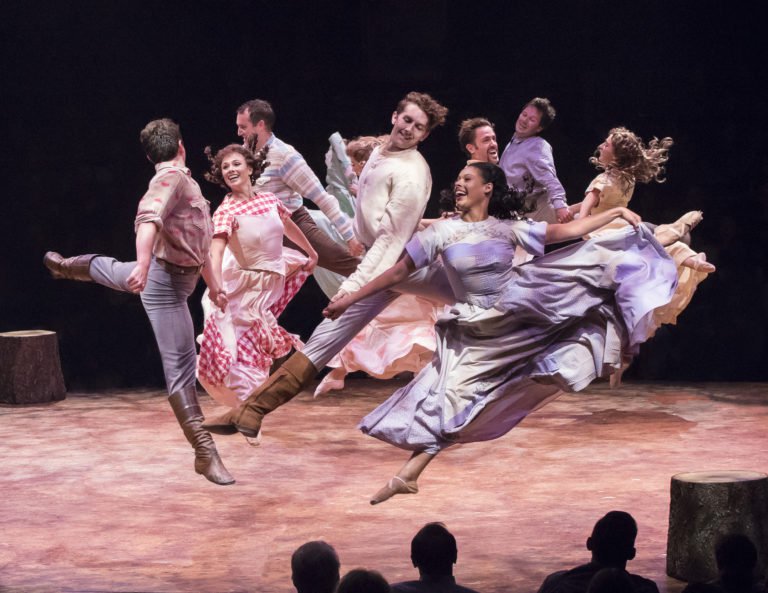
The cast of “Disaster!” includes, from left, Nicole Sterling, Tim Stewart, Natasha Hause,
Jamie Jones and Michael Cross. The Sacramento Theatre Company
production runs through Sunday, May 12.
Charr Crail Photography/Courtesy photo
The laughter was so continuous at the opening night of Sacramento Theatre Company’s “Disaster!” that it was sometimes difficult to hear the dialogue. But that didn’t matter because the plot is more or less negligible to the zany nonsense going on on stage.

This jukebox musical, written by Seth Rudetsky and Jack Plotnick (with additional material by Drew Garaci), uses 27 popular songs of the ’70s like “I Am Woman,” “Feelings,” and “I Will Survive,” played by the five-piece onstage orchestra, to move the action forward — action that never stops, thanks to the nimble hands of director Michael Laun.

This is a parody of those silly ’70s disaster movies like “Poseidon Adventure,” “Jaws” and “Towering Inferno.” The setting is the opening of a new floating casino, and the first act pretty much introduces us to the players (a cast of 20 first-rate actors) who will be trying to escape the casino when disaster strikes in Act 2.

Tony (Tim Stewart), whose baby this casino is, has built it Trump-like, ignoring rules and regulations and taking shortcuts wherever possible. Professor Ted Scheider (Casey McClellan) is the disaster expert who knows what is going to happen but can’t get anybody to believe him. They’re all having too good of a time.

New York Times reporter Marianne (Melissa Brausch) is trying to write an article about Tony’s cost-cutting measures, which have made the casino unsafe.

Because there has to be a love story in there, Marianne runs into former lover Chad (Sam C. Jones) and the two rediscover their “Feelings” for each other, which may lead to their peril.

Lounge singer Jackie (Natasha Hause) is waiting for philandering Tony to pop the question. She has two children, Lisa and Ben, both played by Elizabeth Lamora (alternating with Kateyn Reeves), who proves that you can play two characters on stage at the same time if you stage it right!

The guests are great, particularly Nicole Sterling as Sister Mary Downy, a nun with a previous gambling addiction, trying to resist the lure of the slot machines as she attempts to let people know that if they gamble, they will go to hell. Her “Never Can Say Goodbye” is a highlight.

Maury and Shirley (Michael Cross and Jamie Jones) are a retired couple, celebrating Maury’s retirement (“You’re Still the One”). Shirley is a salute to Shirley Winters’ character in “Poseidon Adventure,” who ends up saving the young lovers. Winters’ character called on her swimming skills; this Shirley resurrects her skills as a former high school tap-dancing champion to tap out the morse code instructions to open a watertight door.

Miranda D. Lawson is Levora, a disco diva, who, in songs such as “Theme from Mahagony” and “Knock on Wood,” shows that she’s not quite ready for retirement yet.

Kudos to scenic designers Jarrod Bodensteiner and Renee Degarmo for creating realistic earthquakes and flooding, with the aid of Emma Bramble’s sound design and Craig Vincent’s lighting design.
If you like to laugh, and especially if you were a fan of either ’70s pop music or those crazy disaster films, this is the show for you!

Wednesday, April 17, 2019

The Self - Unseeing


There’s a new theater in town and if its debut production, “The Self-Unseeing,” is any indication, we are in for some exciting shows in the future. The Happy Hour Theatre was founded by area natives Shenandoah Kehoe and Christi van Eyken in August of 2018. Kehoe grew up in Sacramento and studied theater at Sacramento State. Van Eyken is a Davis resident and an alum of the Davis High School drama program.

The Happy Hour Theatre offers opportunities for theater artists to undertake new challenges and expand their ability to make compelling theater.

The company has no permanent home at the moment, but this first production is held at the Black Box Theater in West Sacramento and the Palms Playhouse in Winters. In the immediate future, the company will perform at various venues, without a single home base.

In addition to using local actors and directors, the company plans to produce original works by community members as well as published pieces in order to give local playwrights a place to bring their words to life. Incidental music for each of the five plays presented in this one-hour production is written by local musicians The Bad Barnacles, Mark Butterworth, Band of Coyotes, Odd Moniker, Lucinda H. Cone and Taeko McCarroll.

The debut production consists of five short plays not original to Happy Hour Theatre and which have been performed at least once before. The entire production takes just one hour, and in the West Sacramento location, there is a happy hour in the café downstairs after the show.

“Don’t Bleed on Me,” by Andy A.A. Rassler, directed by Michael Sicilia, features Christine Nicholson and Luther Hanson as white socks in a washing machine, appalled when a colored athletic sock is tossed into the machine, concerned about the proximity of the bright colors and what they might do to the snowy white socks. It is a very funny bit, with not-so-subtle implications about discrimination. The ultimate solution to the problem is very clever — if only it could happen in real life.

“What Are You Going to Be?” written by Steven Korbar and directed by Acme alum Betsy Raymond, pits parents against a stubborn teenager determined to have her own way in the choice of a Halloween costume. Kathleen Poe and John Ewing are marvelous, trying to explain to daughter Natalie Evans why it is not a good idea to go trick-or-treating in a burqa. The surprise ending is wonderful.

In “Mendacity, or the Herd of Elephants in the Room” by Carlos Murillo and directed by Andrew Fridae, Mauricio (Doug Williams) has developed a very strange physical condition to the consternation of wife (Lisa Derthick) and son (Matthew Hurley). This is a very funny 10 minutes. While not in the least political, it will have you thinking of the current administration. The best line in the evening came from this play, where Mauricio describes his pain as “imagine passing a kidney stone during natural childbirth without medication.”

The final two plays are “Sold!” by Donna Hoke, directed by Lucinda Hitchcock Cone, a familiar name to Sacramento audiences, featuring Christi van Eyken, Chris Scarberry and Kathleen Poe, and “Paper Thin” by Lindsay Price, directed by Vernon F. Lewis, featuring Matthew Canty, Emily Vernon, Chris Scarberry and Shenandoah Kehoe. Each of them is unique and enjoyable.

Happy Hour Theatre is off to a terrific start. I can hardly wait to see what they come up with next.

Wednesday, March 27, 2019

42nd Street


Someone who saw the opening night production of Woodland Opera House’s “42nd Street” (directed by Robert Cooner) told me that it was spectacular and that I would love it. I am happy to report that it is — and I did.

This formulaic Depression-era story of a girl from the midwest arriving in New York, determined to become a star, was first a Busby Berkeley movie vehicle for hoofer Ruby Keeler in 1933, with book by Michael Stewart and Mark Bramble, lyrics by Al Dubin and music by Harry Warren.

In 1980, David Merrick decided to bring the story to Broadway, under the direction of Gower Champion. The stage version used only four of the songs from the original movie version and added songs from other musicals of the 1930s (including one by Hoagy Carmichael, uncredited in the current printed program). The end result was nominated for several awards in 1981 and won a Tony for best revival in 2001.

The cast of 22 fill the Opera House stage and most of them tap dance through several impressive numbers, each of which brings down the house. The best part was that there was nobody out of line — they were as in unison as a murmuration of starlings. Choreographer Staci Arriaga may be the real star of the show!

The central figure of the story of Peggy Sawyer, played by Ernestine Balisi (who played this same role with Davis Musical Theatre Company in 2017). She arrives in New York, wide-eyed and fresh-faced and certain she’ll immediately get cast in a big Broadway musical. She can dance up a storm but has never been on stage before.

Michael David Smith plays Billy Lawlor, the tenor of the show-within-a-show. Smith is a huge bundle of talent in a less-than-huge body. He’s a triple threat — he sings, he acts and he dances up a storm. He and Peggy have an instant rapport and there is hint of a budding romance, though that is not the focus of the story.

Scott Martin is terrific as Julian Marsh, the producer who believes the show, “Pretty Lady,” is going to get him back on top again, after a series of less-than-successful shows. When counting heads, he realizes that he is short one chorus girl and so Peggy, who just happens to be on the street in front of the theater, is chosen, seeming to learn all the dance routines instantly.

Patricia Glass plays Dorothy Brock, an aging, fading Big Name whose sugar daddy, Abner Dillon (David Cross), has backed the production so that his girl can have another hit. While she has a great voice, she has two left feet and so choreography has to be revised so that others can dance around her to hide the fact that she can’t dance.

Lenore Sebastian and Gil Sebastian are Maggie Jones and Bert Barry, the songwriters for the show, offering comic relief throughout. These local favorites do not disappoint and, in fact, Lenore gets some of the biggest applause at the curtain call.
When an accident takes Dorothy Brock out of the cast, Peggy is chosen to be her replacement, in two days, under Marsh’s direction. Marsh is a harsh taskmaster and when Peggy gets the jitters before the curtain goes up, he utters those immortal lines: “Two hundred people, two hundred jobs, two hundred thousand dollars, five weeks of grind and blood and sweat depend upon you. It’s the lives of all these people who’ve worked with you. You’ve got to go on, and you’ve got to give and give and give….You’re going out there a youngster, but you’ve got to come back a star.”

Nothing like a little pressure!

I won’t spoil the show by revealing how it ends, but let’s just say lots of tapping and arm waving are involved.

It’s all very silly, and involves a lot of suspension of disbelief from anyone with even the vaguest inkling of what goes into producing a Broadway show, but what the heck: The important thing is getting from one musical number to the next – and everybody does this exceptionally well.

Woodland offers consistently fine productions and this one exceeds even their own normal standards. Try not to miss it!

Thursday, March 21, 2019

Vietgone

Some time ago, I was chastised by a reader for not warning of “adult language” in a production. So let me say at the outset that if you are upset by adult language, you want to skip “Vietgone,” now at Capital Stage. But if you do, you will be cheating yourself out of a very special theatrical experience.

Is this the new look of American theater? It’s a hilarious comedy that can move you to tears in emotional moments. It’s not a musical, yet entertains with “Hamilton”-esque rap numbers. In place of actual sets, there are projections that enable the story to flip back and forth in time and place and include video news footage from the war era. It even includes a fantasy ninja warrior battle.

While it is contemporary in its examination of stereotypes (both Americans and Asians), and the treatment of immigrants following the Vietnam war, it certainly echoes life today.

As Producing Artistic Director Michael Stevenson completes his welcoming message, he announces that a “special guest” will also speak. Actor David Crane introduces himself as the playwright Qui Nguyen and begins to give an explanation of what might seem confusing about the play, which he describes as an “action sex comedy.”

He explains that though we hear the characters speaking English, they are really speaking Vietnamese and when an American character appears, you’ll know he is American because he will spout American nonsense like “Yee Haw! Get’er done! Cheeseburger, waffle, fries, cholesterol, NASCAR, botox, frickles,” the translation of which will be obvious by the response from the Vietnamese. It is an interesting switch of life and history from the Vietnam perspective, which we rarely, if ever, see.

The story centers on two characters, Quang (Jomar Tagatac), a helicopter pilot during the Vietnam War, who was unable to bring his wife and two young children out of Vietnam and longs to return, and Tong (Rinabeth Apostol), a Vietnamese refugee, whose fiancée was left behind in Vietnam and she whom knows she will never see again.

Tong came to America with her sharp-tongued mother, Huong (Michelle Talgarow), with strong feelings about America, American food, how Tong should act and the men she should date. Talgarow also plays several other characters, as do Anthony Chan and the aforementioned David Crane.
Quang finds a dilapidated motorcycle, which he repairs and, with this friend Nhan, heads for California. Along the road, the two have one of the funnier sequences, when they taste burritos for the first time and decide that maybe not all American food is terrible.

Kudos to, I assume, Christa Kinch, who gets credit for Properties Design, for the great motorcycle which is ridden all over the stage throughout the play.

For Quang and Tong, it is lust at first sight and their relationship is strictly a physical one until they begin having feelings for each other, something both of them fight.

Director Jeffrey Lo has a deft hand at letting the relationship between the two grow until we see the inevitable — Quang’s conversation with their son some 20 years later.

The play gives the audience a chance to witness American culture as seen through the eyes of immigrants, to hear that for the immigrants the war is over and done with and they are moving on, while Americans hunger for more and more details about what happened in the past.

“My life is more than the eight years I fight,” Quang tells his son. “All I hear is politicians using Vietnam as a symbol for a mistake. ‘If the president not careful, this will be another Vietnam.’ This is not how any Vietnamese wants Vietnam to be remembered….let me tell you about the people. But if you only wanting to know about war, then go rent a movie.”

This is a unique production that is well worth seeing.

Wednesday, March 13, 2019

Inherit the Wind

Henry Drummond (J. Toney) interrogates a potential juror (Tyler Tufts)
as the judge (Greg Lanzaro) watches. Courtesy photo
Though they have done a few dramas in the many years I have been reviewing productions of the Winters Community Theatre Company, I think of them as doing mostly comedies, with the occasional musical. I wasn’t sure what to expect when I learned the next production was going to be Jerome Lawrence and Robert Edwin Lee’s “Inherit the Wind.”

Coming off the stage and into the director’s chair for the first time, Rodney Orosco promised the audience “a good show…maybe a great show.” In all honesty, it was not a great show, but it was a very good show.

Most people know that this is the story of the trial of Thomas Scopes (called Bertram Cates in this script), the teacher who had the audacity to teach his students about evolution instead of creationism in 1925. It is sad to realize that many of the things shouted by conservatives in 1925 ring true in 2019, nearly 100 years later. At the time this was known as “Godless science versus fairy-tale notions.” I’m sure somewhere someone is preaching the same sentiment today. We have not evolved as quickly as expected.

The Scopes trial pitted two of the legal giants of the age against each other — three-time presidential candidate William Jennings Bryan (called Matthew Harrison Brady in the play) and Clarence Darrow (known as Henry Drummond).

The impact of the play rests on the performance of these two characters. If they are not strong, the play can fall apart. How fortunate Winters is to have two impressive newcomers in the roles. Will Oberholtzer gives a towering performance as Brady, the self-professed Biblical scholar who defiantly defends fundamentalism. Brady is the more bombastic of the two and Oberholtzer is captivating.

J. Toney’s Drummond is more laconic and sarcastic, but no less effective. He gave a spellbinding interrogation of Brady, whose slow but continuous wilting under the questions was perfect. Brady’s physical condition was hinted at by the attention of his wife (Ana Kormos) throughout the first act and his reaction to the courtroom heat was so realistic, we almost wanted the theater to turn on the air conditioner.

(Toney’s daughter Cameron — last seen in last year’s “It’s a Wonderful Life” — plays the town’s mayor.)

Winters regular Philip Pittman was E.K. Hornbeck, the reporter who covers the trial and arranges for Drummond to represent Cates at the trial. This was another strong performance. Hornbeck knows he is a controversial figure (“I am admired for my detestability”) and uses his reputation to his advantage.

Defendant Cates hasn’t much to say or do, but Spencer Alexander did it well, projecting his concern about his future as well as his feelings for Rachel Brown (Elizabeth Williams, alternating with Sierra Winter), daughter of the town minister, Jeremiah Brown (Tom Rost). Rost is always outstanding and makes a convincing minister, denouncing his daughter as a creature of the devil for her feelings for Cates.

There is a large cast, and Tyler Tufts outdoes himself by playing two characters being interviewed for the jury, one distinguishable by his impressive mustache.

(Also doing double duty is the suitcase, which a reporter (Laurel Brittan) carries in, and off stage, brought back on again minutes later by Rachel, bringing clothes to the jailed Cates.)
Among the many town characters, Germaine Hupe adds comic relief by her many shouted epithets at both Cates and Drummond.

There is a simple set dominated by a stage-wide backdrop by Jeff Hesemeyer. It’s an impressive piece, a vision of the town of Hillsboro, Tenn., strangely reminiscent of the town of Winters itself, both the Putah Creek Café and the Buckhorn easily identifiable.

The debate of creationism vs. evolution continues today and one wonders how many more decades this play is going to remain contemporary.

Thursday, March 07, 2019

Flora the Red Menace

If you know the musicals “Cabaret” and “Chicago,” you know the music of the songwriting duo John Kander and Fred Ebb. But you may not be familiar with “Flora the Red Menace,” their first collaboration.


Now is your chance to see this seldom performed show in a sparkling production at Wyatt Pavilion, under the direction of Mindy Cooper, professor of theater, and Granada Artist-in-Residence Judy Blazer, an acclaimed veteran of Broadway and regional theater. Graduate student Diego Martinez-Campos collaborates with Cooper on the choreography (he also performs in the show). Graham Sobelman provides music direction.


At a talkback after one of the performances, Cooper explained the choice of this musical was precisely because there is so little available about the show on the internet and she felt it was the perfect opportunity for the actors to create their own characters without trying to copy something that had been done before.


The show originally appeared on Broadway and won a Tony for Liza Minnelli, making her Broadway debut. It only ran for 87 performances but was revived off-Broadway, with a new book, in 1987, and it had better success.


Though set in 1935 in the midst of the Depression, the story resonates with today’s young people, struggling with many problems, yet with a renewed desire to work to make the world better.


Flora Meszaros (Talia Friedenberg) plans to be a fashion designer and applies at Gimbel’s, Saks Fifth Avenue, Macy’s and Altman’s before finally applying at Garret and Mellick’s where she meets Harry Toukarian (Nathaniel Challis), a fellow artist, who stutters when he gets nervous.


Friedenberg’s Flora is a positive thinker, knowing she is somehow going to “make it” (“The Kid Herself”), though not quite satisfied when its seems that she does.


“When it all comes true
Just the way you’d planned
It’s funny but the bells don’t ring”


(It should be noted that none of the songs in this show ever made it into the popular repertoire, though they are fun to hear and in places show where Kander and Ebb will go in the future.)


Harry confesses that he is a communist and may be one of the most likable communists you’ll meet outside of “The Americans.” He is earnest, sincere and knows that he will help change the world, as he urges Flora to “Sign Here” and join the party.

Flora invites Harry to come to her artists’ cooperative loft, which is shared by several other struggling artists, including Kenny (Martinez-Campos) and Maggie (Aubrey Schoeman), dancers who are looking for a big break. They have several fun dance numbers, like “Keeping it Hot.”


Sophie Brubaker adds great passion and comic genius to the role of the uber Communist, Charlotte, especially impressing the others with her acts of the week (“Just Tuesday in the subway I threw a rotten egg/I called a man a fascist and I bit his daughter’s leg.”)


Things become more contemporary in lines like ”Don’t worry, there’ll never be another crash” and the chorus:

“There are people out there with no shoes on their feet 
Who shelter in doorways in snow and in sleet. 
And they search through the garbage 
to find something to eat.”


Flora’s dedication to the party is tested when she must make the choice of whether or not to cross a picket line to correct an error she made that will cost 33 people their jobs. Her decision will affect both her dedication to the party and her relationship with Harry.


Special notice must be made of understudy Katie Halls, who learned everyone’s part and then one day before the opening, filled in on some scenes for one of the actors who had some physical problems. You’d never know that Halls had not been cast in the role from the beginning.


This may not have the pizzazz of Chicago or Cabaret, but it is nonetheless fun to see how Kander and Ebb got their start, and the production is excellent, so this is the way to see it!

Sunday, March 03, 2019

Oliver!


Continuing the celebration of its 34th season of musicals in Davis, the Davis Musical Theatre Company opened an excellent production of “Oliver!”, the musical version of Dickens’ “Oliver Twist,” directed and choreographed by Jan Isaacson with musical direction by David Williams.

The production is blessed with several superb performances.  Recent health problems have prevented Steve Isaacson from taking meaty lead roles lately and I’d forgotten what a truly good actor he is.  He dissolves into the character of the criminal Fagin so fully that you imagine that this is what the role was always meant to be.

His gang of youthful pickpockets – Katherine Berdovskly, Katarina Deltrick, Ailani Gentles, Sage Greenwood, Lexy Hutcheon, Audrey Rycerz and Ruby Schwerin (also orphans in the opening scene) are well rehearsed and wonderfully choreographed.  Audrey Rycerz is the youngest in the cast (her mother Rachel is the housekeeper Mrs Bedwin).  For one so tiny, she was amazingly consistent, knew every word and didn’t miss a beat in any of the dance numbers.

Brian McCann is always a winner and his Mr. Bumble, the beadle of the workhouse where Oliver Twist is raised, is outstanding.  His pairing with Dannette Vassar as the widow Corney, matron of the workhouse, is inspired.  The imposing stature of McCann and the diminutive stature of Vassar make for bits of humor not possible in other productions.  Their “I Shall Scream” is particularly funny.

Also outstanding is Elliot DeJong as the Artful Dodger. A member of the Young People’s program, DeJong is moving into main stage productions and it’s easy to see why.  He dominates in most of his scenes and takes the stage confidently.

Gabriel Mark plays Oliver and while he has a beautiful clear voice (that can hit all those high notes in “Where is Love”) and is a winsome actor, he is having too much fun on stage and needs to learn that starving orphans don’t have smiles on their faces when being chased by the beadle, or when being threatened by the evil Bill Sikes (Jesus J. Madrigal).  If he learns how to compose his facial expressions, he will be an outstanding Oliver.

Hanna Van Noland, is Nancy, the girlfriend of the villainous Bill Sikes (not Sykes, a common spelling error) who ultimately becomes Oliver’s protector, at her own peril.   She has a strong voice and is appropriately emotionally torn in the lovely “As long as he needs me,” where she describes why she remains with an abusive partner.

Deborah Bromley is Mrs. Sowerberry, who with her husband (David Muerle) owns the funeral establishment where young Oliver is sold.  Bromley has an ear piercing shriek.

(Bromley is also a member of the ensemble while Muerle later pays Mr. Brownlow, the man who rescues Oliver after he is arrested for stealing.)

Steve Isaacson and Kimmie McCann are the set designers for this production.  There are many sets, the set for Brownlow’s home the most beautiful of them all.  The cast is mesmerizing as they move the huge pieces around in the dark, as coordinated as a choreographed dance number.  The size of the pieces does somewhat slow the pace of the total production, but it’s worth it.

At the conclusion of opening night Steve and Jan Isaacson were presented with 35 red roses, in honor of the 35th anniversary of the decision to start a theater company.  Both Isaacsons pointed out the importance of the “family” this all-volunteer company has become.  The capacity audience gave them thunderous applause.


Thursday, February 07, 2019

STOMP

If the guys with brooms in the 10-minute opening segment of “STOMP,” now at the Sacramento Community Center, were to take a trip up north and apply their expertise to a 240,000-acre forest, they could wipe out all the debris on the floor in short order.

“STOMP” is a 90-minute, nonstop action-filled show where one learns that just about anything — from garbage cans to plastic bags, to matchboxes —  and even the kitchen sink — can be incorporated into a segment.

Nearing its 40th year, “STOMP” is a unique combination of percussion, movement and visual comedy, created in Brighton, U.K., in the summer of 1991, the result of a 10-year collaboration between its creators, Luke Cresswell and Steve McNicholas.

Its success has to have been a “gotcha” nod from all those pot-banging kids whose mothers told them to stop making all that noise.

The group first worked together in 1981 as members of the street band Pookiesnackenburger and the theater group Cliff Hanger. Together, these groups presented a series of street comedy musicals at the
Edinburgh fringe festival throughout the early ’80s.

After two albums, a U.K. TV series and extensive touring throughout Europe, Pookiesnackenburger also produced the highly acclaimed “Bins” commercial for Heineken lager. The piece was originally written and choreographed by Cresswell as part of the band’s stage show; it proved to be the starting point for the “STOMP” climactic garbage can dance. (It’s worth checking out “Heineken bin commercial” on YouTube!)

In 1991, Cresswell and McNicholas first created “STOMP,” previewing at London’s Bloomsbury Theater and premiering at the Assembly Rooms in Edinburgh, where it became the Guardian’s Critic’s Choice and won the Daily Express “Best of Fringe” award.

Between 1991 and 1994 the original cast played to capacity audiences around the world, from Hong Kong to Barcelona to Dublin to Sydney.

“STOMP” began its run at the Orpheum theater in New York in February of 1994 and quickly went on to win both an Obie and a Drama Desk award for “Most Unique Theater Experience.” By the summer of 1994, the first American cast was in place at the Orpheum, freeing the original cast for sellout tours of North America and Japan. The company made a special appearance at the Academy Awards in 1996, with an original piece involving live synchronization of classic film clips and onstage action, featuring 20 performers from all five nominated movies.

“STOMP” performed on the steps of the Lincoln Memorial in an after-midnight performance as part of President Clinton’s millennium celebration and later there was a Muppet-“STOMP” collaboration for

American television.

In 2006, the New York production passed its 5,000th performance, and in 2011 as it entered its 18th year at the Orpheum Theater, beating the previous winner at that theater, “Little Shop of Horrors.”
Most recently, 40 performers from 12 different countries appeared together in the closing ceremony of the London 2012 Olympic games.

The program lists 12 performers, men and women, in the cast: Kayla Cowart, Jonathon Elkins, Desmond Howard, Alexis Juliano, Guido Mandozzi, Artis Olds, Jeremy Price, Krystal Renée, Ivan Salazar, Cade Slattery, Steve Weiss and Joe White.

It is impossible to tell who is who, other than “the guy in the baggy pants who got the audience clapping, the girl with purple hair, the childish guy with the odd hat,” etc.

There is also no program credit for the multi-level set design, but on stage is a metal wall hung with all sorts of noisemakers, from hubcaps to highway signs to oversized plastic bins.

Steve McNicholas and Neil Tiplady are credited with lighting design, and the lights playing a huge role in the feel of the show. Some of the best numbers were lit from each side of the stage, casting large, eery shadows on the theater walls and giving it the effect of some ancient tribe dancing by the light of a fire in a cave somewhere.

Choreography for numbers with brooms, wooden sticks and a number of other things rivals the synchronization of the Rockettes.

There was audience involvement, too, as increasingly more complicated hand claps were demonstrated so the audience could respond — and respond they did.

Not surprising, there was an enthusiastic standing ovation as the group appeared on stage for one final encore.

“STOMP” was last here in 2008, so it is unlikely that it will return again soon. Take the opportunity to see it while you can.


Wednesday, December 12, 2018

Miss Bennet


In December of 2017, Capital Stage introduced Sacramento audiences to a new Christmas play, “Miss Bennet: Christmas at Pemberley.” It was an instant hit and audience favorite to be repeated in 2018.


Written by Lauren Gunderson (“the most produced living playwright in America”) and Margo Melcon, and was written on a six-hour drive from San Francisco to Ashland, Ore., in 2016. The play echoes the format of Jane Austen, recalling what happens after “they lived happily ever after.”
The play is once again directed by Peter Mohrmann.

It is Christmas and the scene is the beautiful living room of sister Lizzie (Brittni Barger) and her husband, the hunky Mr. Darcy (J.R. Yancher). (It is worth noting that six of the eight characters are returning, after their performance in last year’s production).

The set is by Eric Broadwater, and one of the more opulent you will find on a Sacramento stage
The room is dominated by a real Christmas tree, the practice of bringing real trees into the house at Christmas being a new concept in England, though it was started in Germany. The tree becomes almost a major character in the show since it is decorated throughout the evening and everyone has comments to make about it.

Sister Mary (Elyse Sharp) is first to arrive for this family Christmas. She’s the “bookish” one who prefers to live alone, read books and play the piano (kudos to Ed Lee for his sound design which makes it difficult to determine if Sharp is actually playing the piano or not!).

She’s not much interested in the frivolous conversation of sisters Lizzie, the very-pregnant Jane (Jennifer Martin) and Lydia (Allie Coupe). (Sister Kitty is on holiday in London.)

Jane’s husband is Kevin Gish, whom Davis people may remember from his very funny role in “Gutenberg! the Musical!” His militant enthusiasm for everything, including his impending fatherhood, is infectious and makes him an audience favorite.

Mary’s life is shaken up by the arrival of Arthur DeBourgh (Aaron Kitchin), also a bookish loner who seems embarrassed to have just become fabulously wealthy on inheriting his aunt’s estate.

Sparks don’t exactly fly between these two introverts, given their reticent natures, but they are both reading the same book on metaphysics, so there is an instant attraction. Things are starting to get interesting when Arthur’s cousin Anne (Andrea J. Love) arrives to announce she is his fiancée.

“Miss Bennet: Christmas at Pemberley” is a wonderful addition to the usual list of Christmas-themed theatrical productions and, performed so beautifully by Capital Stage, it’s a must-see for all those looking to get a little holly in their hearts before the actual day itself.


Monday, November 19, 2018

It's a Wonderful Life

“It’s a Wonderful Life” has been a favorite ever since it appeared on our movie screens in 1946.  The Winters Theatre company presented a production in 2010 and are reprising the show, though a different version, this one by Philip Grecian. Again, Anita Ahuja directs.

There are many, many scenes and the lengthy set changes make the first act, especially, drag somewhat.  There were also some first night problems with telephones that didn’t ring when they should and did ring when they should not and a few other glitches, which I know will be smoothed out as the run progresses, but all in all, Winters has given a loving tribute to this beloved holiday classic.   

Scott Graf dominates as Clarence Oddbody, the angel who has been trying for 200 years to earn his wings.  He has his chance when God sends him to earth to help George Bailey (Scott Taylor), who has reached a crisis and has decided to kill himself.

Taylor gives a fine performance as George, with all the wide eyed enthusiasm of a young man, and the weight of the world as his world falls apart.  His chemistry with Mary (Cameron Toney) is lovely.  She is the steadfast wife who supports him no matter what (Young Mary is played by Isadora Harris)

Act 1 is a backward look at George’s life, with Kenneth Matheson playing the young George saving his brother Harry (Arlo Harris) from being drowned and preventing the local pharmacist (Jesse Akers) from sending the wrong medication to a patient.

George has great plans for his future–traveling the world and then settling down to become an architect.  But plans go awry when his father dies suddenly and it is up to George to take over the Savings & Loan and keep it from being taken over by the wicked Mr. Potter (Trent Beeby, who played George in the 2010 production).

Beeby is wonderful as the man you love to hate.  People sometimes think stories like this are dated, but some of Potter’s lines could be right out of today’s headlines.

Uncle Billy, who loses $8,000 and plunges the Savaings and Loan into the brink of bankruptcy is played wonderfully by Bryan Pro who gives Billy more "smarts" than some actors, but is devastated by his loss.

“Sesame Street” swears that the Muppet characters of Ernie and Bert are not taken from this story, but William Haggerty (Bert) and Jim Hewlett (Ernie) are fun as these two characters.  Hewlett appears later as a bartender.

Cody Svozil does double duty as Mr Potter’s slimy-haired body guard and “enforcer,” and also as George’s enthusiastic brother, who just received the Congressional Medal of Honor for his heroism in battle.

Alexis Velasquez is very funny as Aunt Tilly, secretary of the Savings and Loan, who answers the phone in the best Lily Tomlin imitation.

Shahzana Ali is Violet Bick, the oversexed young woman whom George befriends.

George’s children are Rachel Rominger as Janie, Jackson Bronson as Peter, Arlo Harris as Tommy and Stella Gonalez as Zuzu, who announced that whenever a bell rings, an angel gets his wings.

Because of the number of locations, sets are necessarily pretty utilitarian, but designer Gary Schroeder manages to make the most of minimal set pieces.  Particularly impressive, though simple, is the bridge on which George wants to commit suicide.

I never leave Winters productions without a smile on my face because of how much fun everyone is having, both on and off the stage.


Saturday, November 03, 2018

Annie

“Annie” is one of those classic musicals that seems to come around so often that I groan at the thought of seeing it again. But then I go to the theater and remember why I really like this retelling of the Little Orphan Annie story, and why it is so popular, especially when done with the enthusiasm and talent of Davis Musical Theatre Company.

This latest production, directed by Steve Isaacson, with choreography by Ron Cisneros, has a wonderful, talented cast.

This show really rises or falls on the talents of Annie and in Katarina Detrick (in her first lead role) DMTC has a winner. She sometimes tends to be shrill, but she is a belter of the first order, and they probably can hear her out in the parking lot when she sings “Tomorrow.” She also is a good actress and professionally handles the dog Sandy (Cleopatra Graves) who is more interested in running into the audience, with tail wagging, than behaving herself on stage, despite the treats Annie kept in her pocket. Detrick never missed a beat and eventually got the dog under control.

Perhaps the moment that most impressed me was when billionaire Oliver Warbucks (Gannon Styles) is letting Annie know how she has wormed her way into his heart. The intense look of real love on her face as she watches him was just beautiful to behold.

Styles, with a solid theater background, is new to DMTC and what an addition he is. He gives great warmth to the character of Warbucks and has a great voice to boot.

Warbucks’ secretary, Grace Farrell, played by Chris Cay Stewart, is a warmhearted woman hiding feelings for Warbucks, and a great friend to Annie. Stewart also appears as part of the ensemble in some scenes, where her beautiful voice is easy to identify.

Rachel Hoover, a Davis native who performed more than 30 shows before she went to college (including some with the former Sunshine Children’s Theater), is a spectacular Miss Hannigan, the harridan who runs the orphanage where Annie was dropped off 11 years ago as an infant. She’s enough to scare anybody, and her musical numbers, particularly “Little Girls,” are outstanding.
Christopher Murphy, another DMTC newcomer, makes an impression as her brother, Rooster Hannigan, as does Bridget Styles as his girlfriend Lily St. Regis.

The orphans — Kiera Chang, Chantelle Holt, Vivian Li, Lexy Hutcheon, Sage Sigmon and Katherine Berdovskiy — are well- rehearsed, in good voice and perform their dances professionally. Each girl also has her moment to shine in the spotlight.

What I love about DMTC shows are the little unexpected “gems.” I found three under that category in this production. Amaralyn Ewey is great as the fresh-faced star-to-be, newly arrived in New York. There never was a better role for Marc Valdez than that of Franklin D. Roosevelt. But especially outstanding was Jan Isaacson’s performance as the silent sound man for a Gert Healy (Amy Woodman) radio broadcast. She is just perfect.

With familiar tunes like “Easy Street” and “Tomorrow,” in addition to a score of other fun songs and a cast of adorable little girls and funny bad guys, this is a show that will appeal to everyone, and DMTC makes it fun for all ages.

Sunday, October 28, 2018

Darkness Into Light


Pamela Trokanski, a Davis treasure, has been choreographing, performing and teaching in Davis for 34 years. She has given lectures and demonstrations and, since 1994, has funded almost 10,000 free-movement classes for adults 65 and older. She has provided free dance classes for people with Parkinson’s Disease and their caregivers since 2010. At one time she wrote a dance column for The Enterprise.


When I started as a critic, she invited me to come and review one of her dance concerts. I explained that I knew absolutely nothing about dance and she said that made me perfect to review her shows because she meant them to be accessible to everyone.

Over the years, I don’t know how much I have learned about dance, but I certainly have appreciated how accessible they are to everyone.

“Darkness into Light” has one more weekend to play at the Trokanski studio. It is a most timely piece, opening the day of the Pittsburgh killings and a week after all the bomb deliveries. The message is about trying to find peace in this chaotic world in which we live, where we are bombarded by pressures and negative messages on all sides.

How do we find peace for ourselves when we are concerned about the health of the planet or the rapid changes in technology? How do we find balance in a world that feels increasingly chaotic and disorganized? We no longer worry about lions, tigers and bears (oh my) but politics, ethics and technology.

Trokanski’s printed programs are always frustrating because they are misleading. There are eight dancers, it says, but nine show up (the unlisted dancer is Trokanski herself). Music is listed in order of performance, but a piece by Pink (which I figured would help me figure out if I was keeping up) is No. 4 on the list and No. 7 in the performance. Company member stories are listed in order, but Allegra Silberstein (the only dancer I recognized) is No. 2 on the list and doesn’t speak until fourth or fifth.

Better to forget trying to keep it straight and just enjoy the dancing (unless you have to write a review of it).

Dancers, who range in age from young (maybe 10 or 11) to 87, are: Lila Boutin, Allegra Silberstein, Michele Tobias, Leela Ghassemi, Padyn den Dulk, Tracy Liu, Asher Habicht and Karen Block, along with Trokanski.

Dances are accompanied by Trokanski’s narrative or by individual dancers’ recorded “stories” of stressors in their lives, some of which set the stage for particular dance numbers.

In one number, the message is about the daily pressures of life: “Have I remembered to put everything in my purse?” “Where are my keys?” “Is there a traffic jam?” “Am I overwhelmed at work?” etc. She compares the stress to the Lucy/Ethel episode of working in the candy factory, with the ever-increasing speed of the conveyor belt. The dancers make the machine, with all the automatic actions while the recorded speakers dance the role of the overwhelmed person. It was an amazing bit of synchronized action that went on so long I don’t know how the dancers had energy to move to the next number.

After a couple of numbers which give suggestions for how to use meditation to slow down our rapid thought processes, there is a beautiful finale, with each dancer holding a lighted candle — and doing an amazing amount of rolling around just barely not touching the candles! They gather together to “Sleeping at Last” for their final bow.

This is a beautiful, meaningful recital, easily enjoyed whether you know dance or not. Just don’t try to follow the printed program.

Tuesday, October 23, 2018

Sweat

A very strong, compelling play, with adult language, is now at Capital Stage.  “Sweat,” by Lynn Nottage was the 2017 Pulitzer prize winner for drama.  It is very much a play for today and one with which many will identify.  The New Yorker calls this the “first theatrical landmark of the Trump era,” a work which attempts to explain the nationwide anxiety that helped put Donald J. Trump in the White House.

In 2008, two men, Jason (Ian Hopps) and Chris (Tarig Elsiddig) have just been released from prison and are meeting with their parole officer (James R. Ellison III).  We don’t know why they were imprisoned or what the bad blood between these formerly good friends is, but in flashbacks (aided by TV news clips showing politicians and timely news as well as relevant tunes of the day) we see what led up to their incarceration.

The setting is Reading, Pennsylvania, which was in 2002 named the “poorest town in America.”  There is a Cheers-like bar (though cheerless) presided over by bartender Stan (Matt K. Miller).  Into the bar come the six regulars and the janitor Oscar (Evan Lucero).

Except for Stan and Oscar, everyone has worked at the local mill for decades (Stan had to quit because of an injury.  “Getting injured was the best thing that ever happened to me.  Got me out of that vortex.”) and the underlying feelings of anger and frustration are apparent from the beginning.

The conversation all centers around working conditions, poor pay and fear that they will lose their jobs if the factory move to Mexico–and then what will they do? 
Two of the women, Jessie (Kelley Ogden) and Cynthia (Kathryn Smith-McGlynn) decide to apply for a position in upper management, which will mean more money, fewer hours, and the chance to help those on the floor better their conditions.

Things begin to fall apart when Cynthia is hired and friendships begin to shatter over working conditions and what she can, or should do about them.

When the worst happens and the workers are locked out of the factory (without even given the chance to clean out their lockers) everyone learns the cruel lesson that you can be a dedicated worker for decades, do your job, often work overtime without pay, graciously accept less than ideal working conditions, but when push comes to shove, you mean nothing to the managers. It doesn’t pay to be a “good guy.”

As Stan says, “I’m in the hospital for nearly two months.  I can’t walk.  Can’t feel my toes.  Not one of those ***s called to check on me, to say ‘I’m sorry for not fixing the machine...’ The only time I heard from them was when they sent their lawyer to the hospital because they didn’t want me to sue. Twenty-eight years.  That’s when I knew I was nobody to them.  Nobody!”

Though this is set in 2000 and 2008, one of the characters swears he will never vote again because what is the use?  (Which may be the best excuse to remind people to get out and vote in 2 weeks!).

Michael Stevenson has directed a tight, riveting drama that will have an impact on everyone, whether part of the upper class, or one of those who are experiencing such situations every day. It is one of those “not to be missed” productions for which Capitol stage is often known and there’s not a weak link in the cast.  Everyone is at the top of their game.


Sweat

A very strong, compelling play, with adult language, is now at Capital Stage.  “Sweat,” by Lynn Nottage was the 2017 Pulitzer prize winner for drama.  It is very much a play for today and one with which many will identify.  The New Yorker calls this the “first theatrical landmark of the Trump era,” a work which attempts to explain the nationwide anxiety that helped put Donald J. Trump in the White House.

In 2008, two men, Jason (Ian Hopps) and Chris (Tarig Elsiddig) have just been released from prison and are meeting with their parole officer (James R. Ellison III).  We don’t know why they were imprisoned or what the bad blood between these formerly good friends is, but in flashbacks (aided by TV news clips showing politicians and timely news as well as relevant tunes of the day) we see what led up to their incarceration.

The setting is Reading, Pennsylvania, which was in 2002 named the “poorest town in America.”  There is a Cheers-like bar (though cheerless) presided over by bartender Stan (Matt K. Miller).  Into the bar come the six regulars and the janitor Oscar (Evan Lucero).

Except for Stan and Oscar, everyone has worked at the local mill for decades (Stan had to quit because of an injury.  “Getting injured was the best thing that ever happened to me.  Got me out of that vortex.”) and the underlying feelings of anger and frustration are apparent from the beginning.

The conversation all centers around working conditions, poor pay and fear that they will lose their jobs if the factory move to Mexico–and then what will they do? 
Two of the women, Jessie (Kelley Ogden) and Cynthia (Kathryn Smith-McGlynn) decide to apply for a position in upper management, which will mean more money, fewer hours, and the chance to help those on the floor better their conditions.

Things begin to fall apart when Cynthia is hired and friendships begin to shatter over working conditions and what she can, or should do about them.

When the worst happens and the workers are locked out of the factory (without even given the chance to clean out their lockers) everyone learns the cruel lesson that you can be a dedicated worker for decades, do your job, often work overtime without pay, graciously accept less than ideal working conditions, but when push comes to shove, you mean nothing to the managers. It doesn’t pay to be a “good guy.”

As Stan says, “I’m in the hospital for nearly two months.  I can’t walk.  Can’t feel my toes.  Not one of those ***s called to check on me, to say ‘I’m sorry for not fixing the machine...’ The only time I heard from them was when they sent their lawyer to the hospital because they didn’t want me to sue. Twenty-eight years.  That’s when I knew I was nobody to them.  Nobody!”

Though this is set in 2000 and 2008, one of the characters swears he will never vote again because what is the use?  (Which may be the best excuse to remind people to get out and vote in 2 weeks!).

Michael Stevenson has directed a tight, riveting drama that will have an impact on everyone, whether part of the upper class, or one of those who are experiencing such situations every day. It is one of those “not to be missed” productions for which Capitol stage is often known and there’s not a weak link in the cast.  Everyone is at the top of their game.


Thursday, July 12, 2018

Newsies


Who says that one young, insignificant poor kid living in the slums can’t change history?
That’s the story, based on true events, which is the subject of the Broadway at Music Circus current production, Disney’s “Newsies.”

At the turn of the 20th century, some 10,000 boys sold newspapers on the streets of New York, many of them orphaned and homeless. The boys paid to get the newspapers, and if they did not sell, the publishers would not buy them back.

During the Spanish-American war, when the desire for news was high, the publishers raised the price charged to the boys from 50 cents per hundred to 60 cents per hundred. But at the end of the war, when the interest dropped, publishers Pulitzer and Hearst did not reduce the price the boys paid, even though other publishers did. The boys demanded a return to the price that their peers at other papers were paying.

Under the leadership of a 15-year-old boy named Kid Blink, the “newsies” organized, held massive outdoor meetings and after two weeks, the publishers and the newsies compromised — they would keep the higher price, but would buy back any unsold papers. The stand-off was considered a major step in the child-labor movement.

In 1992, the story was made into a Disney movie, and in 2014 an award-winning musical with music by Alan Menken, lyrics by Jack Feldman, and book by Harvey Fierstein. It is now a premier for Broadway at Music Circus.

Entering the Wells Fargo Pavilion is like walking into a Brooklyn tenement, with apartments over each doorway, all joined together in a spiderweb of clothes lines, each with laundry hanging from them.

“Kid Blink” (decidedly not the best name for the hero of this tale) is now Jack Kelly (Joey Barreiro), an older teen (so he can have a love interest), but the basics of the story are still there.

For “heart” there is “Crutchie” (Blake Stadnik), who has been crippled and walks with a crutch and is a perfect victim for the goons of the publishers trying to squelch the boys.

There is a love interest, Katherine (Laurie Veldheer), a reporter trying to make it in a male-dominated world, and hiding a surprising secret.

There is Davey (John Krause) and his little brother Les (Josh Davis) who, unlike the others, have a home and parents, but who join the others in selling the papers and protesting the fee increase.

But this show belongs to the newsies themselves (if you look closely you can see Davis High’s Jimin Moon). The dancing is amazing and you do get the feel of their camaraderie as well as their desperation.

Paul Schoeffler is powerful as Joseph Pulitzer, who only cares about money and doesn’t have a bit of compassion for the kids (gee … where have we heard that lately?).

Music Circus’ ubiquitous Ron Wisniski has a short but outstanding appearance as a bombastic Teddy Roosevelt (then governor of New York), which earned him well-deserved applause as he left the stage.

The high-energy physicality and enthusiasm of the cast make this an engaging production — and of course the David vs. Goliath struggle is always good to keep an audience entertained!

Wednesday, July 04, 2018

7 Brides for 7 Brothers

Broadway At Music Circus is presenting a lively production of the 1954 Jane Powell/Howard Keel musical. While it is short on story, its strength is in the powerful dance numbers, of which there are many. The production’s book is by Lawrence Kasha and David Landay, music by Gene de Paul, lyrics by Johnny Mercer and new songs by Al Kasha and Joel Hirschhorn.

There is little “plot” in this adaptation of the 1954 MGM musical. Seven brothers, the Pontipees — mountain men living in the Oregon wilderness — realize that if they had a woman around the place, she could cook and clean for them and keep the place tidy.

Since they’ve been unsuccessful in keeping a housekeeper, it is decided that one of them should find a woman to marry. It falls to Adam, the eldest, to go to town and bring back a wife, along with the other supplies he needs to pick up.

Edward Watts is an imposing Adam with a strong baritone giving a lusty performance.

Adam goes to town and finds Milly (Paige Faure), a fiesty waitress in a local eatery, who is tired of the pressure of serving food to demanding men all day long. What Adam lacks in wooing ability he makes up for in persuasion and Milly agrees to marry him that day and return with him to his wilderness cabin. (Adam just kinda forgot to mention the six brothers who share his home!)

Milly begins to civilize the brothers to the point where they are ready to get their own brides. However, after an altercation at a local dance hall, the brothers are banned from the town,
Lovesick and lonely, and with Adam’s urging, they sneak back to town at night and kidnap their would-be brides. An avalanche closes off the only road to the Pontipees’ spread, preventing the townsfolk from rescuing the kidnaped women, who are forced to wait out the winter with the men, though Milly runs a tight ship and makes sure that no hanky panky goes on until a preacher can come and marry them.

The production is directed by Glenn Casale and choreographed by Patti Colombo, whose numbers are so lively as to leave the audience breathless. “Social Dance,” where the Pontipee brothers begin to win the women away from the townsmen at the monthly town social, needs to be seen to be really appreciated. It stopped the show as the audience could not stop applauding.

Colombo has assembled a core of top-notch dancers in both the Pontipee brothers — Watts, Eric Stretch, Graham Keen, Brian Steven Shaw, Joshua Michael Burrage, Eric Sciotto and KC Fredericks — and their town rivals — Jordan Beall, Devin Neilson, Daniel Kermidas, Mateo Melendez, Eric Anthony Johnson and Cameron Edris.

The dance numbers were vigorously athletic and made this a daring, dazzling choreographic extravaganza.

The brides — Faure, Olivia Rene Sharber, Keely Beirne, Jaimie Pfaff, Elyse Niederee, Ashley Arcement and Rose Iannaccone — often acted as actual props to be tossed through the air by the men.

This is another winner for the second Music Circus offering.

Friday, June 29, 2018

Thanksgiving Play


Larissa FastHorse is a Native American playwright, a member the Rosebud Sioux tribe, Sicangu Lakota Nation. She has been involved with most prominent projects involving indigenous artists. She is most noted as a playwright-activist, having found many ways to bring indigenous stories to the American theater.

FastHorse explains, “I have again and again heard that my plays, after they are produced once, don’t get additional productions … because of casting. Theaters claim they don’t know any indigenous actors or they cannot afford to bring in indigenous actors …

“I would rather get the stories out there to give non-indigenous people the chance to learn about us, and to show indigenous people that there is a place for them in theater.”

And so FastHorse decided to write a play that would mock the attempts of theaters to deal with indigenous characters.

The result is the wickedly funny “The Thanksgiving Play,” now filling Capital Stage with laughter. FastHorse describes its success as “an opportunity to satirize one of the insidious problems in American theater: the fear of making mistakes or offending someone unintentionally.” In this ultra-PC era, its success is indeed both heartbreaking and bittersweet.

Logan (Jennifer LeBlanc) is a high school drama teacher trying to create a Thanksgiving play without an indigenous character. She is joined in this endeavor by her yoga friend Jaxton (Cassidy Brown), politically correct to a fault, who does street performances about composting. Logan is also vegan, and the very thought of a turkey dinner makes her ill.

Jaxton’s idea of how they are going to create the play is to “start with this pile of jagged facts and misguided governmental policies and historical stereotypes about race and turn that all into something beautiful and dramatic and educational for the kids.”

What could possibly go wrong?

Logan is proud of herself for getting a “Native American Heritage Month Awareness through Art” grant, which gives her funding to hire a professional actor. Based on a headshot, she hires Alicia (Gabby Battista) who, as it turns out, is an “ethnic looking” American who can play several cultures depending on how she is photographed. Her braids, a headband and turquoise jewelry led Logan to assume she was Native American.

The group is rounded out by Caden (Jouni Kirjola), an elementary school history teacher with Broadway dreams. He has lots of research, but no experience. He wants to start this play 4,000 years before the present, when European farmers held Harvest Home Festivals.

This well-intentioned quartet brainstorm ideas for the play, their discussion only showing how completely clueless they are about what they hope to accomplish. “Do you know how hard it is for a straight white male to feel less-than in this world?”

Interspersed throughout the play are four different videos of children from very young to high school performing some kind of Thanksgiving play. As I suspect these are not scripted, but real plays, each is funnier than the other.

Director Michael Stevenson keeps the action moving and the laughter constant. It may not yet be the Fourth of July, but this Thanksgiving gift is a wonderful crowd-pleaser.


Monday, June 18, 2018

The Little Mermaid


There was no one who enjoyed the opening night performance of Davis Musical Theatre’s (DMTC) “The Little Mermaid” more than the 2 year old girl who sat in front of us.  She paid attention to the whole show, danced all the dances, waved her arms whenever the chorus did, tried to mouth the words to songs and applauded at the end of each, all without being disruptive.  Watching her joy was almost as much fun was watching the show itself.

There were a lot of children in the opening night performance and those I talked with after the show all said they loved it.

But don’t get the idea that this is a children’s show.  Though based on a Hans Christian Anderson fable and a Disney movie, this show has enough fantasy to keep the attention of a 2 year old and enough “meat” to entertain adults as well.

Arial is a mermaid princess who longs to go to the outside world, especially after she saves the life of a sailor who falls overboard and falls in love with him.  The sailor doesn’t remember what she looks like, but is haunted by her beautiful voice.

With the dubious help of her aunt the evil Ursula, the octopus, Arial agrees to exchange her voice for feet and goes to the surface, where she finds the object of her affections preparing to choose a wife, based on who has the best singing voice.

How this is all resolved, leaving only questions of  biological incompatibilities, is the plot of this show, and it is enchanting.

If you were asked to draw a picture of the Arial in your mind, chances are your picture would look at lot like Julia Hixon, who could not possibly be better.  She is charming and witty and never loses the subtle “treading water” hand motions throughout the show.  She also has the kind of beautiful voice that would enchant a man.

Prince Eric (Hugo Figueroa) exhibits a gentleness as he meets Arial but does not remember her, and realizes she has no voice, yet is strangely attracted to her.  He teaches her how to communicate through dance.

In the “Jiminy Cricket” role of Arial’s protector is Amaralyn Ewey, as Sebastian the crab.  Ewey’s performance is amazing, especially when I learned that this 9th grader only stepped into the role 2 weeks ago, when her father, originally cast, had an accident and was unable to continue. Her performance is so polished that you would never know she only had two weeks to rehearse...or that she was only a 9th grader.  Her “Under the Sea,” the show’s signature song, was delightful.

Arial’s buddy is Scuttle, a sea gull, the expert on all things “above” and teaches Arial, for example, that the strange thing she found (a fork) is used by humans to comb their hair.    

King Triton, father of Arial and her many sisters, is payed by Scott Minor, who is a towering, powerful and somewhat frightening figure.  Arial is obviously his favorite, and he makes allowances for her, though this latest obsession of hers may have gone too far.

Arial’s sisters, Morgan Bartoe, Rebekah Milhoan, Katie Krasnansky, Noah Patterson, Sierra Winter and Lorin Torbitt work as a single unit, though each girl has her own personality and all of them are competing with Arial for their father’s attention.

Gavin Mark is Ariel’s friend Flounder, who often adds comic touches to various scenes, and though his performance is quite good, he is so young, it’s difficult to believe his romantic feelings toward Arial.

As far as comedy is concerned, Cullen Smith is just great as Chef Louis, chasing Sebastian around trying to catch him to cook for dinner (“Les Poisson”).  Smith is a wonderful comedienne and her scene is a highlight of the show.

Cyndi Wall is the evil Ursula.  She is a commanding presence with evil oozing from her tentacles.  She is a perfect addition to the Disney catalog of villains.  She is aided in her evilness by Flotsam (Katherine Fio) and Jetsam (Brittany Owings).


Monica Reeve’s costumes run the gauntlet from the gentle, feminine dress for Arial to the realistic octopus costume for Ursula and everything from plain to very ornate costumes for the sea creatures.


Directed by Steve Isaacson and choreographed by Allison Weaver, this is a delightful production from DMTC, enjoyable for all ages.  Some performances are already sold out and tickets are going fast.


Take Grandma, take the kids.  This a family show that everyone will enjoy.

(And thank you, thank you, thank you, DMTC and program designer Danette Vasser for the bios and photos in the program!)

Saturday, May 26, 2018

Twelfth Night


The enthusiastic crew of Acme Theatre Company are once again giving their yearly gift to the city of Davis in thanks for all the support they receive from everyone throughout the year.  Each year the actors perform a comedy on the outdoor Art Center stage.  The audience is invited to pack a picnic and sit on the grass to enjoy the show (and if it’s too, cold blankets are available to rent and you can even buy socks!)


This year’s play is Shakespeare’s “Twelfth Night,” that wonderful world of ridiculousness, where there are separated twins, mixed up lovers, cross dressing, and lots and lots of chasing and fighting

In fact, there is no special credit given for choreographing the fight scenes, but they were masterful.

This production is set in the Vaudeville circuit 1920s, though the setting is fairly irrelevant to the production, other than the great 20s music that is played before and after the show and during intermission, the show posters on the walls, and the costume choices.  (Note the marquee change for Act 2, which is wonderful)

“Twelfth Night” tells the story of Viola (Fiona Ross), shipwrecked on the shores of Illyria with her brother Sebastian (Braeden Ingram), whom she believes to have drowned.  Viola decides to dress in her brother’s clothes and pass herself off as a page named Cesario, under which guise she enters the service of Duke Orsino (Cory McCutcheon). She finds herself attracted to her new boss.  Ross has a hefty role and does it well.

Duke Orsino is in love with Olivia (Annie Oberholtzer), shining star of stage and screen, who is grieving the death of her father and brothers. Orsino sends Cesario with messages of love to Olivia, who wants nothing to do with Orsino, but finds herself attracted to the young page, who awakens her adolescent hormones and, forgetting her grief, turns her into a horny teenager.  Oberholtzer’s transformation from the stern black-clad, grieving sister into a woman who has rediscovered love is wonderful...and very funny.

(One of the problems with most Acme shows is that there are so few men in the company that women fill in many of the male roles.  They do it well, but it makes trying to figure out who is who difficult, especially when many characters are dressed alike and the names of the actors are also gender neutral!)

Jordan Hayakawa opens the show with comments to the audience and then steps into the action as Maria, Olivia’s personal assistant.  There is something magical about Hayakawa and in no obvious way, she commands attention when she is on stage.

Brother James Hayakawa is Malvolio, Olivia’s loyal, if pompously righteous steward. He is outstanding and displays a talent for tap dancing after he has been played a fiendish trick by Maria.

Toby Belch, a kinsman of Olivia, is one of Shakespeare’s best loved buffoons and Dezla Dawkins does well by him.

Sir Andrew Aguecheek (Gavin Pinnow), is a buddy of Malvolio who puts up with a lot in the hope of an opportunity to woo the fair Olivia.

Irish Harshaw is the clown Feste, Olivia’s fool.  She is petite and appealing and sparkles in each of her scenes.  She also has a lovely singing voice.

Patrick Foraker has appeared in several Acme shows, and has his first speaking role as Curio, one of the Duke’s attendants, which he does very well.

The final performance of this gem is Sunday at 2 p.m.  Do yourself a favor and get down to the Art Center to catch it.

Thursday, May 17, 2018

Airness

From left, John Lamb, Same Kebede, Peter Story and Josh Bonzie
are air-guitar rockers in B Street Theatre's “Airness.”
Rudy Meyers Photography/Courtesy photo

How much, if anything, do you know about the art of the air guitar? You have probably seen someone pretending to play the guitar, without an instrument, but is it really “air guitar.”

Chelsea Marcantel, the author of a play called “Airness,” now at B Street Theatre’s “The Sofia,” is not an air guitarist and admits that she had no idea such a thing existed, and when she learned of it thought, “This is the dumbest thing in the world.” As she learned more, she began to appreciate the performance art and “fell in love with that world.”

So don’t discount this fun play out of hand because you think you know what it will be like. I, too, thought this was “the dumbest thing in the world,” but feel like I had a master class in that world watching “Airness.” I won’t say I’m a convert, but I certainly have a new appreciation for the art than I did before seeing this show.

U.S. Air Guitar is the national association of air-guitar artists, whose mission is to send American representation to the International Air Guitar Competition in Finland each year. Competitions are held in a dozen or so cities around the country, each of which picks a winner to join with the other winners and travel to Finland to compete in the final. (Why Finland? Who knows?!)

We meet Nina (Stephanie Altholz), a real guitarist trying to get over a broken heart, who decides to compete in the Chicago competition and figures she has an edge because she already knows how to play the guitar, but she learns from Shreddy Eddy (Peter Story), Golden Thunder (Sam Kebede), Facebender (John Lamb) and Cannibal Queen (Tara Sissom) that air guitar is much more than just pretending to play a guitar. It’s the ability to translate your dreams of becoming a rock star, in 60 seconds, into something that the audience can see and rock out to.

What may seem ridiculous on the surface has real depth and artistry and Nina is having a difficult time grasping that. But she begins to bond with the little community. “We are all each other’s biggest fans.”

Kebede sparkles as Golden Thunder, in his shopworn golden cape and unfailing bravado. His acts get grander and grander, most memorable in his salute to the American flag. Try to forget that!

Lamb is perhaps the heart of the story, the oldest of the group who gets his personal self-worth from what he does, be-wigged, on the air-guitar stage, since he doesn’t get it in his off-stage life.

In his Facebender persona, he speaks in sonnets, which disappear when the costume comes off. His daughter has never seen him perform and the thought of her coming is enough to send him into an apoplexy of anxiety.

Sissom delivers a sizzling performance as Cannibal Queen. She has fought to be considered an equal among these men — and she has. Her performances ooze power.

She and Nina are oil and water from the start, since she is now dating the man who broke Nina’s heart, and what she teaches Nina about that relationship will shape her future as an air guitarist.

Peter Story’s Shreddy Eddy is fairly low-key, as he becomes a mentor for Nina but when he lets rip on stage, he’s unstoppable. “We share the common dedication of the air guitar world: to share world peace.”

Josh Bonzie is David D’Vicious, the reigning king of the air-guitar world, and Nina’s ex. He strides on stage with bravado, knowing he is the king and will be the king. Bonzie delivers a powerful performance and shows how brutal competition can be.

A search through the program reveals that Wade McKenzie-Bahr and Dylan Ballesteros are the theater technicians, who made the many scene changes so much fun and really were almost as much a part of the play as the actors themselves.

They say that we can keep our brains active by learning a new thing every day. Do yourself a favor by heading to The Sofia and learning about air guitar. You’ll have great fun in the process.

On June 9, B Street is hosting an official US Air Guitar Qualifier in Upstairs at the B. The winner will head to Brooklyn, N.Y., and attempt to win the national championship.